Personal Loan Interest Rates India 2026 — Bank Comparison & True Cost
The lowest stated rate is rarely cheapest — Bank of India 11.25% + 1% fee beats IndusInd 10.49% + 3.5% fee by ₹12,490 on a ₹5 lakh loan. Verified 2026 data.
Key Takeaways
- Prime salaried borrowers (CIBIL 800+, net salary ₹50,000+) qualify for personal loan rates from 10.49%; most salaried borrowers pay 13–16% based on their actual profile.
- A CIBIL score of 800+ versus 700–749 saves ₹34,704 in total interest on a ₹5 lakh, 3-year personal loan — equivalent to more than two monthly EMIs.
- Processing fees of 1–3.93% add ₹5,000–₹19,650 to a ₹5 lakh loan. After including fees, Bank of India (11.25% rate, 1% fee) costs ₹96,444 total — ₹12,490 less than Bajaj Finance at its own advertised 11% rate.
- Personal loans are fixed-rate products in India — the rate you lock at sanction stays constant for the entire tenure. Choose your rate and tenure carefully; there is no reset or refinancing trigger.
Choosing a personal loan by headline rate alone is one of the most common and costly mistakes Indian borrowers make. The market in 2026 spans rates from 10.49% to 35%+ across banks, NBFCs, and digital lenders — and the cheapest-looking option on a rate card is often not the cheapest once processing fees, prepayment terms, and eligibility conditions are factored in. On a ₹5 lakh loan over 3 years, the difference between a 11% loan with a 3.93% processing fee and an 11.25% loan with a 1% fee is ₹12,490 — real money that no lender's brochure highlights. This guide cuts through the noise with verified EMI calculations across 10 lenders, the CIBIL-and-salary combinations that unlock the best rates, and a true-cost table that shows what you will actually pay from sanction to closure.
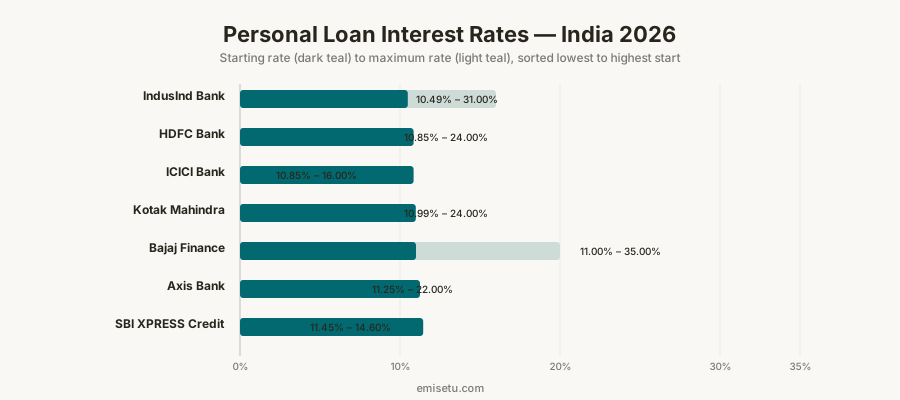
Personal Loan Rate Landscape India 2026
Personal loan rates in India are almost always fixed — unlike home loans which are mandatorily linked to an external benchmark (EBLR) under RBI's October 2019 circular, personal loan rates are not subject to this mandate. The rate you negotiate at sanction is the rate you pay for the entire tenure. There are no reset triggers, no benefit from an RBI rate cut, and no risk of an RBI rate hike either.
The market is tiered by lender type:
| Lender Type | Rate Range | Best For |
|---|---|---|
| PSU Banks (SBI, PNB, BoB, BoI) | 11.05%–18.75% | Government/defence employees; existing salary account holders |
| Private Banks (HDFC, ICICI, Axis, Kotak) | 10.85%–24% | Salaried professionals with strong CIBIL and major-city addresses |
| NBFCs (Bajaj Finance, Tata Capital) | 11%–35% | Borrowers rejected by banks; self-employed; faster disbursal |
| Digital Lenders (MoneyTap, KreditBee, etc.) | 16%–36% | Small-ticket loans (₹25,000–₹2 lakh); thin-file borrowers |
For a salaried employee of a large corporation with a 750+ CIBIL score, a private bank or PSU bank will almost always deliver the best rate. NBFCs earn their place when speed matters (24-hour disbursal vs. 3–5 days for a bank) or when the borrower's profile doesn't meet bank thresholds.
Bank-by-Bank Rate and Fee Comparison (June 2026)
Rates below are starting rates for prime salaried profiles (CIBIL 750+, net monthly income ₹35,000+, established employer). Most borrowers will be quoted higher. Verify current rates using our rates page before applying.
| Lender | Starting Rate | Max Rate | Processing Fee | Loan Range | Tenure |
|---|---|---|---|---|---|
| IndusInd Bank | 10.49% | 31.00% | Up to 3.50% | ₹30K–₹50L | 1–5 yr |
| HDFC Bank | 10.85% | 24.00% | Up to 2.50% | ₹50K–₹40L | 1–5 yr |
| ICICI Bank | 10.85% | 16.00% | 0.50–2.25% | ₹50K–₹50L | 1–6 yr |
| Kotak Mahindra | 10.99% | 24.00% | Up to 2.50% | ₹50K–₹40L | 1–5 yr |
| Bajaj Finance | 11.00% | 35.00% | Up to 3.93% | ₹20K–₹40L | 1–5 yr |
| Bank of Baroda | 11.05% | 18.75% | 2.00% + GST | ₹1L–₹20L | 1–5 yr |
| Axis Bank | 11.25% | 22.00% | 1–2% | ₹50K–₹40L | 1–5 yr |
| Bank of India | 11.25% | 14.75% | 0.50–1.00% | ₹50K–₹20L | 1–5 yr |
| PNB | 11.40% | 16.95% | 1.00% | ₹50K–₹20L | 1–5 yr |
| SBI XPRESS Credit | 11.45% | 14.60% | 1.50% | ₹25K–₹35L | 1–6 yr |
Rates indicative as of June 2026 and subject to change. Processing fee ranges reflect published maximum; actual fee is negotiable.
What the table conceals: Rate ranges are very wide for a reason. A borrower with a 720 CIBIL score applying to HDFC Bank will not get 10.85% — they are more likely to get 18–22%, if approved at all. The starting rate is the floor for the most pristine profiles. Your actual rate will be determined by a combination of CIBIL score, monthly income, employer category, existing relationship with the bank, and current debt obligations.
Use our personal loan EMI calculator to run your own scenarios once you have a rate quote from your lender.
The True Cost: Why the Lowest Rate Is Not Always Cheapest
This is the analysis that lenders never publish side by side. The table below shows the verified all-in cost (interest + processing fee) on a ₹5 lakh, 3-year loan at each lender's starting rate and published maximum processing fee. All interest figures are computed using the standard reducing-balance EMI formula.
| Lender | Rate | Processing Fee | Fee Amount | Total Interest | All-In Cost | Rank |
|---|---|---|---|---|---|---|
| Bank of India | 11.25% | 1.00% | ₹5,000 | ₹91,444 | ₹96,444 | 1 |
| PNB | 11.40% | 1.00% | ₹5,000 | ₹92,704 | ₹97,704 | 2 |
| Bank of Baroda | 11.05% | 2.00% | ₹10,000 | ₹89,716 | ₹99,716 | 3 |
| ICICI Bank | 10.85% | 2.25% | ₹11,250 | ₹88,024 | ₹99,274 | 4 |
| SBI XPRESS | 11.45% | 1.50% | ₹7,500 | ₹93,136 | ₹1,00,636 | 5 |
| HDFC Bank | 10.85% | 2.50% | ₹12,500 | ₹88,024 | ₹1,00,524 | 6 |
| Axis Bank | 11.25% | 2.00% | ₹10,000 | ₹91,444 | ₹1,01,444 | 7 |
| Kotak Mahindra | 10.99% | 2.50% | ₹12,500 | ₹89,212 | ₹1,01,712 | 8 |
| IndusInd Bank | 10.49% | 3.50% | ₹17,500 | ₹84,964 | ₹1,02,464 | 9 |
| Bajaj Finance | 11.00% | 3.93% | ₹19,650 | ₹89,284 | ₹1,08,934 | 10 |
The surprise: IndusInd Bank advertises the lowest rate at 10.49% — but its 3.5% processing fee makes it more expensive than Bank of India (11.25%, 1% fee) by ₹6,020. Bajaj Finance at a comparable 11% rate costs ₹12,490 more than Bank of India due to its 3.93% fee. The lesson: always compute the all-in cost, not the rate in isolation. Use the compare loans tool to model side-by-side total costs before applying.
Note: fees used are published maximums and do not include GST on the processing fee (18% GST applies, adding ₹900–₹3,537 to the fee amounts above). PSU banks often waive or reduce fees for salary account holders — negotiate before submitting the application.
How Your CIBIL Score Determines Your Rate
Your CIBIL score is the single most powerful variable in personal loan pricing. The table below shows what a typical private bank quotes across CIBIL brackets for a salaried borrower — and what that means for a ₹5 lakh, 3-year loan. See how this interacts with interest rate selection in detail at how CIBIL score affects loan interest rates.
| CIBIL Score | Typical Rate | Monthly EMI | Total Interest | vs. 800+ |
|---|---|---|---|---|
| 800+ | 11.00% | ₹16,369 | ₹89,284 | Baseline |
| 750–799 | 12.50% | ₹16,727 | ₹1,02,172 | +₹12,888 |
| 700–749 | 15.00% | ₹17,333 | ₹1,23,988 | +₹34,704 |
| 650–699 | 18.00% | ₹18,076 | ₹1,50,736 | +₹61,452 |
| Below 650 | 24.00%+ | ₹19,616 | ₹2,06,176 | +₹1,16,892 |
A borrower with a 700 CIBIL score pays ₹34,704 more in interest than a 800+ borrower for the exact same ₹5 lakh loan. That is not a rounding error — it is the price of a moderately poor credit profile. A borrower at 650 CIBIL pays ₹1,16,892 more — and many lenders will outright reject the application at that level.
If your score is below 750, the highest-value action you can take before borrowing is spending 3–6 months improving your score. Even a 50-point improvement from 710 to 760 can shift you from a 15% rate to a 12.5% rate — a saving of ₹21,816 over 3 years on a ₹5 lakh loan. Calculate your loan eligibility to see what your current profile qualifies for.
EMI Tables — ₹2 Lakh, ₹5 Lakh, ₹10 Lakh
Verify any quote from a lender against these tables. Every figure below is computed using the standard EMI formula (EMI = P × r × (1+r)^n / ((1+r)^n − 1)).
₹2 Lakh personal loan at 13%
| Tenure | Monthly EMI | Total Interest | Total Amount Paid |
|---|---|---|---|
| 1 Year | ₹17,863 | ₹14,356 | ₹2,14,356 |
| 2 Years | ₹9,508 | ₹28,192 | ₹2,28,192 |
| 3 Years | ₹6,739 | ₹42,604 | ₹2,42,604 |
₹5 Lakh personal loan — EMI at different rates
| Rate | 2-Yr EMI | 2-Yr Interest | 3-Yr EMI | 3-Yr Interest | 5-Yr EMI | 5-Yr Interest |
|---|---|---|---|---|---|---|
| 11% | ₹23,304 | ₹59,296 | ₹16,369 | ₹89,284 | ₹10,871 | ₹1,52,260 |
| 13% | ₹23,771 | ₹70,504 | ₹16,847 | ₹1,06,492 | ₹11,377 | ₹1,82,620 |
| 15% | ₹24,243 | ₹81,832 | ₹17,333 | ₹1,23,988 | ₹11,895 | ₹2,13,700 |
| 18% | ₹24,962 | ₹99,088 | ₹18,076 | ₹1,50,736 | ₹12,697 | ₹2,61,820 |
₹10 Lakh personal loan — EMI at different rates
| Rate | 3-Yr EMI | 3-Yr Interest | 5-Yr EMI | 5-Yr Interest |
|---|---|---|---|---|
| 11% | ₹32,739 | ₹1,78,604 | ₹21,742 | ₹3,04,520 |
| 13% | ₹33,694 | ₹2,12,984 | ₹22,753 | ₹3,65,180 |
| 15% | ₹34,665 | ₹2,47,940 | ₹23,790 | ₹4,27,400 |
| 18% | ₹36,152 | ₹3,01,472 | ₹25,393 | ₹5,23,580 |
Use the personal loan EMI calculator to enter your exact loan amount, rate, and tenure. For a full month-by-month breakdown of principal vs interest, the amortization schedule shows exactly how much of each EMI goes toward reducing your outstanding balance.
Tenure vs Total Interest: The Tradeoff
Longer tenure means lower EMI but dramatically higher interest. On a ₹5 lakh loan at 13%:
| Tenure | Monthly EMI | Total Interest | Interest as % of Loan |
|---|---|---|---|
| 1 Year | ₹44,659 | ₹35,908 | 7.2% |
| 2 Years | ₹23,771 | ₹70,504 | 14.1% |
| 3 Years | ₹16,847 | ₹1,06,492 | 21.3% |
| 4 Years | ₹13,414 | ₹1,43,872 | 28.8% |
| 5 Years | ₹11,377 | ₹1,82,620 | 36.5% |
Extending from 3 years to 5 years reduces your monthly EMI by ₹5,470 — but you pay ₹76,128 more in total interest. That extra interest buys you EMI flexibility; whether it is worth it depends on your monthly cash flow. The general rule: choose the shortest tenure whose EMI stays within 35–40% of your net monthly income.
What Salary Do You Need?
Banks use FOIR (Fixed Obligation to Income Ratio) to assess your personal loan eligibility. Most lenders cap FOIR at 40–55% of net monthly income — which means all your existing EMIs plus the new personal loan EMI cannot exceed that threshold.
| Loan Amount | Rate | Tenure | Monthly EMI | Min Net Salary (50% FOIR) |
|---|---|---|---|---|
| ₹2 lakh | 13% | 2 yrs | ₹9,508 | ₹19,016 |
| ₹3 lakh | 13% | 3 yrs | ₹10,108 | ₹20,216 |
| ₹5 lakh | 13% | 3 yrs | ₹16,847 | ₹33,694 |
| ₹10 lakh | 13% | 5 yrs | ₹22,753 | ₹45,506 |
The minimum salary figures assume no other existing EMIs. If you carry a home loan, a car loan, or credit card minimum payments, those are subtracted from your FOIR headroom before the personal loan EMI fits in. Check your precise borrowing capacity using the loan eligibility calculator.
5 Strategies to Get the Lowest Personal Loan Rate
1. Apply to your salary-account bank first
Banks offer preferential rates — typically 0.25–0.50% below their standard rate — to existing customers whose salaries are credited into an account with them. This is the single highest-probability path to a below-market rate, because the bank can verify your income instantly and already trusts your relationship.
2. Negotiate the processing fee aggressively
Most lenders treat the processing fee as a negotiating lever. Existing customers, high-income borrowers, and applicants in festive seasons (Diwali, financial year-end) regularly get 50–100% of the processing fee waived. On a ₹10 lakh loan, waiving a 2% fee saves ₹20,000 — the equivalent of a 0.5% rate reduction over 3 years.
3. Improve your CIBIL score before applying
Check your credit report for errors (incorrect outstanding balances, settled accounts still showing as active, hard inquiries from lenders you did not approach). Dispute errors through the CIBIL website — corrections typically take 30–45 days. A clean report with a 750+ score is worth a 2–4% lower rate from most lenders.
4. Pre-close high-utilisation credit cards before applying
Credit card utilisation above 30% of your combined limit signals financial stress to lenders. If your cards are at 60–80% utilisation, paying them down before applying can improve your CIBIL score by 30–50 points in as little as one billing cycle — enough to move between rate brackets.
5. Get competing sanction letters and use them
Most lenders prefer to retain qualified borrowers over losing them. If you have a sanction letter from SBI at 13%, your relationship manager at HDFC has a reason to offer 12.5%. Competing offers are your best negotiating tool — and unlike home loans, personal loan sanction letters typically remain valid for 30–60 days, giving you enough time to use them.
Prepayment Rules for Personal Loans
Unlike home loans where RBI prohibits prepayment charges on floating-rate loans, personal loans are typically fixed-rate — and for fixed-rate loans, banks are permitted to charge prepayment penalties. Before signing, check:
- Prepayment lock-in: Most banks prohibit prepayment for the first 12 months of the loan (you must pay at least 12 EMIs before you can foreclose).
- Foreclosure charge: Typically 4–5% of outstanding principal. Some banks charge zero after 24–36 months.
- Part-payment: Many banks do not allow partial prepayments on personal loans — only full foreclosure is permitted. Confirm this before assuming you can make a mid-tenure lump-sum payment.
The prepayment terms differ enough across lenders that for large loan amounts (₹10 lakh+), they should be a factor in the decision — not just the rate.
When Not to Take a Personal Loan
A personal loan is not always the right answer, even when you qualify for a good rate.
Consider an alternative if:
- You own gold: A gold loan at 10–12% from a bank or Muthoot/Mannapuram is typically cheaper than a personal loan, requires no CIBIL check, and disburses in under an hour. See the full comparison in personal loan vs gold loan vs LAP.
- You have a home loan: A home loan top-up at 8.75–9.5% is significantly cheaper than any personal loan rate. The paperwork is more involved but the rate differential over 3 years is substantial.
- The purpose is a large purchase: For appliances, electronics, or furniture above ₹50,000, many brands offer 0% EMI schemes for 6–12 months. The hidden cost is a processing fee of 1–2%, but the effective rate is far lower than a personal loan.
- You are in a revolving credit card cycle: Clearing card debt with a personal loan makes financial sense, but only if you freeze or reduce the card limit after — otherwise you risk accumulating both the personal loan EMI and new card debt simultaneously.
Frequently Asked Questions
What is the lowest personal loan interest rate in India in 2026?
The lowest advertised starting rate in June 2026 is 10.49% (IndusInd Bank) for prime salaried profiles — CIBIL 800+, net salary ₹75,000+, established employer. Most salaried borrowers qualify for 12–16% depending on their CIBIL score, income, and employer category. The lowest all-in cost (rate + fee combined) belongs to PSU banks like Bank of India and PNB, which charge lower processing fees than private banks.
Are personal loan interest rates fixed or floating in India?
Personal loan rates from banks are almost universally fixed in India — the rate is locked at sanction and does not change for the tenure of the loan. This is different from home loans, which are mandatorily linked to an external benchmark (EBLR) under RBI's October 2019 circular. You do not benefit from an RBI rate cut once your personal loan is disbursed, and you do not bear the risk of a rate hike either.
Do banks charge a prepayment penalty on personal loans?
Yes — unlike floating-rate home loans where RBI prohibits prepayment charges, personal loans are fixed-rate and lenders are permitted to charge foreclosure fees. Typical charges are 4–5% of the outstanding principal. Many banks impose a lock-in period of 12 months (you cannot foreclose before paying 12 EMIs). Some banks, like SBI, reduce the foreclosure charge to nil after 36 EMIs. Check your specific lender's loan agreement before signing.
How does CIBIL score affect personal loan interest rates?
Your CIBIL score is the primary pricing input for personal loans. Most banks classify borrowers into 4–5 rate brackets based on score. Moving from a 700–749 score to 800+ on a ₹5 lakh, 3-year loan cuts total interest from ₹1,23,988 to ₹89,284 — a saving of ₹34,704. The most impactful CIBIL improvements are: paying all EMIs and card bills on time, reducing credit card utilisation below 30%, and removing errors from your credit report.
Which bank is best for a personal loan in 2026?
There is no single best bank — the answer depends on your profile, loan amount, and priorities:
- Lowest all-in cost: Bank of India or PNB (lower processing fees offset their slightly higher rates)
- Fastest disbursal: HDFC Bank or ICICI Bank (24–48 hours for pre-approved customers)
- Self-employed or thin-credit profiles: Bajaj Finance or NBFCs (more flexible underwriting, but higher rates and fees)
- Government employees: SBI XPRESS Credit or PNB (special schemes with lower rates for defence, central/state government employees)
Can I get a personal loan with a 650 CIBIL score?
Most banks reject applications below 700. NBFCs and digital lenders will lend, but at 24–35% interest — making the loan very expensive. On a ₹3 lakh loan at 24% over 3 years, total interest is ₹1,23,720 — more than 41% of the loan amount. If your CIBIL is below 700, investing 3–6 months in score improvement before applying will almost always save more in interest than the delay costs you. See the detailed playbook in how to improve your CIBIL score fast.
How is a personal loan EMI calculated?
Using the standard reducing-balance formula: EMI = P × r × (1+r)^n / ((1+r)^n − 1) where P is the principal, r is the monthly interest rate (annual rate ÷ 12 ÷ 100), and n is the number of monthly instalments. For a ₹5 lakh loan at 13% for 3 years: r = 0.01083, n = 36, EMI = ₹16,847. Total interest = ₹16,847 × 36 − ₹5,00,000 = ₹1,06,492. Verify your exact scenario using our personal loan EMI calculator.
Try the calculator
Run your own numbers in seconds. Pick the calculator that fits your loan type.