Personal Loan vs Gold Loan vs Loan Against Property — Which Is Right for You?
When you need money fast, three options dominate the Indian lending market. Here's an honest comparison of rates, speed, risk, and the hidden costs that most borrowers miss.
Key Takeaways
- Gold loans are the fastest (15–60 minutes disbursement) and cheapest secured option (9–14%), but you risk your jewellery.
- Personal loans are unsecured (no collateral) at 10.5–24% and best for amounts up to ₹25 lakh with clean CIBIL scores.
- Loan Against Property (LAP) offers the lowest rate (9–14%) and largest amounts (up to ₹5 crore), but takes 7–21 days and puts your home at risk.
- The right choice depends on three variables: how much you need, how fast, and what collateral you can offer.
When an urgent financial need arises — a medical emergency, a business shortfall, a once-in-a-lifetime opportunity — most Indian borrowers face the same three choices: a personal loan, a gold loan, or a loan against property. All three can deliver funds within days; all three charge interest; all three have consequences if you can't repay.
But the differences between them in rate, speed, risk, and eligibility are enormous. Choosing the wrong one can cost you lakhs in unnecessary interest — or, in the worst case, your home or your family jewellery.
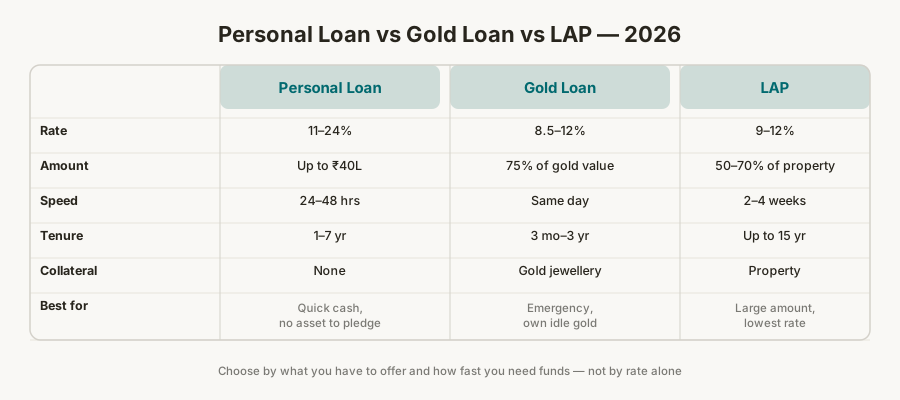
The Three Options: A Quick Comparison
| Feature | Personal Loan | Gold Loan | Loan Against Property (LAP) |
|---|---|---|---|
| Collateral required | None | Gold jewellery | Property (residential/commercial) |
| Interest rate (2026) | 10.5–24% | 9–14% | 9–14% |
| Loan amount | ₹50,000–₹50 lakh | Up to 75% of gold value (RBI cap) | Up to 65–70% of property value |
| Disbursal time | 1–7 days | 15 minutes–2 hours | 7–21 days |
| Tenure | 1–5 years | 3–36 months | 5–20 years |
| CIBIL requirement | 700+ (ideally 750+) | Minimal | 650+ |
| Risk on default | Credit score impact only | Loss of gold | Loss of property |
| Processing fee | 1–3% | Minimal (₹500–₹2,000) | 0.5–1.5% |
| Prepayment penalty | Nil (some charge 2–5%) | Nil (pay anytime) | 2–4% (fixed rate) |
Personal Loan — Best for No-Collateral, Fast Access
When it makes sense
A personal loan is the right choice when you:
- Don't want to pledge any asset (no gold jewellery, don't want to risk property)
- Have a strong CIBIL score (750+) to access the best rates
- Need ₹1–25 lakh for 1–5 years
- Want speed without the hassle of valuation and documentation of an asset
Rate reality in 2026
Personal loan rates in India vary dramatically by lender and borrower profile:
| Lender | Best Rate | Standard Rate | For Low CIBIL |
|---|---|---|---|
| SBI | 10.55% | 13.5% | 15%+ |
| HDFC Bank | 10.5% | 16% | 18%+ |
| ICICI Bank | 10.75% | 16.5% | 18%+ |
| Axis Bank | 10.99% | 17% | 19%+ |
| Fintech lenders | 12% | 20% | 24%+ |
"Best rate" is typically available only to existing salary account holders with CIBIL 780+ and monthly income above ₹50,000. Most borrowers pay 14–18%.
The hidden cost: processing fee
Processing fees of 1–3% + GST are charged upfront and are non-refundable even if you prepay early. On a ₹5 lakh loan with 2% processing fee: ₹10,000 paid on day one. This increases the effective APR significantly for short-tenure loans.
Personal loan EMI example
₹5 lakh at 14%, 3 years: EMI = ₹17,090/month, Total interest = ₹1,15,240. Use our personal loan EMI calculator to model your specific scenario.
Gold Loan — Best for Speed and When You Have Jewellery
When it makes sense
A gold loan is the right choice when you:
- Have household gold jewellery (minimum 18 karat, most lenders require 22 karat)
- Need money within hours — not days
- Have a weak CIBIL score or inconsistent income (gold loans have minimal credit requirements)
- Need a short-duration loan (3–12 months) and are confident of repayment
How gold loans work
You pledge your gold jewellery at the lender's branch. The lender assesses purity (karat) and weight, then applies the RBI-mandated maximum Loan-to-Value (LTV) of 75% of gold value — applicable uniformly for all banks and NBFCs regardless of loan size. Disbursement happens within 15–30 minutes for amounts below ₹5 lakh.
Gold loan rates by lender (2026)
| Lender | Rate | LTV | Notable Feature |
|---|---|---|---|
| Muthoot Finance | 9.96–24% | Up to 75% | Largest gold loan network; 4,600+ branches |
| Manappuram Finance | 12–28% | Up to 75% | Flexible interest-only payment option |
| SBI Gold Loan | 9.70–9.90% | Up to 75% | Lowest rate; slower processing |
| HDFC Bank | 11–16% | Up to 75% | Fast disbursal at bank branches |
| ICICI Bank | 11–15% | Up to 75% | Digital renewal process |
Important: Muthoot and Manappuram's displayed low rates are typically for their largest loan slabs. Smaller loans (under ₹1 lakh) often attract higher rates (18–28%). Always confirm the applicable rate for your specific loan amount.
Gold loan risks
- Auction risk: If you default for 3 consecutive months, the lender can auction your pledged gold to recover the outstanding amount. You lose the jewellery permanently.
- Market value fluctuation: If gold prices fall sharply, lenders may issue a "margin call" — asking you to pledge additional gold or partially repay to maintain LTV.
- Emotional value: Gold jewellery often has irreplaceable sentimental value. Only pledge what you can afford to lose in a worst-case scenario.
Gold loan vs personal loan: the numbers
| Scenario | Personal Loan (14%) | Gold Loan (12%) |
|---|---|---|
| Loan: ₹3 lakh, 12 months | EMI: ₹26,936; Interest: ₹23,232 | Interest: ₹36,000 (if interest-only); Principal due at end |
| Loan: ₹3 lakh, 12 months (EMI basis) | Total interest: ₹23,232 | Total interest: ₹19,860 |
For equivalent tenure, the gold loan is cheaper. But the risk profile is fundamentally different — missed personal loan payments hurt your CIBIL; missed gold loan payments cost you the jewellery.
Loan Against Property (LAP) — Best for Large Amounts at Lowest Rate
When it makes sense
A LAP is the right choice when you:
- Own residential or commercial property (with clear title)
- Need large amounts: ₹20 lakh to ₹5 crore
- Can wait 1–3 weeks for processing
- Have a planned, long-term use for the funds (business expansion, education abroad, debt consolidation)
How LAP works
You mortgage your property to the lender while continuing to live in or use it. The lender values the property (technical and legal assessment), applies an LTV of 50–70% of market value, and disburses the loan. The property title is hypothecated to the lender until full repayment.
LAP rates and eligibility (2026)
| Lender | LAP Rate | Max LTV | Max Tenure |
|---|---|---|---|
| SBI | 9.15–10.85% | 65% | 15 years |
| HDFC Bank | 9.50–11% | 60% | 15 years |
| ICICI Bank | 9.75–11.50% | 65% | 15 years |
| Axis Bank | 9.50–12% | 65% | 20 years |
| Bajaj Finance | 9.75–14% | 70% | 18 years |
LAP risks
- Property risk: Default triggers SARFAESI proceedings — the lender can repossess and auction your property. For most families, the pledged property is their home.
- Valuation gap: Lenders value conservatively. A property you value at ₹1.5 crore may be appraised at ₹1.1 crore by the bank, limiting your loan to ₹65–72 lakh.
- Processing time: Legal due diligence, title search, technical valuation, and loan committee approval take 7–21 business days. Not suitable for genuine emergencies.
- Prepayment penalties: Most LAP products charge 2–4% foreclosure fees, unlike home loans (floating rate) where the RBI bans prepayment penalties.
LAP EMI example
₹30 lakh LAP at 10%, 15 years: EMI = ₹32,238/month, Total interest = ₹28.03 lakh. Use our home loan EMI calculator with these inputs to model your LAP scenario.
Use our compare loans tool to see the full cost difference between any two loan options side by side.
Side-by-Side Decision Guide
By urgency
| Time available | Best option |
|---|---|
| Need funds today / tomorrow | Gold loan |
| 2–7 days | Personal loan |
| 2–3 weeks acceptable | LAP (best rate) |
By loan amount
| Amount needed | Best option |
|---|---|
| Under ₹5 lakh | Personal loan or gold loan |
| ₹5–25 lakh | Personal loan (if CIBIL 750+) or LAP |
| Above ₹25 lakh | LAP |
By risk appetite
| Risk you can accept | Best option |
|---|---|
| No collateral risk | Personal loan |
| Can risk jewellery, not property | Gold loan |
| Can risk property for lowest rate | LAP |
The Debt Consolidation Use Case
If you carry multiple high-interest debts — credit card balances (36–42%), personal loans (14–18%), and small loans — a LAP is often the most powerful consolidation tool:
- Consolidate ₹20 lakh of high-rate debt into a LAP at 10%, 10 years
- Monthly EMI: ₹26,430
- Combined old EMIs (estimated): ₹45,000–₹55,000/month
- Monthly cash flow improvement: ₹18,000–₹28,000
However, this strategy requires strict discipline — the consolidated loan extends your debt horizon and puts your property at risk. Do not consolidate and then re-accumulate credit card debt.
Frequently Asked Questions
Which is better: gold loan or personal loan?
Gold loans are cheaper (9–14% vs 10.5–24%) and faster (minutes vs days) and have lower CIBIL requirements. Personal loans are better if you don't have gold to pledge or can't accept the risk of losing jewellery. For amounts under ₹5 lakh needed urgently, gold loans generally win on cost and speed.
Can I get a loan against property without income proof?
Difficult but not impossible. Some NBFCs offer LAP for self-employed borrowers with bank statements in lieu of ITRs. However, rates are higher (12–16%) and LTV is lower (50–55%). A clean, registered property with clear title is the primary underwriting criterion.
What is the maximum loan I can get against my house?
Lenders typically offer 50–70% of the property's market value as assessed by their approved valuer. On a ₹1 crore house, the maximum LAP is ₹50–70 lakh. This varies by lender, property type (residential vs commercial), and location.
Is gold loan interest tax deductible?
If the gold loan is used for business purposes, the interest may be deductible as a business expense. If used for personal purposes (medical bills, travel, purchases), gold loan interest is not tax deductible. If used to purchase or construct a house, a portion may qualify under Section 24(b).
Can I prepay a gold loan early?
Yes — most gold lenders allow prepayment at any time with no penalty. You can repay interest monthly and principal at the end of tenure, or prepay the full amount early to redeem your jewellery. This flexibility is one of the gold loan's strongest features.
Is Loan Against Property the same as a home loan?
No. A home loan is specifically for purchasing or constructing a residential property, and the loan proceeds are used for that purpose. LAP (Loan Against Property) uses an already-owned property as collateral, and the funds can be used for any purpose — business, education, medical, debt consolidation. LAP rates are slightly higher than home loan rates (9–14% vs 8.4–9.5%) and LAP does not qualify for home loan tax benefits under Section 24(b) or 80C.
Try the calculator
Run your own numbers in seconds. Pick the calculator that fits your loan type.