Flat Rate vs Reducing Balance Interest — Why Your Lender's "10%" is Really 18%
A personal loan at "10% flat rate" costs you almost the same as one at 18% reducing balance. Here's the exact maths, a conversion formula, and how to never get fooled again.
Key Takeaways
- A 10% flat rate is approximately equivalent to 18–19% reducing balance — nearly double.
- All home loans and most modern personal loans are quoted on a reducing balance basis. Car loans and old-style personal loans often use flat rates.
- The conversion formula: Effective Rate ≈ Flat Rate × 1.8. The multiplier stays roughly constant (1.8–1.9) regardless of tenure — a 10% flat rate is approximately 18% reducing whether the loan is for 1, 2, or 3 years.
- Always ask your lender: "Is this a flat rate or reducing balance rate?" before comparing offers.
You walk into a lender's office and are offered a personal loan at "10% per annum." It sounds reasonable — maybe even good. A competing lender offers 18%. You take the 10% loan. Six months later, you realize you've been paying more interest than expected. What happened?
You fell for the flat rate vs. reducing balance trap — one of the most commonly misunderstood concepts in consumer lending in India. The 10% flat rate was actually more expensive than the competitor's 18% reducing balance offer.
This guide explains the mechanics, gives you the exact conversion formula, and shows you how to compare any two loan offers on an apples-to-apples basis.
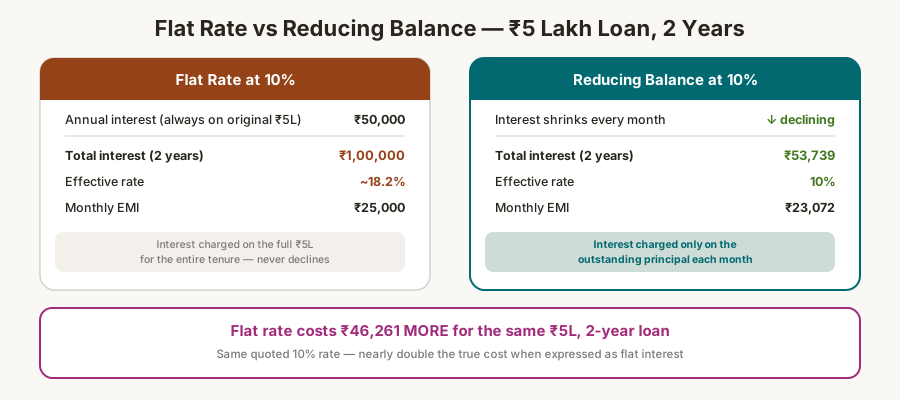
What Is a Flat Interest Rate?
A flat rate (also called an "add-on rate") calculates interest on the original principal for the entire loan tenure, regardless of how much you've repaid.
Flat rate calculation example
Loan: ₹1 lakh at 10% flat for 2 years (24 months)
- Total interest = ₹1,00,000 × 10% × 2 = ₹20,000
- Total repayment = ₹1,00,000 + ₹20,000 = ₹1,20,000
- Monthly EMI = ₹1,20,000 ÷ 24 = ₹5,000
This seems straightforward — but it's mathematically problematic. By month 12, you've already repaid roughly half the principal. Yet you're still paying interest on the original ₹1 lakh. You're paying interest on money you no longer owe.
What Is a Reducing Balance Rate?
A reducing balance rate (also called "diminishing balance") calculates interest only on the outstanding principal at the start of each period. As you repay, your interest component shrinks.
Reducing balance calculation example
Loan: ₹1 lakh at 18% reducing balance for 2 years (24 months)
Using the standard EMI formula:
- Monthly rate = 18% ÷ 12 = 1.5%
- EMI = ₹1,00,000 × 1.5% × (1.015)^24 ÷ ((1.015)^24 − 1) ≈ ₹4,992
The EMI is almost identical to the "10% flat" loan above — ₹4,992 vs ₹5,000. But the flat rate loan is labeled "10%" and the reducing balance loan "18%." Same cost, wildly different stated rates.
This is why comparing rates across loan types without knowing the calculation method is meaningless.
The Conversion Formula
To convert a flat rate to an approximate reducing balance equivalent:
Effective Rate ≈ Flat Rate × (2n / (n + 1))
Where n = number of periods (months in the loan).
Practical examples
| Flat Rate | Tenure | Reducing Balance Equivalent |
|---|---|---|
| 10% | 1 year | ~18.0% |
| 10% | 2 years | ~18.2% |
| 10% | 3 years | ~17.9% |
| 12% | 1 year | ~21.5% |
| 12% | 2 years | ~21.6% |
| 15% | 1 year | ~26.6% |
These equivalents are computed using the IRR (Internal Rate of Return) method — the actual reducing balance rate that produces the same monthly EMI on the same principal. Note that the equivalent rate stays nearly constant across tenures for the same flat rate; the common shorthand "Effective Rate ≈ Flat Rate × 1.8" holds well for 1–3 year loans. The formula "Flat Rate × (2n / (n + 1))" where n = months slightly overestimates for longer tenures; the IRR values above are more accurate.
A Direct Comparison: ₹5 Lakh Personal Loan, 3 Years
| Offer | Stated Rate | Basis | Monthly EMI | Total Interest | Actual Equivalent |
|---|---|---|---|---|---|
| Lender A | 10% | Flat | ₹18,056 | ₹1,50,000 | ~17.9% reducing |
| Lender B | 14% | Reducing balance | ₹17,090 | ₹1,15,240 | 14% |
| Lender C | 18% | Reducing balance | ₹18,076 | ₹1,50,736 | 18% |
In this example, Lender A's "10% flat" costs more than Lender B's "14% reducing balance" — and is nearly equivalent in total cost to Lender C's "18% reducing." Lender A's offer sounds cheapest at 10% — it isn't. Use our personal loan EMI calculator to enter the exact numbers from any offer and compare total interest paid on an apples-to-apples basis.
Where You'll Encounter Each Type
Flat rate (add-on rate) — common in:
- Two-wheeler loans from NBFCs and dealership financing
- Old-style personal loans from cooperative banks and rural lenders
- Consumer durable loans (appliances, electronics) at 0% EMI schemes (the "processing fee" is often the disguised interest)
- Gold loans from some NBFCs
Reducing balance rate — used in:
- All home loans (RBI mandates transparency here)
- Personal loans from major banks (HDFC, ICICI, SBI, Axis)
- Car loans from large banks and NBFCs
- Education loans
- Business loans from banks
The "0% EMI" Trap
Retail stores frequently offer "0% interest EMI" on credit cards or consumer loans. The catch: the "processing fee" (typically 1–3% of the purchase price, charged upfront) is effectively interest.
A ₹50,000 TV on "0% EMI" for 12 months with a 2% processing fee:
- Processing fee paid upfront: ₹1,000
- This is equivalent to an effective interest rate of approximately 3.5–4% on a reducing balance basis
- That's not 0% — but it may still be reasonable depending on alternatives
How to Compare Any Two Loan Offers
Step 1: Determine the basis for each quote
Ask explicitly: "Is this a flat rate or reducing balance rate?" Any reputable lender will tell you. If they're evasive, treat that as a red flag.
Step 2: Convert to reducing balance (if one is flat)
Use the conversion formula or ask the lender to show you the APR (Annual Percentage Rate). Per RBI guidelines, lenders must disclose the APR for loan products — this is always on a reducing balance / effective rate basis.
Step 3: Compare total interest outflow
The cleanest comparison: compute total interest = (Monthly EMI × Number of months) − Principal. This cuts through all rate methodology debates.
Step 4: Factor in processing fees
A loan at 14% reducing balance with 1% processing fee may cost more in the first year than a 15% loan with zero processing fee for short tenures. Always include upfront costs in the comparison. Use our compare loans tool to put any two loan offers side by side on total interest and EMI.
Why Lenders Use Flat Rates
Flat rates make loans appear cheaper than they are. A 10% flat rate vs. 14% reducing balance — the consumer anchors to "10%" even though it's actually more expensive. This is not illegal in India (though lenders must disclose APR), but it is commercially motivated.
NBFC dealership financing in the auto sector remains the most common place you'll encounter flat rates in 2026. The dealership earns a higher margin when customers choose dealer financing over bank loans — partly because the stated flat rate sounds lower.
Frequently Asked Questions
What is the difference between flat rate and reducing balance EMI?
Flat rate calculates interest on the original loan amount throughout the tenure. Reducing balance calculates interest only on the outstanding balance, which decreases as you repay. Flat rate is more expensive for the borrower at the same stated percentage.
How do I convert a flat interest rate to reducing balance?
The approximate formula is: Effective reducing rate = Flat rate × (2n / (n+1)), where n is the number of monthly installments. For more accuracy, use an IRR calculation on the cash flows.
Are home loans in India given on flat rate basis?
No. All home loans in India are mandatorily quoted on a reducing balance (diminishing balance) basis, per RBI guidelines. Use our home loan EMI calculator to verify the exact monthly payment and total interest on any home loan offer using the reducing balance formula.
Is a 10% flat rate loan cheaper than a 14% reducing balance loan?
No. A 10% flat rate for a 2-year loan is approximately equivalent to 17% reducing balance. The 14% reducing balance loan is significantly cheaper.
How do I know if my loan uses flat rate or reducing balance?
Look at your loan agreement — it must disclose the "Annual Percentage Rate" (APR). If the APR is significantly higher than the stated rate, you likely have a flat rate loan. You can also ask your lender directly — they are legally required to disclose the calculation method.
Do credit card interest rates use flat rate or reducing balance?
Credit card interest rates (typically 36–42% per annum in India) are stated on a monthly reducing balance basis, but interest is calculated daily and compounded monthly. This makes credit card debt among the most expensive forms of borrowing available.
Try the calculator
Run your own numbers in seconds. Pick the calculator that fits your loan type.