How Your CIBIL Score Affects Loan Interest Rate — The Complete 2026 Guide
A 50-point CIBIL score drop can cost you ₹3–5 lakh extra on a home loan. Here's exactly how banks price risk using your score, what moves the needle fastest, and how to cross 750 in 60–90 days.
Key Takeaways
- Borrowers with CIBIL 750+ get the best rates. Below 700, most banks either reject or charge 150+ bps premium.
- A 50-point CIBIL improvement — from 720 to 770 — can save ₹3–5 lakh on a ₹50 lakh home loan.
- Reducing credit card utilization below 30% is the fastest way to improve your score — results visible in 30–45 days.
- One 30-day late payment can drop your score 40–80 points and stays on your record for 7 years.
Your CIBIL score is the first number every loan underwriter looks at. Before your income, your employer, or your collateral — your three-digit credit score determines which bucket you fall into and how much you will pay for the privilege of borrowing. In 2026, with major banks publishing explicit rate grids tied to CIBIL bands, the link between your score and your EMI has never been more direct.
This guide explains exactly how CIBIL scoring works, what the score-to-rate relationship looks like at major Indian lenders, and the fastest proven methods to improve your score before a major loan application.
How Banks Use Your CIBIL Score: The Rate Grid
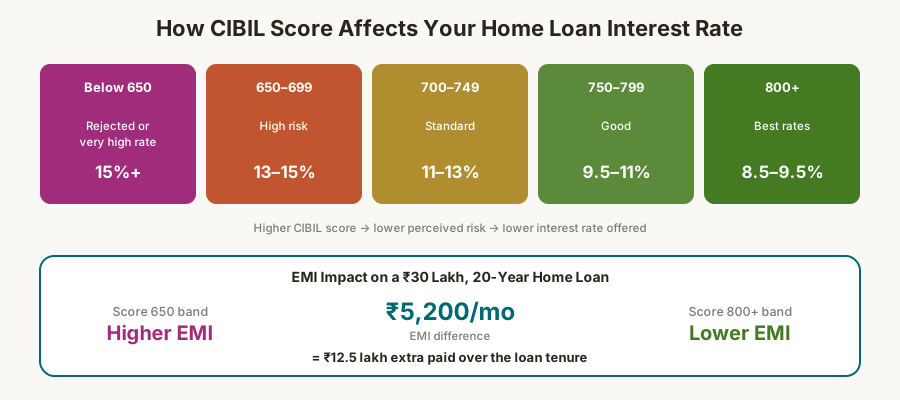
Most large banks maintain an internal rate pricing matrix that ties your interest rate to your CIBIL score band. While not all publish this publicly, the structure at most major lenders looks approximately like this (see our live rates page for current bank-wise home loan rates):
| CIBIL Score Band | SBI (approx.) | HDFC (approx.) | ICICI (approx.) |
|---|---|---|---|
| 800+ | 8.50% | 8.75% | 8.75% |
| 750–799 | 8.65% | 9.00% | 9.00% |
| 700–749 | 9.00% | 9.25% | 9.25% |
| 650–699 | 9.50%+ | 9.65%+ | Often rejected |
| Below 650 | Likely rejected | Rejected | Rejected |
These are approximate figures for salaried borrowers as of mid-2026, following four RBI repo rate cuts in 2025 totalling 125 bps (repo rate: 5.25%). Self-employed borrowers face a further 25–50 bps premium at each band.
The real cost of a lower score
On a ₹50 lakh home loan over 20 years (model your own scenario with our home loan EMI calculator):
- At 8.65% (750–799 band): EMI = ₹43,867; Total interest = ₹55.3 lakh
- At 9.00% (700–749 band): EMI = ₹44,986; Total interest = ₹58.0 lakh
- Difference: ₹1,119/month, ₹2.69 lakh extra interest over 20 years
That ₹2.69 lakh is the price of having a CIBIL score in the 720s instead of the 760s. Use our loan comparison tool to see how different rates and score bands affect your total outflow side by side.
What Makes Up Your CIBIL Score
CIBIL uses a proprietary algorithm, but the broad weightings are consistent with global credit bureau methodology:
| Factor | Approximate Weight | What Moves It |
|---|---|---|
| Payment history | 35% | Late payments, defaults, write-offs |
| Credit utilization | 30% | Card balance ÷ total credit limit |
| Credit age | 15% | Average age of all credit accounts |
| Credit mix | 10% | Balance of secured vs. unsecured credit |
| New credit inquiries | 10% | Hard pulls from new applications |
Payment history (35%)
This is the single most impactful factor — and the hardest to fix quickly. Every EMI, credit card bill, and loan payment is reported to CIBIL monthly by your lender.
What damages it:
- 30-day late payment: −40 to −80 points
- 60-day late payment: −70 to −120 points
- 90+ day late payment (NPA classification): −100 to −150 points
- Settled account (settled for less than full amount): −50 to −100 points
- Written-off account: −100 to −200 points
Negative payment entries remain on your record for 7 years in the CIBIL system. A single default from 2023 is still visible in 2026 and affecting your score.
Credit utilization (30%)
This is the fastest factor to move — and often the most misunderstood. Your utilization ratio is calculated across all your credit cards combined.
Utilization bands and their effect:
| Utilization Rate | Score Impact |
|---|---|
| 0–10% | Excellent — slight positive |
| 11–30% | Good — neutral to slightly positive |
| 31–50% | Moderate — mild negative |
| 51–75% | High — significant negative |
| 76–100% | Very high — major negative |
If you have two credit cards with combined limits of ₹3 lakh and combined outstanding balances of ₹2 lakh, your utilization is 67% — in the "high" band.
Credit age (15%)
The average age of all your credit accounts. Closing old credit cards — even ones you don't use — reduces this average and can hurt your score. Keep old cards open with small recurring charges to maintain credit age.
Credit mix (10%)
A healthy mix of secured credit (home loan, auto loan) and unsecured credit (credit cards, personal loans) is modestly positive. Pure reliance on only one type is neutral to mildly negative.
New credit inquiries (10%)
Every time a lender pulls your credit report for a loan or card application, it creates a "hard inquiry." Each hard inquiry can reduce your score by 5–10 points for 6–12 months.
Exception: Multiple home loan inquiries within a 45-day window are treated as a single inquiry by CIBIL (rate shopping allowance). Apply to multiple home loan lenders within this window, not sequentially over months.
The Fastest Ways to Improve Your CIBIL Score
1. Pay down credit card balances (30–45 days to see results)
The single fastest action. If your combined card utilization is above 30%, aggressively pay it down before applying for a loan.
Example: Combined card limit ₹4 lakh, outstanding ₹2.8 lakh (70% utilization). Pay down to ₹1 lakh (25% utilization). Expected score improvement: 30–60 points within one billing cycle.
Target: get below 30% combined utilization. Getting below 10% is even better but requires keeping barely any balance.
2. Dispute errors on your CIBIL report (30–60 days to resolve)
CIBIL estimates that 15–20% of Indian credit reports contain at least one error. Common errors include:
- Loans that have been repaid still showing as outstanding
- Duplicate accounts from bank mergers
- Incorrect personal information causing mismatches
- Accounts that aren't yours (identity confusion or fraud)
Pull your free annual CIBIL report at cibil.com and review every account. File disputes online — CIBIL has a 30-day resolution mandate for disputed items.
3. Get an authorized user addition (45–60 days)
If a family member (spouse, parent) has an excellent credit history and a high-limit card, ask to be added as an authorized user. Their account age and payment history is partially incorporated into your profile. This works particularly well if you have a thin credit file (few accounts).
4. Avoid all new credit applications for 6 months before a loan
Each hard inquiry deducts 5–10 points. Do not apply for credit cards, personal loans, or buy-now-pay-later products in the 6 months before your home loan application. The only exception is rate-shopping at multiple home loan lenders simultaneously.
5. Pay off outstanding defaults — but understand the nuances
If you have a settled or written-off account, paying the remaining balance marks it "closed" but does not immediately erase the negative history. The account will show as "settled" or "written-off and paid" — still negative, but less damaging than an open default.
Lenders may also have internal blacklists for settled accounts that persist beyond CIBIL's reporting window. Some banks will not lend to borrowers with any settled account in the last 3–5 years, regardless of current CIBIL score.
The 750 Threshold: Why It Matters So Much
The 750+ CIBIL Club unlocks:
- Access to the prime rate tier at all major banks
- Unsecured credit card limits above ₹5 lakh
- Pre-approved loan offers (digital, instant disbursal)
- Negotiating leverage with relationship managers
- Lower insurance premiums on credit-linked products
Use our loan eligibility calculator to see how your CIBIL score band affects your maximum eligible loan amount.
The 90-Day Plan to Cross 750
| Week | Action | Expected Impact |
|---|---|---|
| Week 1 | Pull CIBIL report, identify errors | — |
| Week 1–2 | File disputes for any erroneous entries | +5–30 pts (when resolved) |
| Week 1–4 | Pay down card balances to below 30% utilization | +20–60 pts |
| Week 4 | Request credit limit increase on cards with clean payment history | +5–15 pts |
| Week 4–8 | Ensure all EMIs and card bills are paid on time | Maintains baseline |
| Week 8–12 | Keep utilization low, no new applications | Consolidate gains |
Realistic score improvements from this plan: 30–80 points over 60–90 days, depending on starting profile.
Checking Your CIBIL Score
You can check your score for free once per year at cibil.com. Paid plans (₹500–₹1,200/year) give monthly monitoring and alerts. Third-party platforms like BankBazaar, Paisabazaar, and OneScore offer free unlimited checks — these are soft inquiries and do not affect your score.
Check your score at least 6 months before any major loan application. This gives you time to identify and correct issues before they cost you basis points on your rate.
Frequently Asked Questions
What is a good CIBIL score for a home loan?
750 or above. Most major banks offer their best rates for CIBIL 750+. A score of 800+ gives you the strongest negotiating leverage. Below 700, many private banks will reject the application or charge a significant premium.
How long does it take to improve CIBIL score from 650 to 750?
Realistically, 6–12 months of consistent effort — paying down utilization, ensuring zero late payments, and resolving any disputes. The speed depends heavily on whether there are active defaults or settled accounts in your history. Clean payment history going forward is mandatory.
Does checking your own CIBIL score reduce it?
No. Self-checks are "soft inquiries" and do not affect your score. Only "hard inquiries" (when a lender pulls your report for a credit decision) affect the score.
Will a personal loan hurt my CIBIL score?
Taking a personal loan creates a hard inquiry (−5 to −10 points initially) and adds an unsecured account. If you repay it on time, the payment history benefit outweighs the initial dip within 6–12 months. Missing payments on a personal loan, however, significantly damages your score.
Can I get a home loan with a CIBIL score of 700?
Yes, but expect to pay 50–100 bps above the prime rate, and several private banks may reject the application. PSU banks (SBI, Bank of Baroda, PNB) generally have more flexible minimum score requirements than private banks. NBFC lenders may approve at 680+ but charge 1–2% above bank rates.
My CIBIL report shows a loan I never took — what do I do?
This is a fraud red flag. File a dispute with CIBIL immediately, file a complaint with the lender named on the account, and file a police complaint (FIR) for identity theft. CIBIL has a 30-day resolution mandate for disputes. Also notify the RBI Banking Ombudsman if the lender does not cooperate.
Try the calculator
Run your own numbers in seconds. Pick the calculator that fits your loan type.