What Happens If You Miss an EMI? Consequences, Fees, and Recovery Steps
Missing one EMI triggers a cascade — penalty fees, CIBIL damage, and eventually legal action. Here's exactly what happens at each stage and how to stop the cascade before it starts.
Key Takeaways
- One missed EMI triggers a penalty fee (usually 1–3% of EMI amount) and a 30-day late mark on CIBIL — a 40–80 point score drop.
- After 90 consecutive days of non-payment, the account is classified as NPA (Non-Performing Asset) — a severe credit event.
- Banks must follow a specific legal process (SARFAESI Act) before repossessing a secured asset — you have time to act.
- The single most effective recovery step: call your bank's loan restructuring team before you miss the first EMI, not after.
Missing an EMI feels like a private failure. But it quickly becomes a very public financial problem — it cascades from a penalty fee, to a CIBIL score collapse, to legal proceedings, in a timeline that most borrowers don't realize is so compressed.
This guide explains the exact consequences at each stage, your legal rights as a borrower, and the most effective steps to take depending on how far down the cascade you are. If you are concerned about affordability before it becomes a problem, use our loan eligibility calculator to check whether your current EMI-to-income ratio is sustainable.
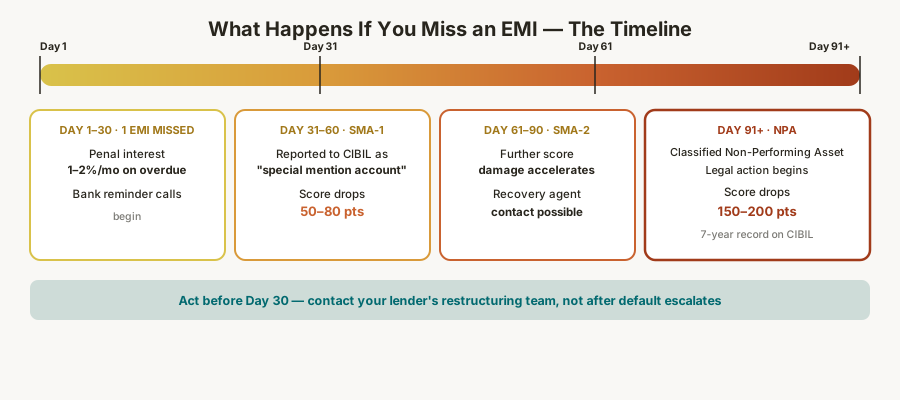
Stage 1: The First Missed EMI (Day 1–29)
The moment your EMI bounce is declined or missed, the clock starts.
What happens immediately:
- Penal interest / late payment fee: Most banks charge 1–3% per month on the overdue amount, or a flat fee of ₹500–₹2,000 per instance. For a ₹45,000 home loan EMI, the penalty is ₹450–₹1,350 immediately.
- Reminder calls and SMS: Your bank's collections team will contact you — typically within 2–3 days of the missed payment.
- Bounce charges (if ECS/NACH was attempted): ₹350–₹500 per bounce from your bank, plus ₹350–₹500 from the lender. Total: ₹700–₹1,000 per bounce.
CIBIL impact:
- Banks report payment status to CIBIL on a monthly cycle, typically around the 7th–15th of each month.
- A single missed payment that is not regularized before the bank's reporting date will appear as "DPD 30" (Days Past Due 30) on your CIBIL report.
- Expected score impact: −40 to −80 points. This single event can push a 750 score to 680–710.
What to do immediately:
Pay the EMI plus any accumulated penalty as soon as possible. If you pay within the same calendar month and before your bank's CIBIL reporting date (~7th–15th), there may be no reporting impact. Call your relationship manager and ask if the report has already been filed.
Stage 2: EMI 30–89 Days Overdue (DPD 30–89)
One missed payment that isn't caught in time leads to the next EMI also falling due. Now you have a compounding problem.
What happens:
- DPD 30 and DPD 60 marks on CIBIL: Each overdue milestone is reported. A DPD 60 mark causes a further 30–50 point CIBIL drop on top of the initial DPD 30 impact.
- Increased collections pressure: More frequent calls, possible field visit from bank's collections team.
- Compounding overdue amount: You owe the missed EMIs + penal interest that is itself accumulating.
- Credit card impacts: If you have a credit card with the same bank, they may reduce your limit or freeze the card.
Legal position:
At this stage, no legal proceedings have begun. This is firmly in the recovery phase — the bank wants to resolve this commercially before escalating.
What to do:
Contact your bank's loan restructuring or retention team (different from customer care — ask specifically for the loan restructuring cell). Explain your situation. Options they can offer at this stage:
- Overdue amount installment plan: Pay the overdue amount in 2–3 installments over the next 30–60 days.
- Moratorium: RBI guidelines allow banks to offer a moratorium (pause in EMIs) for genuine hardship cases. During COVID-19, this was mandatory. Outside specific RBI mandates, it's at the bank's discretion.
- Restructuring: Extending the tenure to reduce EMI to a sustainable level.
Stage 3: NPA Classification (Day 90+)
After 90 consecutive days of non-payment, your account is classified as NPA (Non-Performing Asset). This is a serious credit event with long-lasting consequences.
What changes at NPA classification:
| Consequence | Impact |
|---|---|
| CIBIL score | Additional 100–150 point drop. Total cumulative loss: 150–250 points from original score |
| Account status | Reported as "NPA" — visible to all lenders for 7 years |
| Penal interest | Continues accruing at higher "penal rate" (typically 2–3% above normal rate per annum) |
| Bank's internal classification | Moved to "stressed assets" — different internal team takes over |
| Future credit access | Most banks will reject applications while NPA is active. Even after resolution, many impose a 2–5 year blackout period |
An NPA classification is not permanent — it can be "upgraded" back to standard if you regularize the account (pay all outstanding dues). But the historical NPA mark on your CIBIL record remains for 7 years.
Stage 4: Formal Recovery Proceedings
If the NPA is not resolved, banks initiate formal legal proceedings under the SARFAESI Act (Securitisation and Reconstruction of Financial Assets and Enforcement of Security Interest Act, 2002) for secured loans above ₹1 lakh.
The SARFAESI process timeline:
Notice under Section 13(2): Demand notice issued for full outstanding amount with 60 days to respond/pay.
Section 13(4) — Symbolic Possession Notice: If unpaid after 60 days, bank takes "symbolic possession" of the property — meaning they affix a possession notice. At this point, you still occupy the property.
Physical possession: Bank approaches Debt Recovery Tribunal (DRT) for an order to physically hand over possession. This process typically takes 6–18 months in courts.
Auction: Property is auctioned to recover the outstanding amount. Any surplus after recovering the loan balance is returned to you. Any deficit remains your liability.
Your rights during SARFAESI proceedings:
- Right to be heard: Challenge the demand notice within 60 days by providing written representation.
- Right to redeem: Pay the full outstanding amount at any point before the auction and recover the property.
- Right to notice: Bank must provide proper notices at each stage — any procedural failure can be challenged.
- Approach DRT: File an appeal at the Debt Recovery Tribunal to challenge any step in the proceedings.
Recovery Paths: What to Do Based on Your Situation
If you've missed 1–2 EMIs:
- Pay immediately — full overdue amount plus penalties.
- If you cannot pay immediately, call the bank's restructuring team and request a one-time settlement of the overdue amount in 2 installments.
- Check CIBIL reporting date — if you regularize before reporting, you may escape with no CIBIL impact.
If you're at DPD 30–60:
- Do not ignore calls — engage with the collections team.
- Request formal loan restructuring in writing (email, with acknowledgment).
- If genuine hardship: consult a financial advisor or credit counselor. Reputable credit counseling organizations can help negotiate with lenders.
If you're at NPA stage:
- Seek a One-Time Settlement (OTS) — many banks negotiate the total payable amount (waiving some penal interest) for lump-sum settlement.
- Consider refinancing with an NBFC that specializes in stressed assets — at higher rates, but clears the NPA.
- Consult a lawyer familiar with DRT proceedings if SARFAESI notices have been served.
If you anticipate future difficulty (the most valuable stage):
Contact your bank before missing the first EMI. Proactive borrowers who come forward with a restructuring request are treated very differently from those who go silent and default. Banks prefer restructured loans over NPAs — restructuring is cheaper for them. If you want to check whether extending tenure could bring your EMI to an affordable level, model the revised EMI with our home loan EMI calculator before approaching your lender. If you have surplus income in better months, use the prepayment calculator to see how even a modest part-payment reduces your outstanding principal and lowers the risk of future EMI stress.
Frequently Asked Questions
How many missed EMIs lead to NPA?
Three consecutive months (90 days) of non-payment results in NPA classification under RBI's prudential norms. This applies to all types of loans — home loans, car loans, personal loans, and credit cards.
Does one missed EMI affect my CIBIL score?
Yes, potentially significantly. A single missed payment reported as DPD 30 can reduce your CIBIL score by 40–80 points. The impact depends on your baseline score and overall credit history. If you regularize before your bank's monthly CIBIL reporting date, the impact may be avoided.
What is the difference between DPD 30, DPD 60, and DPD 90?
DPD stands for "Days Past Due." DPD 30 means the EMI was not paid for 30 days, DPD 60 means 60 days overdue, DPD 90 means 90 days overdue (NPA threshold). Each successive stage has a worse CIBIL impact and triggers more serious action from the lender.
Can I negotiate with my bank after missing EMIs?
Yes. Banks have formal restructuring and hardship programs. Contact the loan restructuring or special assets team (not standard customer care). For genuine financial hardship, banks can: extend tenure, offer a moratorium, consolidate overdue into the loan balance, or negotiate an OTS (One-Time Settlement).
What is a One-Time Settlement (OTS) and how does it affect CIBIL?
An OTS is an agreement where the borrower pays a negotiated lump sum (less than full outstanding) to close the account. The account is then marked "settled" on CIBIL — which is better than "written-off" but worse than "closed/repaid in full." A settled account typically causes a 50–100 point CIBIL score drop and remains on the record for 7 years.
Can the bank take my property without going to court?
Under SARFAESI, banks can take symbolic and physical possession without a court order for secured loans above ₹1 lakh, but the process has mandatory notice periods and the borrower can challenge at the DRT (Debt Recovery Tribunal). The complete process — from NPA to auction — typically takes 12–36 months, giving borrowers time to act.
Does missing EMI on one loan affect other loans?
Yes, indirectly. A CIBIL score drop from a missed EMI affects your eligibility and rates on all future borrowing. Additionally, if you have other loans with the same lender, they may freeze your credit card, reduce your overdraft limit, or call other loans if cross-default clauses are present in the loan agreements.
Try the calculator
Run your own numbers in seconds. Pick the calculator that fits your loan type.