Loan Amortization Explained — How Every EMI Is Split Between Interest and Principal
In the first year of a ₹50 lakh home loan, 86% of your EMI goes to the bank as interest, not equity. Here's how amortization works, why it matters, and how to use it to pay less.
Key Takeaways
- In a typical 20-year home loan, you pay more in interest than in principal for the first 12–13 years.
- The EMI formula is: EMI = P × r(1+r)^n / ((1+r)^n − 1), where r = monthly rate, n = months.
- Amortization front-loads interest — early prepayments save disproportionately more interest.
- An amortization schedule is the most useful single document you can have when deciding whether and when to prepay.
Every month you pay your EMI, it gets split into two components: interest (the bank's fee for lending you money) and principal (the actual repayment of your loan). Most people know this. What surprises most borrowers is how this split changes over time — and how dramatically it's skewed toward interest in the early years.
Understanding amortization isn't just academic. It's the foundation for every smart prepayment and refinancing decision you'll make over the life of your loan.
The EMI Formula
Your monthly EMI is calculated using this formula:
EMI = P × r × (1 + r)^n ÷ ((1 + r)^n − 1)
Where:
- P = Principal (loan amount)
- r = Monthly interest rate = Annual rate ÷ 12
- n = Total number of months (tenure × 12)
Example
Loan: ₹50 lakh | Rate: 9% per annum | Tenure: 20 years
- r = 9% ÷ 12 = 0.75% = 0.0075
- n = 20 × 12 = 240
- EMI = ₹50,00,000 × 0.0075 × (1.0075)^240 ÷ ((1.0075)^240 − 1)
- (1.0075)^240 = 6.0093
- EMI = ₹50,00,000 × 0.0075 × 6.0093 ÷ (6.0093 − 1)
- EMI ≈ ₹44,986
How Each EMI Is Split: Month by Month
For the same ₹50 lakh, 9%, 20-year loan:
Month 1:
- Interest = ₹50,00,000 × 0.75% = ₹37,500
- Principal = ₹44,986 − ₹37,500 = ₹7,486
- Outstanding after Month 1: ₹50,00,000 − ₹7,486 = ₹49,92,514
Month 2:
- Interest = ₹49,92,514 × 0.75% = ₹37,444
- Principal = ₹44,986 − ₹37,444 = ₹7,542
- Outstanding: ₹49,84,972
Each month, the interest component shrinks slightly (because the outstanding balance is slightly lower) and the principal component grows slightly.
The Amortization Schedule: Year-by-Year View
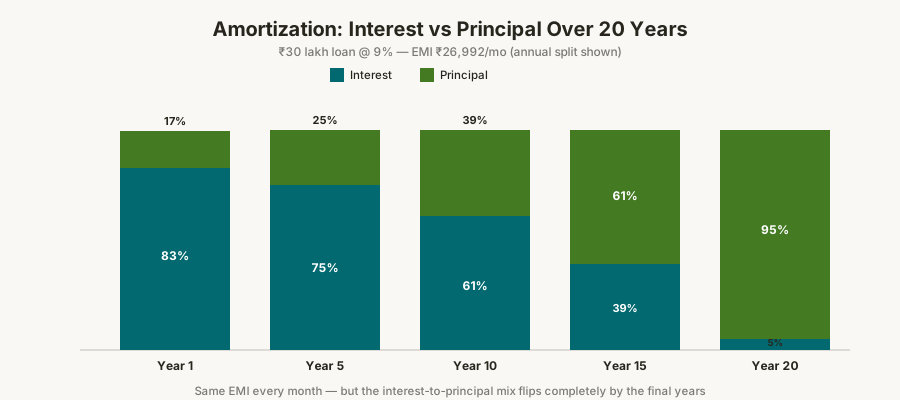
Here is how the split evolves for the ₹50 lakh, 9%, 20-year loan:
| Year | Annual EMI Paid | Interest Paid | Principal Paid | Outstanding Balance |
|---|---|---|---|---|
| 1 | ₹5,39,832 | ₹4,46,200 | ₹93,632 | ₹49,06,364 |
| 3 | ₹5,39,832 | ₹4,27,809 | ₹1,12,023 | ₹46,91,919 |
| 5 | ₹5,39,832 | ₹4,05,805 | ₹1,34,027 | ₹44,35,352 |
| 8 | ₹5,39,832 | ₹3,64,437 | ₹1,75,395 | ₹39,52,995 |
| 10 | ₹5,39,832 | ₹3,29,987 | ₹2,09,845 | ₹35,51,294 |
| 13 | ₹5,39,832 | ₹2,65,218 | ₹2,74,614 | ₹27,96,077 |
| 15 | ₹5,39,832 | ₹2,11,279 | ₹3,28,553 | ₹21,67,142 |
| 18 | ₹5,39,832 | ₹1,09,872 | ₹4,29,960 | ₹9,84,712 |
| 20 | ₹5,39,832 | ₹25,421 | ₹5,14,411 | ₹0 |
Key observation: In Year 1, you pay ₹4.46 lakh in interest and only ₹0.94 lakh in principal — 83% goes to interest. By Year 13, the split crosses 49:51 (interest = principal). Only from Year 13 onward does the majority of each EMI reduce your principal.
Use our home loan EMI calculator to compute the EMI for any loan amount, rate, and tenure instantly.
Total interest paid over 20 years: ₹57.97 lakh
You borrowed ₹50 lakh and paid back ₹1,07.97 lakh. The bank earned ₹57.97 lakh for the 20-year loan — more than the original principal.
Why Front-Loaded Interest Matters for Prepayment
The amortization schedule explains precisely why early prepayments are so much more powerful than late ones.
When you prepay ₹5 lakh in Year 3, you are removing principal that would otherwise generate interest for the next 17 years. That ₹5 lakh in principal would have cost you approximately ₹6.5 lakh in future interest.
When you prepay ₹5 lakh in Year 15, it would have generated interest for only 5 more years — approximately ₹1.8 lakh in future interest.
Same ₹5 lakh. Year 3 saves ₹6.5 lakh in interest. Year 15 saves ₹1.8 lakh.
This is the central insight of loan amortization applied to prepayment strategy. Model the exact saving for your loan using our prepayment calculator, or read the full strategic breakdown in prepay vs invest.
Negative Amortization: When Your EMI Isn't Enough
Negative amortization occurs when your EMI is set too low to cover even the monthly interest — so your outstanding balance actually increases rather than decreasing. This doesn't happen with standard fixed-EMI loans, but it can happen in two scenarios:
1. Floating rate increases after EMI is fixed
Some banks keep the EMI constant when rates rise and instead extend the tenure. If the rate rises significantly enough, the EMI may no longer cover the full monthly interest — creating negative amortization invisibly. Ask your bank: "If rates rise, how is my loan adjusted — EMI or tenure?"
2. Interest-only or moratorium periods
During the COVID-19 RBI moratorium (2020) and in some construction-phase home loans, borrowers pay only interest for 6–24 months. Principal outstanding does not reduce during this period — it stays constant or can even grow if interest is deferred rather than paid.
If you took a moratorium in 2020 and didn't pay EMIs, your outstanding balance as of 2026 may be significantly higher than your original loan amount. Check with your lender.
Using an Amortization Schedule Strategically
Find out when interest-to-principal split crosses 50:50
For a 20-year loan at 9%, the crossover (where principal component exceeds interest component in each EMI) occurs around Year 13. This is useful knowledge: if you're beyond Year 13, the urgency of prepaying has reduced significantly.
Model the impact of any prepayment
Generate your amortization table (use our amortization tool), identify your current outstanding balance, and model different prepayment scenarios. The tool will show you exactly how much interest you save and how much tenure you cut for any given prepayment.
Verify your loan statements
Your bank sends a statement every year showing interest paid and principal repaid. Cross-check this against your expected amortization schedule. Discrepancies can indicate calculation errors — rare but not unheard of in manual processing systems at smaller banks and NBFCs.
Frequently Asked Questions
What is loan amortization?
Loan amortization is the process by which a loan is paid down through regular equal payments (EMIs) over time. Each payment contains two components: interest (calculated on the outstanding balance) and principal (the repayment of borrowed amount). The proportion shifts over time — early payments are mostly interest, later payments are mostly principal.
Why do home loans pay so much interest in early years?
Because interest is calculated on the outstanding balance. When the loan is new, the outstanding balance is highest — so interest is highest. As you repay principal, the outstanding balance falls, and the interest component of each EMI gradually decreases.
What is an amortization schedule?
An amortization schedule is a complete table showing, for every period of the loan, the beginning balance, EMI paid, interest component, principal component, and ending balance. It allows borrowers to see exactly how their loan balance decreases over time.
How do I calculate my loan's amortization schedule?
Use our amortization calculator — enter your loan amount, interest rate, and tenure to generate a month-by-month and year-by-year schedule. Alternatively, use the Excel PMT, IPMT, and PPMT functions.
Does the interest-to-principal ratio change if rates change?
Yes. If your floating rate increases, the interest component of each EMI increases. Banks typically respond by either increasing the EMI or extending the tenure. If the tenure is extended, your amortization schedule is effectively redrawn from that point with a higher outstanding balance curve.
Should I ask my bank for an amortization schedule?
Yes — every bank is required to provide one on request. For RBI-regulated lenders, it is a mandatory disclosure for loan products. Request it at the time of loan sanction and whenever your rate is reset. It's the most useful document you have for managing your loan intelligently.
Try the calculator
Run your own numbers in seconds. Pick the calculator that fits your loan type.