How to Improve Your CIBIL Score Fast — 7 Proven Steps for 2026
Your CIBIL score can be repaired — but only if you know exactly which levers to pull and in which order. This step-by-step guide covers every actionable tactic, realistic timelines, and the mistakes that silently undo your progress.
Quick summary
- Clearing overdue accounts is the single biggest lever — can add 40–80 points once resolved.
- Reducing credit card utilisation below 30% shows up in 30–45 days, often adding 20–40 points.
- One missed EMI can drop your score 40–80 points and stays on your record for 7 years.
- Most people can move from 650 to 750 in 6–9 months with consistent effort.
- 15–20% of CIBIL reports contain errors — a free dispute can fix your score without changing your behaviour at all.
Your CIBIL score follows you everywhere. Every home loan, personal loan, and even some landlords check it before saying yes. Yet most people only discover their score matters when they're sitting across a loan officer and the number comes back lower than expected.
The good news: a low CIBIL score is not a life sentence. It is a financial problem with a known set of solutions, a predictable timeline, and clear milestones. This guide gives you the complete tactical playbook.
Why Your CIBIL Score Is the Number That Matters Most
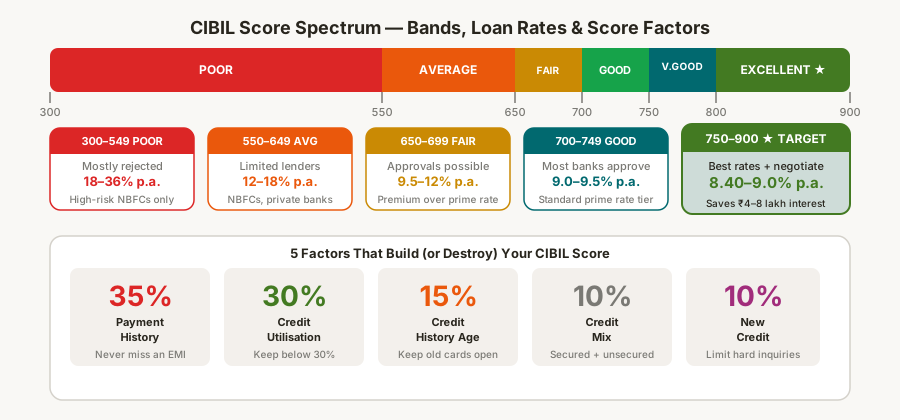
CIBIL (Credit Information Bureau India Limited) calculates a score between 300 and 900 using data fed by banks, NBFCs, and credit card companies. Every time you borrow — or fail to repay — those events get reported to CIBIL within 30–45 days.
Banks don't look at your salary first. They look at your score first. A borrower with ₹1.5 lakh monthly income and a 780 score will get a better rate than a borrower with ₹3 lakh income and a 680 score.
At CIBIL 750+, SBI offers home loans at 8.40–8.55%. At 680–700, the same bank adds 50–100 basis points. On a ₹50 lakh loan over 20 years, that's ₹4–8 lakh extra in interest — verify the exact figure for your loan with our home loan EMI calculator.
How Your Score Is Calculated
Before you can repair your score, you need to understand exactly what feeds it:
| Factor | Weight | What moves it |
|---|---|---|
| Payment history | 35% | On-time EMI and card payments |
| Credit utilisation ratio | 30% | % of total card limit used |
| Credit history age | 15% | Age of oldest account |
| Credit mix | 10% | Ratio of secured to unsecured loans |
| New credit enquiries | 10% | Number of recent hard inquiries |
Payment history and credit utilisation together control 65% of your score. Fix these two and you fix most of your score.
The 7-Step Improvement Plan
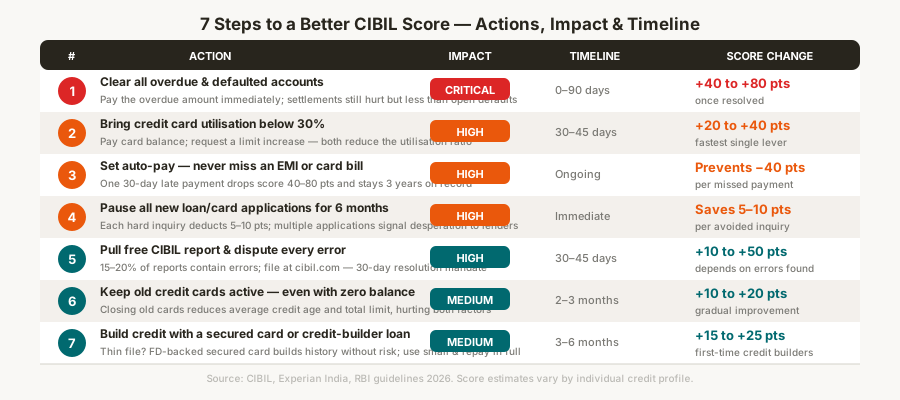
Step 1: Clear all overdue and defaulted accounts (Priority: CRITICAL)
If you have any overdue EMIs, settled accounts, or written-off loans, these are the landmines destroying your score. A loan marked "DPD 90+" (Days Past Due, 90 days or more) is catastrophic for your credit profile.
What to do:
- List every loan and credit card — check your CIBIL report for accounts you may have forgotten
- Pay all outstanding dues in full where possible
- For large defaults you can't pay in full, negotiate a one-time settlement — a settled account is bad but less bad than an open default
Important nuance on settlements: A "settled" status stays on your CIBIL report for 7 years. Some banks will not lend to borrowers with any settled account in the last 3–5 years, regardless of your current score. Pay in full wherever humanly possible.
Expected timeline: The underlying default won't disappear, but once you clear the dues, the account stops accumulating further damage. Fresh positive history from this point forward starts repairing the score within 60–90 days.
Step 2: Bring credit card utilisation below 30% (Priority: HIGH)
Credit utilisation is your total card spending as a percentage of your total credit limit. If you have three cards with a combined limit of ₹3 lakh and you owe ₹1.8 lakh, your utilisation is 60% — dangerously high.
The 30% rule: Keep utilisation below 30% consistently. For maximum score, aim for below 10% in the month before a loan application.
Two ways to reduce utilisation without changing spending:
- Pay down the balance — the obvious but most effective method
- Request a credit limit increase — if your payment history is clean on a card, call the bank and ask for a limit increase. They often approve without a hard inquiry. A higher limit at the same balance = lower utilisation.
This change reflects in your CIBIL report within 30–45 days of the card company's next monthly reporting cycle.
Step 3: Set auto-pay on every EMI and credit card bill (Priority: HIGH)
One 30-day late payment can drop your score by 40–80 points. It stays on your CIBIL record for 7 years. There is no way to erase it — only time and consistent positive payments can dilute its impact.
Set auto-debit from your salary account for every EMI and at minimum the "minimum due" on every credit card (though paying in full is better for your finances). Never miss a payment again.
For credit cards specifically: Pay the full statement balance, not just the minimum. Minimum payments keep you in debt and accumulate interest at 36–42% per year.
Step 4: Stop all new loan and credit card applications for 6 months (Priority: HIGH)
Every time a lender pulls your CIBIL report to evaluate a credit application, it's called a "hard inquiry." Each hard inquiry deducts 5–10 points. Ten applications in three months can cost you 50–100 points before you've even been approved or rejected.
The counterintuitive rule: the worse your score, the more desperate you look when applying for credit, and the more you get rejected, each rejection triggering another inquiry.
Stop the cycle completely. Apply for nothing new for 6 months. Exception: when rate-shopping for a home loan, multiple inquiries from mortgage lenders within a 45-day window are typically treated as a single inquiry by CIBIL.
Step 5: Dispute errors on your CIBIL report (Priority: HIGH)
Approximately 15–20% of Indian credit reports contain at least one factual error. Common errors include:
- Loans you repaid years ago still showing as outstanding
- Duplicate accounts (common after bank mergers)
- Accounts that belong to someone with a similar name
- Incorrect date of birth causing report mixing
- Late payments that were actually paid on time
How to check: Visit cibil.com and download your free annual credit report. Review every account listed under "Credit Summary." Look for accounts you don't recognise, wrong balances, and incorrect DPD status.
How to dispute: File the dispute online at cibil.com/dispute. CIBIL has a legal obligation to resolve disputes within 30 days. The lender named in the disputed entry must verify the data; if they cannot, the entry is deleted or corrected.
A single corrected error can instantly add 10–50 points without any change in your actual financial behaviour. This is the highest ROI action for anyone with a potentially incorrect report.
Step 6: Keep old credit cards active — even with zero balance (Priority: MEDIUM)
Credit history age accounts for 15% of your score. The age of your oldest account and the average age of all accounts both matter.
Closing a credit card you've had for 8 years to "simplify your finances" may seem sensible. In reality, you're deleting 8 years of positive history from your score calculation.
What to do: Keep old cards open. Make one small purchase per month (₹100–500) and pay it in full. This keeps the account active and reported, while keeping utilisation near zero.
If a card has a high annual fee, call the bank and ask them to downgrade to a no-fee variant of the same card before closing. Many banks will do this.
Step 7: Build secured credit history from scratch (Priority: MEDIUM — for thin-file borrowers)
If you've never had a loan or credit card, you may have a very low score simply due to lack of credit history — a "thin file." Banks can't assess risk without data, so they either reject or charge a premium.
Two ways to build history fast:
-
Secured credit card: Open a fixed deposit for ₹10,000–50,000 and ask the same bank for a secured credit card against it. The FD is your collateral. Use the card for small monthly expenses and pay in full each month. Within 6 months you'll have a track record.
-
Credit-builder loan: Some NBFCs offer small loans specifically designed to build credit history. The loan amount is held in a fixed deposit; you make EMI payments; on completion you receive the FD. Every on-time payment is reported to CIBIL.
Timeline: What to Expect
| Timeframe | What You Can Achieve |
|---|---|
| 30 days | Reduce utilisation: +20–40 pts visible |
| 45 days | Dispute errors resolved: +10–50 pts (if errors found) |
| 60–90 days | Clear overdue accounts: +40–80 pts |
| 3 months | Stop hard inquiries, consistent payments: baseline stabilised |
| 6 months | 50–80 point improvement typical for 650→730 journey |
| 9–12 months | Cross 750 if starting from 650 with no active defaults |
| 12–24 months | Cross 800 from 700, with no defaults and active good behaviour |
Realistic expectation: Going from 620 to 750 typically takes 9–12 months. Going from 700 to 800 takes 12–18 months. Anyone promising faster results is either ignoring defaults in your file or oversimplifying.
Common Mistakes That Silently Undo Progress
Closing your oldest credit card. Removes your longest history — can drop score 15–30 points immediately.
Using 80%+ of your credit limit. Even if you pay in full each month, the utilisation at the time of reporting (mid-month) counts. If your salary hits on the 5th and your card reports to CIBIL on the 20th, pay down the balance before the 20th.
Settling rather than fully paying old dues. A "settled" status is a permanent negative marker. Full repayment, even years later, marks the account "closed" — still not positive, but better than "settled."
Applying for a loan to consolidate debt while simultaneously applying for new credit. Each application is a hard inquiry. Consolidation is smart; serial applications are not.
Checking your score at multiple lender sites. Many lender portals run soft checks, but some run hard checks. Only check via cibil.com, OneScore, or Paisabazaar — these are confirmed soft-inquiry platforms.
CIBIL vs Experian vs CRIF — Which Score Matters?
India has four licensed credit bureaus: CIBIL, Experian, Equifax, and CRIF High Mark. Most major banks primarily use CIBIL, but PSU banks often cross-check with CRIF, and some private banks run Experian checks.
The scoring models are different, so your score at each bureau may vary by 10–30 points. If you're applying for a loan, the bank will specify which bureau they use. Ask your relationship manager.
If one bureau has a significantly lower score, check that report for errors — it may have picked up a different error than your CIBIL report.
How to Check Your CIBIL Score for Free
| Platform | Cost | Frequency | Hard Inquiry? |
|---|---|---|---|
| cibil.com | Free (1/year) | Annual | No |
| OneScore app | Free | Monthly | No |
| Paisabazaar | Free | Unlimited | No |
| BankBazaar | Free | Unlimited | No |
| CIBIL monthly subscription | ₹500–₹1,200/year | Monthly | No |
Rule of thumb: Check your CIBIL score at least 6–9 months before any major loan application. This gives you time to identify errors, improve utilisation, and let recent positive payments show up in the data.
Frequently Asked Questions
How long does it take to improve CIBIL score from 650 to 750?
Typically 6–9 months with consistent effort: no new defaults, utilisation below 30%, all EMIs paid on time, and any disputes resolved. If there are active defaults or recent settled accounts in your file, the timeline extends to 12–18 months.
Does checking my own CIBIL score reduce it?
No. Self-checks are "soft inquiries" and have no impact on your score. Only lender-initiated checks (hard inquiries) deduct points.
I have a settled account from 4 years ago. Can I still get a home loan?
Some banks will approve, but many private sector banks and PSU banks have internal policies against lending to borrowers with any settled account in the last 5 years. Your best options are: (a) apply to a bank with more flexible policies, (b) apply with a co-applicant who has a clean record, or (c) wait for the 5-year mark.
My score dropped 60 points overnight. What happened?
The most likely causes are: a new missed payment reported, a new hard inquiry from a lender, a credit card balance spike (high utilisation), or an error added by a lender. Pull your report immediately to identify the cause.
Can paying off a personal loan improve my score?
Yes, gradually. The loan closing removes an outstanding balance and improves your credit utilisation metrics. The payment history from that loan remains on record as a positive. Don't close the account ahead of schedule for a score boost — the benefit is small (5–15 points) and not worth the foreclosure charges.
My CIBIL report shows a loan I never took. What do I do?
This is an identity theft red flag. File a dispute with CIBIL immediately at cibil.com. Simultaneously: contact the lender on the report and file a complaint, file a police FIR for identity theft, and report to the RBI Banking Ombudsman if the lender is uncooperative. CIBIL must resolve the dispute within 30 days.
Check how much loan your improved CIBIL score unlocks with the loan eligibility calculator, or compare lender rates with the compare loans tool.
Try the calculator
Run your own numbers in seconds. Pick the calculator that fits your loan type.