Home Loan Tenure — 15 vs 20 vs 30 Years: The Decision Guide
The wrong home loan tenure costs ₹20–40 lakh extra in interest. Numbers-driven guide to choosing 15 vs 20 vs 30 years for your income and age.
Key Takeaways
- A ₹50 lakh loan at 9%: 30-year tenure costs ₹94.83 lakh in total interest — ₹36.87 lakh more than a 20-year tenure.
- Longer tenure = lower EMI but dramatically higher lifetime interest; shorter tenure = higher EMI but significant long-term savings.
- Your FOIR (Fixed Obligation to Income Ratio) should stay below 50% — if a 20-year tenure keeps you within this, don't stretch to 30 years just to lower EMI.
- The most efficient strategy: take the longest tenure the bank allows, but prepay aggressively — you get the safety of a low mandatory EMI with the interest savings of a short tenure.
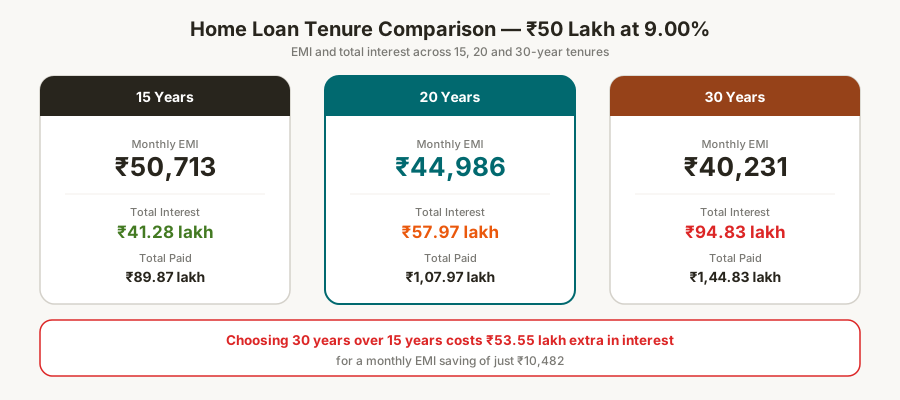
Choosing your home loan tenure may be the single most financially consequential decision you make at the time of borrowing. Most buyers focus on the interest rate — haggling for 10–15 bps — while ignoring the tenure, which can swing the total interest outgo by ₹20–40 lakh on a ₹50 lakh loan.
This guide gives you the complete framework: exact EMI and total-interest calculations across all standard tenures, age-based recommendations, income-based analysis, and a clear decision tree so you can choose the right tenure for your specific situation.
The Numbers: EMI and Total Interest Across Tenures
Let's start with the core data. All calculations below are for a ₹50 lakh home loan at 9.00% interest rate.
₹50 Lakh Loan at 9.00%
| Tenure | Monthly EMI | Total Amount Paid | Total Interest | Interest vs Principal |
|---|---|---|---|---|
| 10 years | ₹63,338 | ₹76,00,560 | ₹26,00,560 | 52% |
| 15 years | ₹50,713 | ₹91,28,340 | ₹41,28,340 | 83% |
| 20 years | ₹44,986 | ₹1,07,96,640 | ₹57,96,640 | 116% |
| 25 years | ₹41,960 | ₹1,25,88,000 | ₹75,88,000 | 152% |
| 30 years | ₹40,231 | ₹1,44,83,160 | ₹94,83,160 | 190% |
The most striking insight: Moving from a 20-year to a 30-year tenure reduces your EMI by just ₹4,755/month — but costs you an additional ₹36.86 lakh in interest over the loan's life. Spread across the 120 extra months of that extension, each additional month costs ₹30,721 in extra interest — 6.5 times the ₹4,755 monthly "saving".
₹75 Lakh Loan at 9.00%
| Tenure | Monthly EMI | Total Interest | Difference vs 20-Year |
|---|---|---|---|
| 15 years | ₹76,070 | ₹61,92,600 | −₹25,02,360 |
| 20 years | ₹67,479 | ₹86,94,960 | — (baseline) |
| 25 years | ₹62,940 | ₹1,13,82,000 | +₹26,87,040 |
| 30 years | ₹60,347 | ₹1,42,24,920 | +₹55,29,960 |
₹1 Crore Loan at 9.00%
| Tenure | Monthly EMI | Total Interest | Difference vs 20-Year |
|---|---|---|---|
| 15 years | ₹1,01,427 | ₹82,56,860 | −₹33,36,660 |
| 20 years | ₹89,973 | ₹1,15,93,520 | — (baseline) |
| 25 years | ₹83,920 | ₹1,51,76,000 | +₹35,82,480 |
| 30 years | ₹80,462 | ₹1,89,66,320 | +₹73,72,800 |
On a ₹1 crore loan, choosing 30 years over 20 years costs an extra ₹73.7 lakh in interest — to "save" ₹9,511/month in EMI.
Use our home loan EMI calculator and amortization calculator to run these numbers for your exact loan amount and rate.
The EMI Reduction from Extending Tenure Is Smaller Than You Think
Here is the counterintuitive reality of tenure extension: the EMI reduction gets progressively smaller as you extend further. Most of the EMI reduction happens in the move from 10 to 15 years. Beyond 20 years, the marginal benefit is minimal.
| Tenure Extension | Monthly EMI Drop (₹50L, 9%) | Annual EMI Saving | Total Extra Interest Cost |
|---|---|---|---|
| 10 → 15 years | ₹12,625/month | ₹1,51,500 | +₹15,27,780 |
| 15 → 20 years | ₹5,727/month | ₹68,724 | +₹16,68,300 |
| 20 → 25 years | ₹3,026/month | ₹36,312 | +₹17,91,360 |
| 25 → 30 years | ₹1,729/month | ₹20,748 | +₹18,95,160 |
Each additional 5 years of tenure buys you a smaller and smaller EMI reduction — while adding roughly the same amount of total interest cost (~₹17–19 lakh on a ₹50 lakh loan). The return on extension diminishes rapidly past 20 years.
How Age Should Drive Your Tenure Decision
The RBI and most lenders cap home loan tenure so the loan closes before you turn 70 (some PSU banks extend to 75). This means your current age is the first hard constraint.
| Current Age | Maximum Possible Tenure | Practical Maximum (Recommendation) |
|---|---|---|
| 25 years | 30 years (closes at 55) | 25–30 years |
| 30 years | 30 years (closes at 60) | 20–30 years |
| 35 years | 25–30 years (closes at 60–65) | 20–25 years |
| 40 years | 20–25 years (closes at 60–65) | 15–20 years |
| 45 years | 15–20 years (closes at 60–65) | 15 years |
| 50 years | 10–15 years (closes at 60–65) | 10–12 years |
The retirement boundary rule
Your loan should ideally close before retirement — the moment your income drops from salary to pension or withdrawals. Running a large home loan EMI on a reduced retirement income creates significant financial stress and limits your ability to respond to medical emergencies.
If you are 30 today and plan to retire at 58, your effective maximum tenure is 28 years — not 30. Plan accordingly.
The younger borrower's tenure dilemma
A 25-year-old borrower can technically take a 30-year tenure and pay EMIs until age 55. This may look attractive (lowest EMI) but has a hidden cost: you delay wealth accumulation for three extra decades. The extra ₹36 lakh paid in interest on a ₹50 lakh loan is money that could have been in equity mutual funds compounding at 11–12% CAGR.
A 25-year-old choosing 20 years over 30 years saves ₹36 lakh in interest and clears the loan by 45 — leaving 10–15 peak earning years entirely free of loan obligations, with full surplus income available for retirement corpus building.
Income and FOIR: The Real Constraint on Tenure Choice
Your Fixed Obligation to Income Ratio (FOIR) is the share of gross monthly income consumed by all loan EMIs. RBI guidelines and most banks cap FOIR at 50–55% for retail borrowers.
FOIR formula:
FOIR = (Total monthly EMI obligations ÷ Gross monthly income) × 100
Minimum income required to stay under 50% FOIR
For a ₹50 lakh home loan at 9%, with no other loans:
| Tenure | Monthly EMI | Minimum Monthly Income (50% FOIR) |
|---|---|---|
| 10 years | ₹63,338 | ₹1,26,676 |
| 15 years | ₹50,713 | ₹1,01,426 |
| 20 years | ₹44,986 | ₹89,972 |
| 25 years | ₹41,960 | ₹83,920 |
| 30 years | ₹40,231 | ₹80,462 |
If your monthly income is ₹90,000 and you have no other loans, a 20-year tenure keeps you right at 50% FOIR — the maximum comfortable level. A 30-year tenure would reduce FOIR to 44.7%, giving you more monthly breathing room at a high interest cost. A 15-year tenure would push FOIR to 56% — above the comfort threshold.
Practical guidance: If a 20-year tenure keeps your FOIR below 45%, choose 20 years. Don't extend tenure simply because the bank offers it. If the 20-year FOIR sits between 45–50%, consider 25 years. Only take 30 years if 25 years already strains your FOIR.
The Optimal Strategy: Long Tenure + Aggressive Prepayment
The single most effective tenure strategy for most Indian home loan borrowers is:
- Take the maximum available tenure (to keep mandatory EMI low)
- Make structured prepayments whenever you have surplus — annual bonus, salary increment, matured FD
- Target actual loan closure in 12–18 years, regardless of the 20–30 year contract tenure
This strategy combines:
- Flexibility: Low mandatory EMI means financial shocks (job loss, medical emergency, business downturn) don't immediately threaten your home
- Savings: Systematic prepayments slash total interest cost to near what a 12-year tenure would deliver
- Tax efficiency: You maintain Section 24(b) eligibility as long as the loan is active
How prepayment transforms a 30-year loan
Consider a ₹50 lakh loan at 9% with a 30-year tenure (EMI: ₹40,231). If the borrower makes an additional ₹1 lakh prepayment every year (one extra monthly salary amount):
| Strategy | Effective Loan Closure | Total Interest Paid | Interest Saved vs 30-Year |
|---|---|---|---|
| No prepayment | 30 years | ₹94,83,160 | — |
| ₹1L/year prepayment | ~22 years | ₹68,40,000 (approx) | ₹26,43,160 |
| ₹2L/year prepayment | ~17 years | ₹53,10,000 (approx) | ₹41,73,160 |
| ₹1L/year + salary hike EMI step-up | ~16 years | ₹50,80,000 (approx) | ₹44,03,160 |
Use our prepayment calculator to model your exact prepayment schedule and see the tenure reduction and interest savings in real time.
Floating Rate Loans: Tenure Risk You Must Understand
One aspect of tenure selection that most borrowers overlook: floating rate loans change over time, and not always in your favour.
When interest rates rise (as they did through 2022–23 when the RBI hiked 250 bps), lenders typically extend your tenure rather than raising your EMI — to avoid the administrative friction of EMI changes. The result: your 20-year loan can quietly stretch to 23–25 years without your monthly outgo changing.
The risk: A ₹60 lakh loan at 8.5% on a 20-year tenure. Rate rises 100 bps to 9.5%. If tenure is extended to keep EMI constant, the new effective tenure is ~24 years — adding 4 years and approximately ₹18–20 lakh in interest cost, entirely invisibly.
How to protect yourself:
- Request a revised amortization schedule from your lender every April when you get your interest certificate
- Verify your outstanding principal against what the original schedule projected — if it's higher, tenure has silently extended
- After any rate cut, explicitly ask your lender to reduce tenure rather than EMI (or make a lump-sum prepayment to reset the original schedule)
Tenure and Tax Efficiency
An often-missed consideration: the longer your loan tenure, the longer you benefit from Section 24(b) and Section 80C deductions.
For a ₹50 lakh loan at 9% in the 30% tax slab:
- Annual tax saving from Section 24(b): ₹60,000 (interest capped at ₹2L × 30% slab)
- Annual tax saving from Section 80C (principal): Up to ₹45,000 in the first 6–7 years
A 30-year loan gives 10 more years of these tax benefits compared to a 20-year loan:
- Extra tax saving = 10 years × ₹60,000/year = ₹6,00,000 in additional 24(b) benefit alone
This is real money — but it doesn't fully offset the ₹36.86 lakh extra interest on the 30-year tenure. The math still favours the shorter tenure for most borrowers in the 30% slab; however, for borrowers in the 20% slab, the tax benefit calculation changes slightly (saving ₹40,000/year instead of ₹60,000).
Step-Up EMI: The Middle Path
If income is expected to grow significantly (young professionals, early-career doctors, CAs, startup employees), a step-up EMI structure allows you to take a shorter effective tenure without the current EMI burden.
How it works: EMI starts 20–30% lower in the first 2–3 years, then steps up annually as income grows. Banks like SBI, HDFC, and Axis offer this as a standard product.
Example — ₹50 lakh, 9%, step-up for a 28-year-old earning ₹80,000/month:
- Year 1–3: EMI = ₹39,500 (12% below the 20-year EMI of ₹44,986; above the ₹37,500 monthly interest floor at 9%)
- Year 4–6: EMI = ₹45,000
- Year 7+: EMI = ₹53,000
- Effective tenure: ~18 years
- Total interest: ~₹54.6 lakh (vs ₹94.8 lakh for 30-year flat — saving ~₹40 lakh)
Use our step-up EMI calculator to model this strategy with your own income growth assumptions.
The Decision Framework: Which Tenure Is Right for You?
Work through these four questions in order:
Question 1: What does your FOIR allow?
Calculate your current FOIR across all existing loan EMIs + the proposed new home loan EMI at a 20-year tenure. If FOIR < 45%: start at 20 years. If 45–50%: consider 25 years. If > 50%: must take 25–30 years.
Question 2: What is your age and retirement horizon?
Your tenure must close before retirement (typically age 58–60). At age 40, your maximum practical tenure is 18–20 years. At 30, you have latitude for 25–30 years if income requires it.
Question 3: Do you have a reliable surplus income history?
If you have consistently generated ₹1–2 lakh/year in surplus (bonus, freelance, rental income), the long-tenure + prepayment strategy is ideal. If income is variable or your emergency fund is thin, a longer tenure with lower mandatory EMI provides real financial safety.
Question 4: What is your psychological relationship with debt?
Some borrowers are materially impaired by a large outstanding debt — it affects spending, risk-taking, and wellbeing. If you are debt-averse and can manage the EMI, a 15-year tenure that delivers earlier freedom may be worth the higher monthly payment. Personal finance is ultimately personal.
Summary Decision Tree
| Scenario | Recommended Tenure |
|---|---|
| FOIR > 50% at 20 years, age < 35 | 25–30 years + prepayment plan |
| FOIR 40–50% at 20 years, age 30–40 | 20 years (optimal balance) |
| FOIR < 40% at 15 years, age < 35 | 15–20 years |
| Age 40–45, FOIR OK at 15 years | 15 years (close before retirement) |
| Age 45+, high income, debt-averse | 10–12 years (aggressive payoff) |
| Young borrower, variable income | 25–30 years + structured prepayments |
Frequently Asked Questions
Is a 30-year home loan a bad idea?
Not necessarily — but it depends on whether you use it as a safety net or a crutch. If you take a 30-year tenure to keep mandatory EMI low and commit to systematic prepayments, the outcome can be better than a rigid 20-year tenure that leaves no room for financial shocks. The mistake is taking 30 years and making no prepayments — in that case, you pay nearly double the principal in interest over the loan's life.
Can I change my home loan tenure after the loan is disbursed?
Yes, with some restrictions. You can request a tenure reduction at any time — most lenders process this with a written request and a small fee (₹500–₹2,000). A lump-sum prepayment automatically reduces tenure if you instruct the bank to keep EMI constant. Extending tenure is also possible (subject to remaining below the maximum age cap), though lenders may charge a processing fee and revaluation.
Does a shorter tenure mean I pay less interest overall?
Yes, always. The shorter the tenure, the less time your outstanding principal is accruing interest. For the same loan amount and rate, a 15-year tenure will always result in lower total interest than a 20-year tenure, which will always be lower than a 30-year tenure.
Should I take a longer tenure to invest the saved EMI?
This strategy works mathematically if your investment return (after tax) exceeds your home loan rate (after tax benefit). At current rates — 9% home loan, 30% slab, effective rate ~8.4% — a Nifty index fund returning 11–12% CAGR over 15+ years can beat the loan cost. However, this requires discipline: the "saved" EMI must actually go into the investment, not lifestyle spending. Read our detailed guide: Should You Prepay Your Home Loan or Invest?
What tenure do most Indian home loan borrowers choose?
According to CRISIL and NHB data, the median home loan tenure in India has been creeping upward over the past decade. In FY2024–25, the median new home loan tenure was 18–20 years, with ~35% of new loans taken at 25–30 years. The shift to longer tenures has been driven by rising property prices outpacing income growth — borrowers are extending tenures to keep EMIs manageable rather than reducing loan size.
Does tenure affect home loan eligibility or interest rate?
Tenure itself doesn't directly affect your eligibility or interest rate in most cases. Your eligibility (loan amount) is driven by FOIR, CIBIL score, and income. However, some lenders offer marginally better rates for shorter tenures (below 10 years) or premium borrower profiles. For standard 15–30 year tenures, the rate is identical at most lenders.
Can I prepay a home loan without penalty?
For floating-rate home loans, the RBI prohibits prepayment penalties — banks cannot charge you for part-prepayment or foreclosure. For fixed-rate loans, lenders may charge a prepayment penalty of 2–3% of the outstanding principal. Always confirm before choosing a fixed-rate product if prepayment is part of your strategy.
Try the calculator
Run your own numbers in seconds. Pick the calculator that fits your loan type.