Pre-EMI vs Full EMI — Under-Construction Home Loan Guide
Pre-EMI on a ₹56 lakh loan costs ₹5.25 lakh before possession — full EMI saves ₹2.34 lakh and builds equity from day one. Here is the complete comparison.
Key Takeaways
- On a ₹56 lakh loan at 8.75% with a 24-month construction phase, pre-EMI interest totals ₹5.25 lakh before you make a single rupee of principal repayment.
- Choosing full EMI (22-year total tenure) reduces total interest by approximately ₹2.34 lakh compared to the pre-EMI path — and eliminates the risk of interest ballooning if possession is delayed.
- Pre-EMI interest paid during construction is NOT deductible in the year it is paid — it can only be claimed in 5 equal instalments starting from the year of possession, under the Old Tax Regime.
- Full EMI principal payments during construction qualify for Section 80C deduction (up to ₹1.5 lakh combined annual limit) — an advantage pre-EMI borrowers miss entirely.
Buying an under-construction property is the most common home purchase in India — and the least understood from a loan cost perspective. When your bank offers you two choices — pre-EMI or full EMI — most buyers pick pre-EMI because the monthly outgo looks smaller. What they don't realise is that pre-EMI means paying pure interest for months or years with zero principal reduction, creating a compounding interest burden and a meaningful tax disadvantage. This guide gives you the verified numbers, the tax rules, and a clear framework to decide which option is right for your situation.
How Disbursement Works for Under-Construction Loans
Unlike a ready-to-move property where the bank releases the full loan on registration day, under-construction loans are disbursed in tranches that match the construction milestones defined by the builder. A typical disbursement schedule looks like this:
| Milestone | Month | Tranche Disbursed | Cumulative Loan Outstanding |
|---|---|---|---|
| Booking / foundation | Month 0 | ₹20,00,000 | ₹20,00,000 |
| Slab completion | Month 12 | ₹20,00,000 | ₹40,00,000 |
| Possession / handover | Month 24 | ₹16,00,000 | ₹56,00,000 |
The bank charges interest from the day each tranche is disbursed. What you pay on that interest — and whether you also reduce principal — is where pre-EMI and full EMI diverge.
Pre-EMI Explained: Interest-Only Payments During Construction
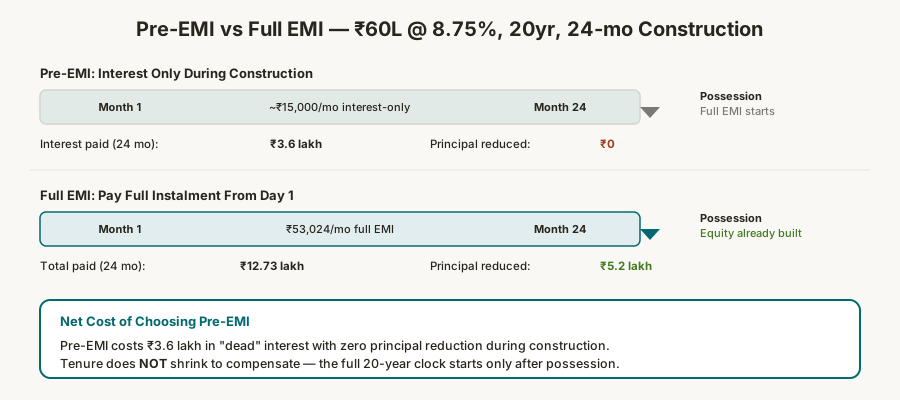
Under the pre-EMI option, you pay only the interest accrued on the disbursed amount each month. No principal is repaid during the construction phase. Full EMI (principal + interest on the total ₹56 lakh) begins only after possession.
Pre-EMI calculation for our scenario:
- Monthly rate: 8.75% ÷ 12 = 0.7292% per month
- After tranche 1 (₹20 lakh disbursed): Pre-EMI = ₹20,00,000 × 0.7292% = ₹14,583/month
- After tranche 2 (₹40 lakh outstanding): Pre-EMI = ₹40,00,000 × 0.7292% = ₹29,167/month
| Phase | Duration | Monthly Pre-EMI | Total Interest Paid |
|---|---|---|---|
| Months 1–12 (₹20L outstanding) | 12 months | ₹14,583 | ₹1,74,996 |
| Months 13–24 (₹40L outstanding) | 12 months | ₹29,167 | ₹3,50,004 |
| Total pre-EMI interest (24 months) | ₹5,25,000 |
After possession (month 24), full EMI on the complete ₹56 lakh begins. Use our home loan EMI calculator to verify: ₹56 lakh at 8.75% for 20 years gives a monthly EMI of ₹49,488.
| Phase | Duration | Monthly EMI | Total Paid |
|---|---|---|---|
| Construction (pre-EMI) | 24 months | ₹14,583 → ₹29,167 | ₹5,25,000 |
| Repayment post-possession | 240 months | ₹49,488 | ₹1,18,77,120 |
| Grand total (pre-EMI path) | ₹1,24,02,120 | ||
| Total interest (pre-EMI path) | ₹68,02,120 |
Note: Under this path, you pay ₹5.25 lakh before your principal even starts reducing. Check the full amortization breakdown using our amortization calculator after possession to see exactly how the interest-principal split evolves over 20 years.
Full EMI Explained: Principal + Interest from Day One
Under the full EMI option, you elect to pay the complete EMI (principal + interest) from the date of each tranche disbursement — even during construction. The advantage: your principal starts reducing from day one.
In practice, most lenders structure this as: you pay a full EMI on the entire sanctioned loan amount from the date of first disbursement, running the loan for the complete tenor of 22 years (24 months construction + 20-year repayment).
Full EMI on ₹56 lakh, 8.75%, 22 years (264 months):
Using the standard formula: EMI = P × r × (1+r)^n / ((1+r)^n − 1)
= ₹56,00,000 × 0.007292 × (1.007292)^264 / ((1.007292)^264 − 1) = ₹47,865/month
| Metric | Full EMI Option (22 years) |
|---|---|
| Monthly EMI | ₹47,865 |
| Total amount paid (264 months) | ₹1,26,36,360 |
| Total interest | ₹70,36,360 |
Wait — that looks like the full EMI option is more expensive? Let's do the proper comparison.
The Real Comparison: Pre-EMI Path vs Full EMI Path
The right way to compare is to hold the effective tenure constant at 22 years total (24 months construction + 20 years repayment) and compare total interest:
| Metric | Pre-EMI Path | Full EMI Path (22 yr) | Difference |
|---|---|---|---|
| Monthly payment during construction | ₹14,583–₹29,167 | ₹47,865 (fixed) | Full EMI higher by ₹18K–₹33K/month |
| Monthly EMI after possession | ₹49,488 | ₹47,865 | Pre-EMI higher by ₹1,623/month |
| Total interest paid | ₹68,02,120 | ₹70,36,360 | Pre-EMI cheaper by ₹2,34,240 |
| Principal repaid during construction | ₹0 | ₹1,00,000+ (approx) | Full EMI builds equity |
| Loan outstanding at possession | ₹56,00,000 | ~₹54,60,000 | Full EMI lower by ~₹1.4 lakh |
The pre-EMI path turns out to be modestly cheaper in total interest (by about ₹2.34 lakh over the life of the loan) — because the interest-only pre-EMI payments are lower than the full EMI, meaning less money is deployed against the same principal. However, this ignores the tax dimension, which often reverses the advantage.
The Tax Dimension: Where Full EMI Gains a Decisive Edge
This is the section that most financial advisors skip — and it's the most important factor for borrowers in the 20% or 30% tax slab.
Pre-EMI interest: deferred deduction with a strict cap
Under the Income Tax Act (Section 24(b)), interest paid during the construction period (the pre-EMI phase) cannot be claimed as a deduction in the year it is paid. It must be accumulated and then claimed in 5 equal instalments starting from the year of possession.
For our ₹5.25 lakh total pre-EMI interest:
- Annual deduction from possession year: ₹5,25,000 ÷ 5 = ₹1,05,000/year for 5 years
- This is in addition to the regular annual interest deduction post-possession
Critical constraint: Section 24(b) caps the combined deduction at ₹2 lakh/year for self-occupied property under the Old Tax Regime. In the years immediately after possession, your regular post-possession interest is already high (e.g., year 1 after possession: approximately ₹4.07 lakh in interest on ₹56 lakh at 8.75%). You can only claim ₹2 lakh against that ₹4.07 lakh — the ₹1.05 lakh pre-EMI instalment gets absorbed into that ₹2 lakh cap, not added on top. Effectively, for most borrowers, the pre-EMI interest deduction is partially or fully wasted due to the ₹2 lakh ceiling.
Use our home loan tax calculator to model exactly how much of your pre-EMI interest you can actually claim given your post-possession interest and the Section 24(b) cap.
Under the New Tax Regime (default from FY2023–24): Section 24(b) for self-occupied property is NOT available at all. If you are on the new regime, the pre-EMI interest deduction is zero.
Full EMI during construction: 80C benefit on principal
When you pay full EMI during the construction phase, a portion of each payment goes toward principal repayment. That principal repayment qualifies for Section 80C deduction (up to ₹1.5 lakh combined annual limit) — even during construction.
Pre-EMI borrowers pay no principal during construction, so they get zero 80C benefit during those 24 months.
Tax benefit comparison (Old Tax Regime, 30% slab):
| Tax benefit | Pre-EMI path | Full EMI path |
|---|---|---|
| 80C during construction (24 months) | ₹0 | Up to ₹90,000 (₹45K/yr × 2 yr) |
| Tax saved on 80C (30% slab) | ₹0 | ~₹27,000 |
| 24(b) during construction | ₹0 (deferred) | ₹0 (under construction, not claimable until possession) |
| Pre-EMI interest deduction (5-yr split) | Partially wasted due to ₹2L cap | N/A |
For a detailed explanation of all home loan tax benefits, read our guide on home loan tax benefits under Section 24(b) and 80C.
When Pre-EMI Makes Sense
Despite the tax disadvantage, pre-EMI is the right call in specific situations:
1. Cash flow is genuinely constrained. If you are currently paying rent (₹15,000–₹25,000/month) in addition to the pre-EMI, and full EMI of ₹47,865 would push your FOIR above 50%, pre-EMI is not just convenient — it may be the only viable option. Banks themselves will insist on it if your income doesn't support full EMI.
2. Construction timeline is short (under 12 months). If possession is within a year, the pre-EMI interest accumulation is minimal (₹14,583/month on ₹20 lakh = ₹1.75 lakh total) and the cash flow relief is meaningful. The tax inefficiency barely matters over such a short window.
3. You have surplus funds earmarked for investment. The ₹18,000–₹33,000/month difference between full EMI and pre-EMI during construction could be deployed in a liquid fund or ELSS. If your post-tax investment return exceeds the 8.75% home loan rate (effectively 6.1% post-tax benefit in the Old Regime), you come out ahead. This requires genuine investment discipline.
4. You are on the New Tax Regime. Since neither pre-EMI interest nor full EMI principal/interest gives you a Section 24(b) deduction under the new regime, the tax argument for full EMI disappears. The decision reduces to pure cash flow — and pre-EMI wins on monthly outgo.
When Full EMI Makes Sense
1. Long construction timeline (18–36 months). Every additional month of pre-EMI is pure interest expense with no principal reduction. On ₹40 lakh outstanding, that's ₹29,167/month that builds zero equity. Over 36 months at that level, pre-EMI interest alone would cross ₹10 lakh — a substantial dead cost.
2. You are on the Old Tax Regime and expect to stay there. Full EMI's 80C benefit during construction is real money for the 30% slab: ₹27,000 in tax savings over 24 months, which partially offsets the higher monthly outgo.
3. You want lower post-possession EMI. Because full EMI payments reduce principal during construction, the outstanding loan at possession is slightly lower (approximately ₹54.6 lakh vs ₹56 lakh). The post-possession EMI under full EMI (₹47,865) is ₹1,623/month lower than under the pre-EMI path (₹49,488) — a saving of ₹19,476/year for 20 years.
4. You worry about builder delays. Under pre-EMI, every month of delay is an extra ₹29,167 in interest with zero benefit to you. Under full EMI, the same delay month still reduces your principal — you are not just bleeding interest into a void.
What If the Builder Delays Possession?
Builder delays are the single biggest hidden risk of the pre-EMI option. India's real estate history is full of projects that promised 24-month delivery and delivered in 48–60 months. Under pre-EMI, each extra month is additional interest outgo that never reduces principal.
Delay impact (pre-EMI scenario, ₹40L outstanding from month 12 onward):
| Delay | Extra Pre-EMI Interest | Total Pre-EMI Interest |
|---|---|---|
| No delay (possession at month 24) | — | ₹5,25,000 |
| 6-month delay (possession at month 30) | ₹1,75,000 | ₹7,00,000 |
| 12-month delay (possession at month 36) | ₹3,50,000 | ₹8,75,000 |
| 24-month delay (possession at month 48) | ₹7,00,000 | ₹12,25,000 |
A 24-month delay more than doubles your pre-EMI interest burden — from ₹5.25 lakh to ₹12.25 lakh — with your principal completely untouched.
RERA protections: Under RERA (Real Estate Regulation and Development Act), if the builder delays possession, you are entitled to compensation at the home loan interest rate for the delayed period. However, enforcement is uneven across states, and litigation takes time. RERA does not eliminate the interest outgo — it only creates a claim you must pursue separately.
Practical protection: If builder delays beyond 6 months are a realistic risk, consider switching to full EMI or making voluntary principal prepayments to reduce the outstanding loan. Use our prepayment calculator to model how a lump-sum payment during construction reduces both the outstanding principal and future interest.
Switching Between Pre-EMI and Full EMI
Most lenders allow borrowers to switch from pre-EMI to full EMI mid-construction. The process:
- Submit a written request to the bank's home loan servicing centre
- Bank recalculates EMI on the then-outstanding principal for the remaining combined tenure
- New full EMI starts from the following month's billing cycle
The reverse — switching from full EMI to pre-EMI — is less common and may not be permitted by all lenders. Confirm your lender's policy at the time of loan sanction.
Trigger for switching: If the builder announces a delay of more than 6 months, consider switching immediately. Every month you stay on pre-EMI after a delay is confirmed is avoidable interest expense.
Complete Cost Comparison Summary
For a ₹56 lakh loan at 8.75% with 24-month construction:
| Metric | Pre-EMI Path | Full EMI Path (22 yr) |
|---|---|---|
| EMI during construction | ₹14,583–₹29,167 | ₹47,865 |
| EMI post-possession | ₹49,488 (20 yr) | ₹47,865 (continues) |
| Interest during construction | ₹5,25,000 | Included in 22-yr tenure |
| Total interest (full tenure) | ₹68,02,120 | ₹70,36,360 |
| 80C benefit during construction | ₹0 | Up to ₹90,000 (Old Regime) |
| Tax saved at 30% slab (80C) | ₹0 | ~₹27,000 |
| Effective total cost (after 80C tax benefit) | ₹68,02,120 | ~₹70,09,360 |
| Risk if delayed 12 months | +₹3,50,000 interest | No change |
The pre-EMI path is cheaper by approximately ₹2.34 lakh in gross interest — but the full EMI path recovers ~₹27,000 through 80C savings for Old Regime borrowers, narrowing the gap to ₹2.07 lakh. On a builder delay of 6+ months, the pre-EMI advantage disappears entirely.
Frequently Asked Questions
Is pre-EMI tax deductible?
Pre-EMI interest is not deductible in the year it is paid. Under the Old Tax Regime, it accumulates as "pre-construction interest" and is deducted in 5 equal instalments starting from the year of possession (Section 24(b)). However, since post-possession interest is typically far higher than the ₹2 lakh annual cap for self-occupied property, the pre-construction instalment often gets fully absorbed into the cap — effectively providing zero additional tax benefit. Under the New Tax Regime (default since FY2023–24), Section 24(b) for self-occupied property is not available at all, so pre-EMI interest gives you no deduction under any circumstance.
Can I switch from pre-EMI to full EMI mid-construction?
Yes, most lenders permit a switch from pre-EMI to full EMI during the construction phase. You submit a written request, the lender recalculates the EMI on the outstanding principal for the remaining tenure, and full EMI starts from the next billing cycle. The switch cannot be backdated. Some lenders charge a nominal fee (₹500–₹2,000) for restructuring. Switching back from full EMI to pre-EMI is not commonly offered — confirm your lender's specific policy at sanction.
Does pre-EMI affect CIBIL score?
Pre-EMI payments are reported to credit bureaus in the same way as any EMI — timely payments improve your CIBIL score and defaults hurt it. Your loan account appears on your CIBIL report from the date of first disbursement, not from possession. One important nuance: during the pre-EMI phase, your utilisation of the sanctioned limit increases with each tranche, which banks assess differently from a revolving credit limit. On balance, timely pre-EMI payments are good for your credit profile.
What happens to pre-EMI interest if the builder delays?
You continue paying interest on the outstanding disbursed amount for every month of delay. If the builder delays possession by 12 months on a ₹40 lakh outstanding, you pay an additional ₹3.5 lakh in pre-EMI interest with zero principal reduction. RERA entitles you to compensation from the builder at the home loan interest rate — but this requires filing a complaint with the state RERA authority and may take months to resolve. The pre-EMI interest outflow does not pause during the dispute. This is the strongest argument for full EMI on projects with uncertain delivery timelines.
Which option do banks prefer — pre-EMI or full EMI?
Banks are indifferent — both options generate the same revenue for the bank. The choice is entirely the borrower's. Many banks default to pre-EMI and offer full EMI only on request, because pre-EMI is easier to explain and results in lower monthly outgo during construction (which helps the borrower qualify). If you want full EMI, explicitly request it at the time of loan sanction — ask the bank to structure the loan as a 22-year (or 24-year) loan starting immediately rather than a 20-year loan starting at possession.
Does the pre-EMI period count towards loan tenure?
Under the standard pre-EMI structure, the pre-EMI period does NOT count towards the loan tenure. The 20-year repayment tenure starts only at possession. This means if construction takes 24 months and repayment runs 20 years, your total loan relationship with the bank is 22 years — but the amortization schedule reflects only the 20-year post-possession period. Under the full EMI option, the entire 22 years is counted as the loan tenure, and the amortization schedule runs from day one. This distinction matters for senior borrowers approaching retirement — a 24-month construction delay on a notional 20-year tenure could push the effective loan closure date past 65–70 years of age.
Try the calculator
Run your own numbers in seconds. Pick the calculator that fits your loan type.