Best Home Loan Banks in India 2026 — Rates, Fees & Hidden Catches Compared
SBI, HDFC, ICICI, Axis, Kotak, and LIC Housing compared on what actually matters — effective rate, processing fees, prepayment terms, disbursal speed, and the catches buried in the fine print.
Key Takeaways
- Headline rates range from 8.15% (Bank of Baroda, prime profiles) to 10.50%+ (housing finance companies for subprime borrowers). SBI starts at 8.50%, HDFC Bank at 8.75%.
- The cheapest headline rate is rarely the cheapest loan — processing fees, insurance bundling, and floor rates matter enormously.
- Bank of Baroda offers the lowest floor rate; SBI has the lowest processing fee cap (₹10,000) but the slowest disbursal. HDFC Bank offers the fastest approval.
- For a ₹50 lakh, 20-year loan, a 0.5% rate difference adds up to ₹3.8 lakh in extra interest.
Home loan rates in India in 2026 are broadly linked to the RBI's repo rate (5.25% as of August 2026, after four cuts in 2025 totalling 125 bps) via EBLR (External Benchmark Lending Rate). Every major bank's floating rate moves with the repo rate — in theory. In practice, the spread above EBLR that your bank charges is where the real competition happens, and where most borrowers leave money on the table.
This comparison covers the seven lenders that originate the majority of home loans in India: SBI, HDFC Bank, ICICI Bank, Axis Bank, Kotak Mahindra Bank, Bank of Baroda, and LIC Housing Finance. You can model any of these rates against your own loan amount with the home loan EMI calculator.
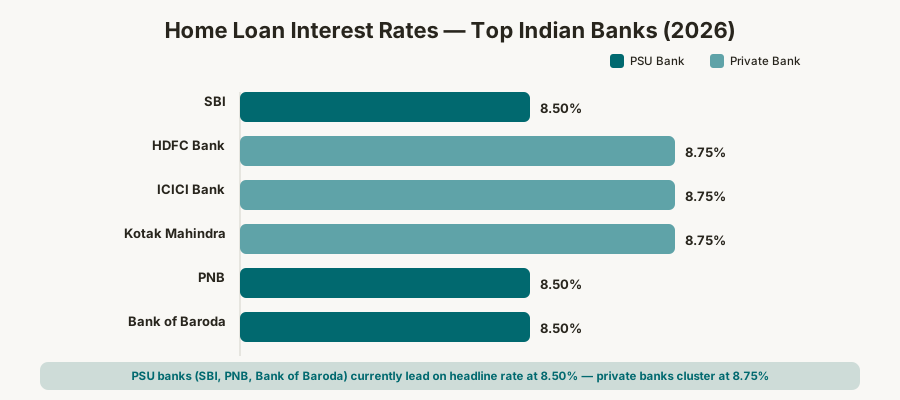
The Rate Comparison at a Glance
| Lender | Rate Range | Processing Fee | Prepayment Penalty | Disbursal Speed |
|---|---|---|---|---|
| Bank of Baroda | 8.15% – 9.50%+ | 0.25% (max ₹7,500) | Nil | 12–20 days |
| SBI | 8.50% – 9.50%+ | 0.35% (max ₹10,000) | Nil | 15–25 days |
| LIC Housing | 8.50% – 9.50%+ | ₹10,000–₹15,000 flat | Nil | 15–20 days |
| HDFC Bank | 8.75% – 9.65%+ | Up to 0.5% (often waived) | Nil | 5–10 days |
| ICICI Bank | 8.75% – 9.50%+ | 0.5–1% + GST | Nil | 7–12 days |
| Axis Bank | 8.75% – 9.50%+ | 0.5–1% (negotiable) | Nil | 7–14 days |
| Kotak Mahindra | 8.75% – 9.50%+ | 0.5% + GST | Nil | 10–15 days |
All rates shown are for salaried borrowers with CIBIL score 750+. Rates for self-employed borrowers are typically 25–50 bps higher.
SBI Home Loan — Best for Rate-Conscious Borrowers
SBI (State Bank of India) remains the benchmark for home loan pricing in India. Its EBLR-linked rate structure is the most transparent in the industry — the spread above EBLR is published and generally lower than private peers.
What makes SBI stand out
Rate floor: SBI's floor rate (the minimum rate any borrower pays regardless of EBLR movements) is among the lowest in the market. When RBI cuts rates, SBI passes them on fully and immediately.
No prepayment penalty: Mandated by RBI for all floating-rate loans, but SBI's internal policies around part-payments are also clean — no restrictions on frequency or minimum amount (beyond ₹10,000).
Processing fee cap: At ₹10,000 maximum, SBI's processing fee is a steal for large loans. On a ₹80 lakh loan, peers charge ₹30,000–₹60,000 in processing fees. SBI charges ₹10,000.
The catch
SBI's physical documentation requirements remain the most stringent in the industry. Expect 3–4 branch visits, physical copies of most documents, and 15–25 business days from application to disbursal. For under-construction properties or builder deals with tight timelines, SBI is often not practical.
Best for: Government employees, PSU staff, and self-employed borrowers with comprehensive documentation who can afford to wait.
HDFC Bank Home Loan — Best for Speed and Service
HDFC Bank (which absorbed HDFC Ltd in 2023) is the private sector benchmark — fastest disbursal, best digital experience, and a customer service operation that is genuinely responsive.
What makes HDFC stand out
Disbursal speed: HDFC Bank can disburse in 5–7 business days for ready-possession properties with clean titles. For competitive builder deals, this speed can be the difference between getting the property and losing it.
Digital application: HDFC's online application and HDFC Bank branch network makes document collection seamless. Video KYC, digital salary slip verification, and e-stamping are fully integrated.
Negotiating room: HDFC routinely offers processing fee waivers (full or 50%) during festive offers and for salary-account holders. The displayed rate is not the final rate — prime borrowers can negotiate 10–25 bps off the displayed spread.
The catch
HDFC's base rate is 20–30 bps higher than SBI's for equivalent profiles. On a ₹50 lakh, 20-year loan, that difference costs ~₹1.1 lakh more in total interest. Also, HDFC has historically been slower to pass on RBI rate cuts compared to pure EBLR-linked products at SBI and ICICI.
Best for: Salaried professionals in metros who need speed, a strong digital experience, and are willing to pay a small premium for it.
ICICI Bank Home Loan — Best for Digital Borrowers
ICICI Bank offers one of the most robust digital home loan journeys in India — instant in-principle approvals, video KYC, and a tracking dashboard that updates in real time.
What makes ICICI stand out
Instant in-principle approval: For salaried borrowers with ICICI salary accounts, in-principle approval (subject to property valuation) is generated in minutes online.
Competitive pricing for top profiles: ICICI's 8.75% floor rate for 800+ CIBIL borrowers is competitive. They also offer repo-linked rates (RLLR) that reset quarterly — ensuring rate cuts are passed on quickly.
Flexibility: ICICI offers step-up EMI plans, extended tenure options (up to 30 years), and balance transfer with top-up in a single transaction.
The catch
Processing fees at ICICI (0.5–1% + GST) are among the highest in the market. On a ₹60 lakh loan, that is ₹30,000–₹60,000 + GST before you even start. Also, ICICI's floor rate mechanism on legacy MCLR-linked loans has been criticized for being slow to pass on rate cuts. Ensure your loan is EBLR/RLLR linked.
Best for: Tech-savvy ICICI account holders who want a fully digital experience and have strong CIBIL profiles.
Axis Bank Home Loan — Best for Negotiators
Axis Bank operates with more pricing flexibility than most peers — their relationship managers have discretion to cut rates for the right borrower profiles.
What makes Axis stand out
Rate negotiability: For borrowers with CIBIL 780+ and a clean repayment history, Axis RMs can typically go 25–50 bps below the displayed rate. Bring a competing offer; Axis will usually match or beat it.
Repayment flexibility: Axis offers EMI holiday options (up to 3 months), step-up and step-down EMI structures, and a Flexi Loan product where you can withdraw and repay like an overdraft against your approved limit.
The catch
Processing fees are negotiable but can start high (displayed at 1%). The initial quoted rate for walk-in customers is rarely the best rate — you need to negotiate. This is an advantage if you're comfortable negotiating; a disadvantage if you take the first offer.
Best for: Experienced borrowers who know how to negotiate and want flexibility in repayment structure.
Kotak Mahindra Bank Home Loan — Best for HNI Borrowers
Kotak positions itself in the premium segment — relationship-based pricing for borrowers with higher incomes and larger loan sizes.
What makes Kotak stand out
Personalized relationship pricing: For loan amounts above ₹75 lakh, Kotak's RM-driven approach often delivers rates that match or beat SBI on a case-by-case basis.
Fast processing for HNI: Kotak's priority banking segment processes large loans with dedicated RMs, reducing timelines to 7–10 days for ready properties.
The catch
Kotak's branch network is thinner than SBI or ICICI outside major metros. Self-employed borrowers report variable experiences depending on their city and assigned RM. The processing fee (0.5% + GST) is standard but not waived as readily as HDFC.
Best for: High-income borrowers (₹25 lakh+ annual income) with loan requirements above ₹75 lakh, particularly in metros.
LIC Housing Finance — Best for Self-Employed and Non-Standard Profiles
LIC Housing Finance (LICHFL) is an HFC (Housing Finance Company), not a bank — which means it raises funds differently (bonds and NCDs rather than deposits). This historically made it slightly more expensive than SBI, but LICHFL has improved its pricing significantly and remains a strong option for borrowers that banks routinely reject.
What makes LIC Housing stand out
Fixed processing fee: ₹10,000 flat, regardless of loan size. For large loans (₹80 lakh+), this is significantly cheaper than percentage-based fees at banks.
Self-employed friendliness: LICHFL's underwriting team has deeper experience with non-standard income profiles — business owners, professionals with P&L-based income, and NRI borrowers.
Long tenure options: LICHFL offers loans up to 30 years for borrowers up to age 65 at maturity.
The catch
As an HFC, LIC Housing's cost of funds is typically 15–25 bps higher than SBI, which limits how low its rate can go. Rate reset lag after RBI cuts is also more pronounced than bank competitors.
Best for: Self-employed borrowers, professionals with non-standard income documentation, and NRI borrowers.
How to Actually Choose: A 5-Step Framework
Step 1: Get your CIBIL score
Check your score before approaching any lender. Under 750 and you should delay to improve it (see our CIBIL score guide). Above 780 and you have strong negotiating leverage everywhere.
Step 2: Apply to 3 lenders simultaneously
Applying to multiple lenders does not significantly affect your score if done within 45 days (CIBIL's documented rate-shopping window — multiple home loan inquiries within this period are treated as a single inquiry). Before applying, estimate how much you can borrow using our loan eligibility calculator.
Step 3: Compare total cost, not just EMI
Use our home loan EMI calculator to compute total interest paid over the full tenure for each offer. Add processing fees and any mandatory insurance to get the true cost of borrowing.
Step 4: Negotiate with sanction letters in hand
Once you have two or three offers, go back to your preferred lender with the best competing offer and ask them to beat it. Banks routinely drop 10–25 bps to retain a good borrower. Use our compare loans tool to put the two offers side by side on total interest paid.
Step 5: Read the fine print on rate resets
Ask specifically: "Is my rate linked to EBLR or RLLR? How often does it reset? What is the floor rate?" A loan linked to MCLR or base rate is inferior — it may not pass on RBI rate cuts fully or promptly. Check the current bank lending rates to see where each lender stands today.
Frequently Asked Questions
Which bank gives the lowest home loan interest rate in India in 2026?
Bank of Baroda offers the lowest starting rate at 8.15% for prime borrowers (CIBIL 800+, salaried government employees) as of August 2026. SBI and LIC Housing Finance start at 8.50%. Private banks (HDFC Bank, ICICI, Axis, Kotak) start at 8.75% but may match PSU rates for top profiles through negotiation.
Can I get a home loan at 8% in 2026?
Not from a mainstream lender. With the repo rate at 5.25% and bank EBLR spreads of roughly 2.65%, the EBLR floor itself sits near 7.90% — before any borrower-specific spread is added. That makes a sub-8% offer structurally implausible in August 2026. The realistic best case is 8.15% at Bank of Baroda for a CIBIL 800+ salaried government employee with LTV below 80%. Treat any advertised rate materially below that as a teaser rate that resets after 1–3 years, or as a quote that excludes mandatory insurance bundling — ask for the effective annualised cost in writing before committing.
Is HDFC bank or SBI better for home loans?
SBI is better if you prioritize the lowest rate and have time for a slower process. HDFC is better if you need speed, a strong digital experience, and are comfortable paying 20–30 bps more for the service premium.
Do home loan interest rates differ for women borrowers?
Yes. SBI, HDFC, and several other lenders offer a 5 bps concession for women as the primary or co-applicant. Stamp duty concessions for women co-applicants are also available in many states. This is a small but worth-capturing saving.
Can I negotiate my home loan processing fee?
Yes — processing fees are negotiable at all private banks, especially during festive offers (October–January) or for salary-account holders. HDFC, ICICI, and Axis regularly offer 50–100% processing fee waivers on campaigns. Always ask.
What is EBLR and how does it affect my home loan rate?
EBLR stands for External Benchmark Lending Rate. Since October 2019, all new floating-rate retail loans (including home loans) must be linked to an external benchmark — either the RBI repo rate or a T-bill rate. This means when the RBI cuts the repo rate, your home loan rate must be revised within 3 months. It is more transparent and borrower-friendly than the old MCLR system. With the repo rate at 5.25% (as of August 2026), EBLR-linked borrowers have benefited from the full 125 bps of cuts made across February, April, June and December 2025.
Should I go for a fixed or floating rate home loan in 2026?
Floating rate. With the RBI expected to maintain or cut rates through 2026–27, a floating-rate loan allows you to benefit from any reductions. Fixed-rate home loans in India are typically 100–150 bps higher than floating rates, and most lenders reset them periodically anyway.
Try the calculator
Run your own numbers in seconds. Pick the calculator that fits your loan type.