Fixed vs Floating Interest Rate Home Loan — Which Is Better in 2026?
Fixed rates give certainty; floating rates are cheaper and pass on RBI cuts. With the RBI in a rate-cutting cycle in 2026, the math and logic both favour floating — but the nuances matter.
Key Takeaways
- Floating rates in 2026 start 100–150 bps below fixed rates — saving ₹56,000–₹84,000 in year-one interest on a ₹60 lakh loan.
- All new floating-rate home loans are linked to EBLR (repo rate) — RBI rate cuts pass through within 3 months.
- Fixed rates are not truly fixed for 30 years in India — most lenders reset them every 3–5 years.
- For most 2026 borrowers, floating is the better choice. Fixed makes sense only for highly risk-averse borrowers or when rates are at multi-year lows.
The fixed vs. floating rate question is one of the oldest debates in home loan planning. In 2026, with the RBI having completed a rate-easing cycle (repo rate at 5.25%, down from 6.50% in early 2025 — a 125 bps reduction across four cuts), the answer is clearer than it's been in years — but it's still worth understanding the full picture before signing a 20-year commitment.
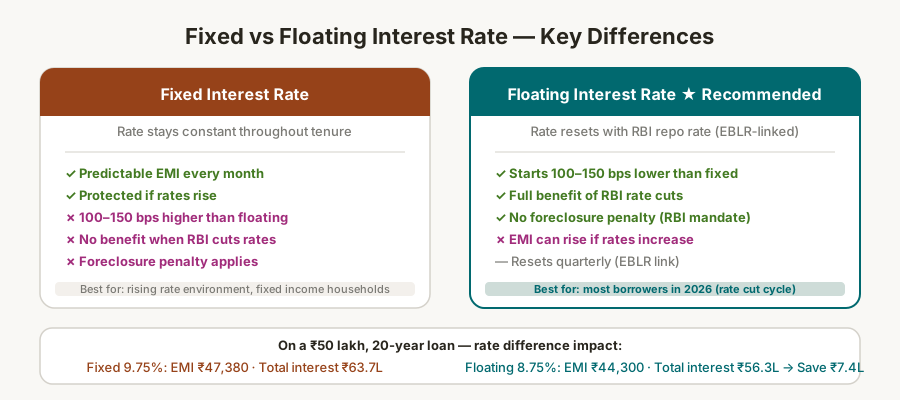
How Each Rate Type Works
Fixed interest rate home loan
The interest rate is locked at the time of sanction and does not change during a specified period. In theory, this means your EMI stays constant regardless of what RBI does with the repo rate.
The catch in India: Very few lenders offer truly fixed rates for the full loan tenure. Most "fixed" home loan products in India are:
- Fixed for an initial period (typically 3–7 years), then automatically converting to floating
- Fully fixed but with a reset clause every 3–5 years allowing the lender to revise the rate
A 20-year "fixed" rate home loan from SBI or HDFC typically has reset provisions. Ask explicitly: "Is this rate fixed for the full tenure, or does it reset?"
Floating interest rate home loan
The rate is linked to an external benchmark — since October 2019, RBI mandates all new floating-rate retail loans to be linked to EBLR (External Benchmark Lending Rate), which is directly tied to the RBI repo rate.
Your home loan rate = EBLR + Spread (lender-determined)
When the RBI cuts or raises the repo rate, EBLR moves by the same amount, and your rate adjusts within 3 months. The spread set by the lender at the time of sanction remains constant. Check current EBLR-linked rates across banks to see today's effective home loan rates.
The Rate Difference in 2026
| Loan Type | Rate Range | Representative Rate |
|---|---|---|
| Floating (EBLR-linked) | 8.15–9.65% | 8.75% |
| Fixed (initial period) | 9.50–11.00% | 10.00% |
| Gap | 100–150 bps | 125 bps |
This 125 bps difference has massive compounding implications:
| Loan: ₹60 lakh, 20 years | Fixed (10%) | Floating (8.75%) | Difference |
|---|---|---|---|
| Monthly EMI | ₹57,901 | ₹53,023 | ₹4,878/month |
| Year-1 interest | ₹5,96,000 | ₹5,20,000 | ₹76,000 |
| Total interest (20 yrs) | ₹78.96 lakh | ₹67.26 lakh | ₹11.71 lakh |
Over 20 years, the floating rate borrower saves ₹11.71 lakh at the current rate differential — even before any further RBI rate cuts. Use our home loan EMI calculator to model the fixed vs. floating EMI difference for your own loan amount and tenure.
Why Floating Is Better in 2026 Specifically
RBI rate-cutting cycle
The RBI cut the repo rate by 125 bps through four moves in 2025 (from 6.50% to 5.25%), and has held rates steady at 5.25% through all four 2026 MPC meetings so far (February, April, June and August). Floating rate borrowers have already benefited from every cut automatically. Fixed rate borrowers who locked in before 2025 missed the entire easing cycle.
RBI ban on floating-rate prepayment penalties
For floating-rate home loans, lenders cannot charge prepayment penalties. For fixed-rate loans, penalties of 2–4% apply on foreclosure. This significantly hampers the fixed-rate borrower's ability to pay down the loan early or refinance.
The spread is locked; only the benchmark moves
When you take a floating rate loan, the spread your lender charges is fixed in your loan agreement. Only the EBLR component changes with RBI policy. So you benefit from rate cuts but your lender's margin (spread) is contractually protected.
When Fixed Rate Makes Sense
Despite the clear 2026 advantage of floating, fixed rates have valid use cases:
1. You're borrowing near a cyclical rate low
If rates are at multi-decade lows (as they were globally in 2020–21), locking in a fixed rate for 5–7 years protects against the rate cycle reversing. In mid-2026, rates are moderately high and trending down — not the classic scenario for locking in a fixed rate.
2. Highly risk-averse or fixed-income households
If a rate increase of ₹2,000–₹5,000/month would genuinely threaten your ability to service the loan, the certainty of a fixed EMI has real value. Peace of mind has a price — and for some borrowers, it's worth paying 125 bps for it.
3. Short-tenure loans (under 5 years)
For short tenures, the fixed-rate premium is a smaller absolute amount, and the predictability of the fixed EMI may be valued. For 15–30 year home loans, the compounding disadvantage of a fixed rate is too significant to ignore.
Semi-Fixed (Hybrid) Options
Some lenders offer hybrid products: fixed for 3–5 years, then converting to floating. This provides initial EMI certainty during early years (typically when households are most financially stretched by the purchase) while eventually capturing rate cuts.
| Product | Initial Period | After Fixed Period |
|---|---|---|
| SBI Hybrid Loan | Fixed 2–3 years | Converts to EBLR floating |
| HDFC FlexiPay | Fixed 3 years | Converts to floating |
| Axis Bank Hybrid | Fixed 5 years | Converts to floating |
These can be a reasonable compromise if you want 3–5 years of EMI certainty but don't want to pay the full 20-year fixed rate premium.
The MCLR Trap — What to Avoid
Before October 2019, home loans were linked to MCLR (Marginal Cost of Funds-based Lending Rate) — an internal rate set by each bank. MCLR-linked loans pass on rate cuts more slowly and incompletely than EBLR-linked loans.
If you have an older home loan still linked to MCLR:
- Check your loan agreement
- Request a switch to EBLR (most banks allow this for a nominal fee of ₹1,000–₹5,000)
- You'll immediately start getting full benefit of RBI rate cuts
This switch is one of the quickest and easiest ways to reduce your loan cost. Once you switch, use our amortization calculator to see how your interest-vs-principal breakdown changes going forward.
Frequently Asked Questions
Is floating rate home loan risky?
Floating rates carry the risk of rate increases — if the RBI raises the repo rate, your EMI increases. However, RBI rate movements are gradual (typically 25–50 bps per cycle) and transparent. The risk is manageable, and the long-term average benefit of floating rates over fixed rates is significant.
What happens to my floating rate home loan EMI if RBI raises rates?
Most lenders keep your EMI constant and instead extend the loan tenure. Some increase the EMI directly. Ask your lender upfront: "How will rate increases be handled — EMI revision or tenure extension?" Knowing this in advance helps you plan.
Can I switch from fixed to floating rate home loan?
Yes, with your existing lender for a fee (typically 0.5–2% of outstanding balance). Alternatively, a balance transfer to a new lender with a floating rate product effectively achieves the same outcome, often with better rates. See our home loan balance transfer guide.
What is the current EBLR rate?
EBLR at each bank = RBI Repo Rate (5.25% as of August 2026) + an internal adjustment. SBI's EBLR is typically 2.65% above the repo rate — making SBI's EBLR approximately 7.90% in August 2026. Your home loan rate = EBLR + the spread agreed at sanction.
Should I pay more EMI to offset floating rate risk?
Yes — a common strategy is to continue paying your current (higher) EMI even after a rate cut, directing the surplus to principal reduction. This builds a buffer that absorbs future rate increases and reduces tenure. Use our prepayment calculator to model this.
Try the calculator
Run your own numbers in seconds. Pick the calculator that fits your loan type.