Personal Loan Balance Transfer 2026 — Lower EMI & Save Interest
A personal loan balance transfer at 5% lower rate on ₹5 lakh saves ₹44,244 in 3 years — this guide shows exactly when and how to do it.
Key Takeaways
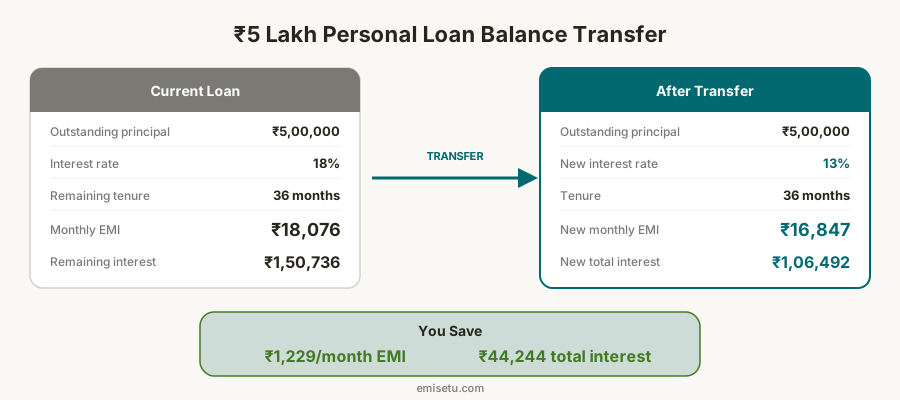
- Transferring a ₹5 lakh personal loan from 18% to 13% with 36 months remaining cuts your EMI from ₹18,076 to ₹16,847 — saving ₹44,244 in total interest.
- At a 5% rate difference, break-even on a ₹10,000 switching cost is just 9 months — after which every rupee saved is net gain.
- Personal loan balance transfers are rarely worth it when fewer than 12 months remain, because the gross interest saving is smaller than the switching cost.
- RBI prohibits prepayment penalties on floating-rate personal loans. Fixed-rate loans may carry a foreclosure charge of 2–4% — factor this into your break-even calculation.
You took a personal loan at 18% two years ago when it was the best offer available. Now, a competing bank is advertising 13%. That 5% gap matters: on ₹5 lakh with 3 years remaining, it represents ₹44,244 in interest you could avoid paying. A personal loan balance transfer is exactly what it sounds like — you move your outstanding loan balance to a lower-rate lender and instantly shrink both your EMI and your total repayment. But not every transfer is worth the paperwork and switching cost. This guide walks through the precise break-even math, what the process involves, and the situations where it is — and is not — the right move.
What Is a Personal Loan Balance Transfer?
A personal loan balance transfer (also called personal loan refinancing or takeover) moves your outstanding personal loan principal from your current lender to a new lender offering a lower interest rate. The new lender pays off your existing lender, and you now repay the same outstanding principal at the new, lower rate.
Unlike a home loan balance transfer, there is no property security involved — the transfer is purely an unsecured loan swap. This makes it faster (typically 7–15 working days) but also means lenders scrutinise your creditworthiness afresh, as if you were applying for a new personal loan.
The Core Scenario: ₹5 Lakh, 18% to 13%, 36 Months Remaining
To make the numbers concrete, consider this benchmark scenario that we will reference throughout this guide.
Outstanding principal: ₹5 lakh Current rate: 18% per annum New rate after transfer: 13% per annum Remaining tenure: 36 months
| Current Loan (18%) | After Transfer (13%) | |
|---|---|---|
| Monthly EMI | ₹18,076 | ₹16,847 |
| Total repayment (36 months) | ₹6,50,736 | ₹6,06,492 |
| Total interest paid | ₹1,50,736 | ₹1,06,492 |
| Gross interest saving | ₹44,244 | |
| Monthly EMI saving | ₹1,229 |
Use the personal loan EMI calculator to run the same comparison for your outstanding balance and rates before committing to a transfer.
Break-Even Calculation
A balance transfer is not free. Typical costs include:
- Processing fee on new loan: 1–3% of loan amount (₹5,000–₹15,000 on a ₹5 lakh loan)
- Foreclosure charge on old loan: 2–4% if fixed rate (₹10,000–₹20,000); nil if floating rate
- Documentation / administrative charges: ₹500–₹2,000
Assuming a total switching cost of ₹10,000 (2% processing fee, floating-rate old loan so no foreclosure charge):
Break-even months = Switching cost ÷ Monthly EMI saving
                  = ₹10,000 ÷ ₹1,229
                  = 9 months
After 9 months, the transfer has paid for itself. With 36 months remaining, the net saving after costs is ₹44,244 − ₹10,000 = ₹34,244.
Run your own numbers instantly using the balance transfer calculator — enter your outstanding principal, current rate, new rate, and switching cost to get the break-even month and net saving for your specific situation.
Use a prepayment calculator to model how making additional lump-sum payments after the transfer can further accelerate your payoff timeline and reduce total interest below even this figure.
When Does a Personal Loan Balance Transfer Make Sense?
The key variable is whether the break-even period falls within your remaining tenure. Shorter remaining tenure means less time to recover the switching cost.
Decision Table: Is the Transfer Worth It?
The table below uses the same ₹5 lakh principal, 18% → 13% rate switch, and ₹10,000 switching cost.
| Remaining Tenure | Old EMI | New EMI | Monthly Saving | Gross Interest Saving | Break-even | Worth It? |
|---|---|---|---|---|---|---|
| 6 months | ₹87,763 | ₹86,521 | ₹1,242 | ₹7,452 | 9 months | No — break-even exceeds tenure |
| 12 months | ₹45,840 | ₹44,659 | ₹1,181 | ₹14,172 | 9 months | Yes — recovers cost in 9 of 12 months |
| 24 months | ₹24,962 | ₹23,771 | ₹1,191 | ₹28,584 | 9 months | Yes — net saving ₹18,584 |
| 36 months | ₹18,076 | ₹16,847 | ₹1,229 | ₹44,244 | 9 months | Yes — net saving ₹34,244 |
Rule of thumb: With a 5% rate reduction, break-even is approximately 9 months regardless of remaining tenure, because the monthly saving is roughly proportional to the EMI at any tenure. For a transfer to make sense, you need at least 12+ months remaining. The longer the remaining tenure, the greater the net gain.
What Rate Difference is Enough?
A small rate difference (under 2%) on a short-remaining loan typically does not justify the effort. With an 18% → 16% switch (2% gap, ₹10,000 switching cost):
| Remaining Tenure | Monthly Saving | Break-even | Worth It? |
|---|---|---|---|
| 6 months | ₹498 | 21 months | No |
| 12 months | ₹475 | 22 months | No |
| 24 months | ₹480 | 21 months | Yes (barely) |
| 36 months | ₹497 | 21 months | Yes |
Minimum threshold: A 2% rate reduction needs at least 24 months remaining to recover a ₹10,000 switching cost. A 5% reduction needs only 12 months. The general guidance is: rate gap × remaining tenure must be sufficient to cover all switching costs — calculate the exact break-even before proceeding.
Costs Involved in a Personal Loan Balance Transfer
Understanding all costs upfront prevents post-transfer regret.
Processing Fee on New Loan
The new lender charges a one-time processing fee of 1–3% of the loan amount. For ₹5 lakh, this is ₹5,000–₹15,000. Many lenders negotiate or waive this for high-credit-score applicants or transfer cases from larger balances (₹10 lakh+).
Foreclosure Charge on Old Loan
Per RBI guidelines (Pre-payment Charges on Loans Directions, 2025, effective January 1, 2026):
- Floating-rate personal loans: No foreclosure or prepayment charge is permitted. Any lender attempting to charge you for closing a floating-rate loan is in violation of RBI regulations.
- Fixed-rate personal loans: Lenders may charge 2–4% of the outstanding principal as a foreclosure fee.
Most personal loans in India are issued at fixed rates. If your current loan is fixed-rate, the foreclosure charge is the single largest switching cost. On ₹5 lakh at 4%, this is ₹20,000 — which would extend break-even to approximately 33 months and may make the transfer unviable for shorter remaining tenures.
Documentation and Administrative Charges
New lender may charge ₹500–₹2,000 for processing, stamp duty on loan agreement, and administrative fees. These are minor compared to processing and foreclosure costs.
Step-by-Step Personal Loan Balance Transfer Process
Step 1: Check Your Current Loan Terms
Pull your latest loan statement and sanction letter. Identify: outstanding principal, remaining tenure, current interest rate, whether the rate is fixed or floating, and the foreclosure charge clause. Most banks provide outstanding balance certificates on request (sometimes at a fee of ₹200–₹500).
Step 2: Compare New Lender Offers
Get firm quotes (not advertisements) from at least 3 lenders. The quote should specify the interest rate, processing fee, tenure, and whether the rate is fixed or floating. For indicative market rates, compare at current personal loan rates — but always get a lender-specific offer before relying on any published rate.
Banks offering competitive personal loan balance transfer rates in 2026 (indicative; verify directly):
| Lender | Indicative Transfer Rate | Notes |
|---|---|---|
| SBI | ~11–12% | Depends on CIBIL; lowest for government employees |
| HDFC Bank | ~10.75–14% | Quick processing; pre-approved offers available |
| ICICI Bank | ~10.85–16% | Competitive for CIBIL 750+ |
| Axis Bank | ~11–14% | Negotiable for existing salary account holders |
| Bajaj Finance | ~11–26% | Wide range; confirm rate before applying |
Rates vary significantly based on credit score, income, employer, and existing relationship with the lender. Always compare the post-offer rate, not the advertised range.
Step 3: Calculate the Net Saving
Before applying, complete the break-even calculation:
- Get outstanding principal and remaining months from your current lender
- Calculate old EMI and new EMI for the same tenure
- Subtract: gross interest saving minus all switching costs
- Divide switching costs by monthly EMI saving to get break-even months
- Proceed only if break-even months < remaining months
Use the personal loan EMI calculator to compute both EMI figures quickly.
Step 4: Apply with the New Lender
Submit your application to the new lender with:
- Identity and address proof (Aadhaar, PAN)
- Last 3 months' salary slips and 6 months' bank statements
- Latest ITR (if self-employed)
- Existing loan account statement (last 12 months)
- Sanction letter from current lender
- Outstanding balance certificate
The new lender will run a credit check (hard enquiry), which temporarily reduces your CIBIL score by 5–10 points.
Step 5: Obtain NOC and Close Old Loan
Once the new lender approves and disburses the amount directly to your old lender's account, your old lender closes your account and issues a No Objection Certificate (NOC). Keep this NOC permanently — it confirms the old debt is fully discharged.
Total timeline: 7–15 working days for a standard case with complete documentation.
Impact on CIBIL Score
A personal loan balance transfer affects your credit report in two ways:
- Hard enquiry: The new lender's credit pull reduces your score by 5–10 points temporarily. This typically recovers within 3–6 months.
- Account closure: Closing the old loan account can slightly reduce the average age of your credit history (a factor in CIBIL scoring). This is a minor, short-term effect.
On balance, if you consistently repay the new loan on time, your CIBIL score will improve over the next 6–12 months beyond its pre-transfer level — because the lower EMI reduces your debt burden and default risk.
Read how to get approved for a personal loan for a full breakdown of factors lenders assess during the transfer application — credit score considerations are covered in depth there.
Balance Transfer vs Prepayment — Which Is Better?
If you have a lump sum available, should you prepay your current loan or go through a balance transfer first?
| Scenario | Better Option | Reason |
|---|---|---|
| You have ₹2 lakh spare and ₹5 lakh outstanding at 18% | Prepay ₹2 lakh, then consider transfer on the remaining ₹3 lakh | Reduces principal immediately at 18% rate |
| You have no spare cash but can access 13% transfer | Transfer | Lowers rate on entire outstanding amount |
| Less than 12 months remaining | Prepay if possible | Transfer costs unlikely to recover in time |
| More than 24 months remaining, 5%+ rate gap | Transfer | Break-even well within remaining tenure |
The two strategies can be combined: transfer first (to lock in the lower rate), then make prepayments on the transferred loan at the new lower rate. Use the prepayment calculator to model how much you save by adding a lump sum after the transfer versus not prepaying at all.
Frequently Asked Questions
Can I transfer my personal loan to any bank?
Not necessarily. The new lender will evaluate your current creditworthiness as if you were applying for a fresh personal loan. You need a CIBIL score typically above 700, stable income, and the new lender must be willing to take on personal loans of your size and tenure. Some banks have a minimum transfer amount (e.g., ₹1 lakh) and will not process smaller outstanding balances.
Does personal loan balance transfer affect my CIBIL score?
Yes, in two short-term ways: a hard enquiry from the new lender reduces your score by 5–10 points, and closing the old loan account may slightly reduce your average credit history length. Both effects are temporary. Regular on-time repayment of the new loan rebuilds the score within 6–12 months. Do not initiate multiple simultaneous balance transfer applications — each hard pull compounds the score impact.
What is the minimum loan amount for a personal loan balance transfer?
Most major banks and NBFCs set a minimum outstanding balance of ₹1 lakh to ₹2 lakh for a personal loan balance transfer. For amounts below ₹1 lakh, lenders may decline the transfer application as uneconomical to process. If your outstanding balance is near closure (under ₹50,000), it is almost always more practical to simply prepay the remainder rather than initiating a formal transfer.
How long does a personal loan balance transfer take?
A straightforward transfer with complete documentation typically takes 7–15 working days. The timeline breaks down as: new lender credit approval (3–5 days), document verification (2–3 days), disbursement to old lender (1–2 days), NOC issuance from old lender (2–5 days). Delays commonly occur if the outstanding balance certificate or NOC from the old lender is slow to arrive.
Is balance transfer better than prepayment?
It depends on whether you have a lump sum available and how much rate reduction is available. Prepayment is better when you have spare cash and your current rate penalty for early closure is low — it eliminates debt immediately. A balance transfer is better when you have no lump sum but can access a materially lower rate (5%+ gap) with a long remaining tenure. If you can do both — transfer first, then prepay on the lower-rate loan — you maximise savings on both fronts.
Try the calculator
Run your own numbers in seconds. Pick the calculator that fits your loan type.