Home Loan Tax Benefits 2026 — Section 24b, 80C, and 80EEA Explained
A ₹50 lakh home loan can save you ₹75,000–₹1.5 lakh in income tax every year. Here is every deduction available to Indian home loan borrowers in 2026 — with exact calculations and eligibility rules.
Key Takeaways
- Home loan interest is deductible up to ₹2 lakh/year under Section 24(b) — saving up to ₹60,000/year for borrowers in the 30% tax slab.
- Principal repayment up to ₹1.5 lakh/year qualifies for Section 80C deduction — shared with PPF, ELSS, and other 80C investments.
- Section 80EEA (additional ₹1.5 lakh) is only for loans sanctioned between April 2019 and March 2022 — this window is now closed. Existing eligible borrowers can still claim for the remaining loan tenure.
- Under the New Tax Regime, Section 24b and 80C deductions for home loans are NOT available — this is one of the biggest reasons many borrowers stick with the Old Regime.
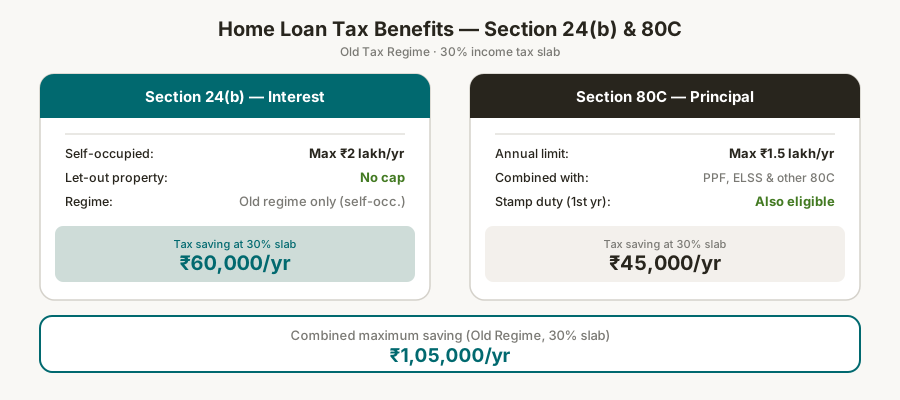
A home loan is not just a liability — it is also one of the most generous tax-saving instruments available to Indian taxpayers. The government actively incentivises home ownership through multiple sections of the Income Tax Act. Taken together, these deductions can reduce your annual tax outgo by ₹60,000 to ₹1.5 lakh depending on your loan size and income slab.
This guide explains every deduction available to Indian home loan borrowers in 2026, the exact eligibility conditions for each, and worked calculations to show the real rupee savings.
Overview: Home Loan Tax Benefits at a Glance
| Section | What You Can Deduct | Maximum Limit | Applicable Regime |
|---|---|---|---|
| Section 24(b) — self-occupied | Home loan interest | ₹2 lakh/year | Old Regime only |
| Section 24(b) — let-out property | Home loan interest | No ceiling (set off against rental income) | Both regimes |
| Section 80C | Principal repayment | ₹1.5 lakh/year (combined 80C limit) | Old Regime only |
| Section 80EEA | Additional interest (first-time buyers) | ₹1.5 lakh/year | Old Regime only |
| Section 80EE | Additional interest (older loans) | ₹50,000/year | Old Regime only |
Important distinction: Under the New Tax Regime (default from FY2023–24), the ₹2 lakh Section 24(b) deduction for self-occupied property is not available. However, for let-out (rented) property, interest on the home loan remains deductible against rental income under both regimes — there is no ceiling in either case.
Section 24(b) — Home Loan Interest Deduction
What qualifies
Interest paid on a home loan for a self-occupied property is deductible up to ₹2 lakh per financial year. For a let-out property (rented out), there is no upper cap — the full interest paid is deductible, though this can only be set off against property income in the same year (any remaining loss is set off against other income up to ₹2 lakh; the rest is carried forward for 8 years).
Eligibility conditions
- The property must have been acquired or constructed within 5 years from the end of the financial year in which the loan was taken. If construction takes longer, the ₹2 lakh limit reduces to ₹30,000.
- The loan must be from a recognized financial institution (bank, NBFC, housing finance company) — loans from family members do not qualify for the ₹2 lakh limit.
- The property must be in your name (or jointly owned, in which case each co-borrower can claim their share independently).
Pre-construction interest
Interest paid during the construction period (before the property is handed over) cannot be claimed in the year paid. It is aggregated and deductible in 5 equal installments starting from the year of possession.
Tax saving calculation
| Loan Amount | Interest in Year 1 (at 9%) | Claimable Under 24(b) | Tax Saved (30% slab) | Tax Saved (20% slab) |
|---|---|---|---|---|
| ₹20 lakh | ₹1.77 lakh | ₹1.77 lakh | ₹53,100 | ₹35,400 |
| ₹30 lakh | ₹2.66 lakh | ₹2.00 lakh (capped) | ₹60,000 | ₹40,000 |
| ₹50 lakh | ₹4.47 lakh | ₹2.00 lakh (capped) | ₹60,000 | ₹40,000 |
| ₹75 lakh | ₹6.70 lakh | ₹2.00 lakh (capped) | ₹60,000 | ₹40,000 |
For loans above ~₹22 lakh at 9%, the interest will exceed ₹2 lakh from year one — the deduction is always capped at ₹2 lakh for self-occupied properties. Use our home loan tax calculator to compute your exact Section 24(b) saving for any loan amount and tax slab; use the home loan EMI calculator to see the year-by-year interest component in your repayment schedule.
Section 80C — Principal Repayment Deduction
What qualifies
The principal component of your home loan EMI is deductible under Section 80C, up to a combined limit of ₹1.5 lakh per year across all 80C investments. Other instruments in the 80C basket include: EPF contribution, PPF, ELSS mutual funds, NSC, life insurance premiums, tuition fees, and tax-saving FDs.
Important restriction
If you sell the property within 5 years of possession, the 80C deduction you claimed for principal repayment in all prior years is reversed — it is added back to your income in the year of sale.
How much principal you repay in early years
In the early years of a home loan, the principal component is small because most of the EMI is interest. Use our amortization calculator to see the exact interest vs. principal breakdown for each year of your loan. For a ₹50 lakh, 9%, 20-year loan:
| Year | Annual Principal Repaid | Claimable Under 80C |
|---|---|---|
| 1 | ₹92,809 | ₹92,809 |
| 2 | ₹1,01,498 | ₹1,01,498 |
| 3 | ₹1,10,982 | ₹1,10,982 |
| 5 | ₹1,32,756 | ₹1,32,756 |
| 7 | ₹1,57,688 | ₹1,50,000 (capped) |
By year 7 onward, annual principal repayment exceeds the ₹1.5 lakh cap. But in the first 5 years, the actual principal repaid is less than ₹1.5 lakh, so you can claim the full amount — and still have room under 80C for other instruments like PPF or ELSS.
Tax saving from 80C (principal)
At 30% tax slab, claiming ₹1.5 lakh under 80C saves ₹45,000/year (₹1,50,000 × 30% = ₹45,000; add 4% cess = ₹46,800).
Section 80EEA — Additional Interest Deduction for First-Time Buyers
What qualifies
Section 80EEA provides an additional ₹1.5 lakh deduction on home loan interest, over and above the ₹2 lakh under Section 24(b). This brings the total interest deduction to ₹3.5 lakh/year for eligible borrowers.
Eligibility conditions (strict)
Important: The Section 80EEA sanction window closed on 31 March 2022. No new loans sanctioned after that date are eligible for this deduction. Only borrowers with existing loans sanctioned between 1 April 2019 and 31 March 2022 can continue claiming this benefit for the remaining tenure of their loan.
- Loan must have been sanctioned between 1 April 2019 and 31 March 2022 (this window is now closed — no new loans qualify).
- The stamp duty value of the property must not exceed ₹45 lakh at the time of purchase.
- You must be a first-time home buyer — you should not own any other residential property on the date of loan sanction.
- You must not also be claiming under Section 80EE (the earlier scheme for FY 2016–17 loans).
Tax impact of Section 80EEA
For an eligible borrower in the 30% tax slab claiming the full ₹1.5 lakh:
- Additional tax saving = ₹1,50,000 × 30% × 1.04 (cess) = ₹46,800/year
Combined with Section 24(b) (₹60,000/year), eligible first-time buyers save ₹1,06,800/year in income tax on home loan interest alone.
Section 80EE — For Loans Sanctioned in FY 2016–17
Section 80EE offered an additional ₹50,000 deduction on interest for loans sanctioned between April 2016 and March 2017, for properties valued below ₹50 lakh with loan amounts up to ₹35 lakh. This scheme has closed; new loans no longer qualify. Borrowers who are still within the tenure of a loan sanctioned in FY16–17 can continue claiming ₹50,000/year until the loan is fully repaid.
Joint Home Loans — Maximising the Benefit
A joint home loan (typically with a spouse) allows each co-borrower to independently claim the full tax benefits on their share:
| Benefit | Individual Loan | Joint Loan (2 borrowers) |
|---|---|---|
| Section 24(b) interest | ₹2 lakh | ₹2 lakh × 2 = ₹4 lakh |
| Section 80C principal | ₹1.5 lakh | ₹1.5 lakh × 2 = ₹3 lakh |
| Total annual deduction | ₹3.5 lakh | ₹7 lakh |
| Tax saved (30% slab) | ₹1,09,200 | ₹2,18,400 |
Conditions for joint claim: Both must be co-owners of the property and co-borrowers on the loan. The deduction is proportional to ownership share. If one co-borrower is in a lower tax slab, the other can be shown as having a larger ownership/repayment share to maximise total tax saving.
Old Regime vs New Regime: Should You Claim Home Loan Deductions?
This is a critical decision that many borrowers get wrong.
| Income | Old Regime (with 24b + 80C) | New Regime | Verdict |
|---|---|---|---|
| ₹8 lakh | ₹7,54,800 taxable after deductions | ₹8 lakh | Old Regime typically wins |
| ₹12 lakh | With ₹3.5L home loan deductions: better | Standard deduction only | Compare carefully |
| ₹15 lakh | Home loan deductions give significant edge | Lower slab rates | Old Regime likely wins with large loan |
| ₹20 lakh+ | Case-by-case — depends on total deductions | Simpler, lower rates | Compute both |
Rule of thumb: If your home loan interest alone is ≥ ₹2 lakh/year (virtually all loans above ₹22 lakh at 9%) and you also have EPF, PPF, and other 80C investments, the Old Regime typically saves more tax for most borrowers in the ₹8–25 lakh income range.
Use our home loan tax calculator or consult a CA to compare both regimes for your specific income and deduction profile.
The Combined Tax Saving: A Worked Example
Borrower profile: Salaried, ₹15 lakh annual income, 30% tax slab, ₹50 lakh home loan at 9%, 20 years. First-time buyer, loan sanctioned December 2021 (eligible for 80EEA if property ≤ ₹45 lakh).
Year 3 deductions:
- Section 24(b): ₹2,00,000 (full cap; actual interest in year 3 = ₹4.28 lakh)
- Section 80C (principal): ₹1,11,000 (actual principal in year 3)
- Section 80EEA: ₹1,50,000 (if eligible — stamp duty value ≤ ₹45 lakh)
Total deduction: ₹4,61,000
Tax saving at 30% slab (including 4% cess): ₹4,61,000 × 30% × 1.04 = ₹1,43,832/year
This ₹1.43 lakh in annual tax saving reduces the effective cost of the ₹50 lakh loan significantly — the effective net interest outgo drops from ₹4.28 lakh to ~₹2.85 lakh in year 3 after deductions.
How to Claim Home Loan Tax Benefits
- Obtain the interest certificate from your lender every April. This shows total interest paid and principal repaid in the previous financial year. Banks issue these automatically or on request.
- Include in your ITR filing: Declare property income (or loss for self-occupied property under "Income from House Property"). Enter interest deduction under Section 24(b).
- 80C claim: Total your 80C investments (EPF, PPF, principal repaid, insurance) and enter in the 80C schedule — up to ₹1.5 lakh combined.
- 80EEA (if eligible): Declare in the additional deductions section; provide loan sanction letter as proof of sanction date.
- TDS adjustment: If you're salaried, submit the interest certificate to your employer (HR/payroll) at the start of the financial year so TDS is deducted at the correct (reduced) rate throughout the year.
Frequently Asked Questions
Can I claim both Section 24b and Section 80EEA together?
Yes. Section 80EEA is an additional deduction over and above Section 24(b). An eligible first-time buyer can claim up to ₹2 lakh under Section 24(b) and a further ₹1.5 lakh under Section 80EEA — total ₹3.5 lakh per year on interest alone.
Is home loan principal repayment fully deductible?
No. Principal repayment is deductible under Section 80C, but the entire 80C limit is only ₹1.5 lakh/year — shared with all other 80C investments (PPF, EPF, ELSS, insurance premiums, etc.). Only the portion up to the available 80C room is deductible.
Can I claim home loan tax benefit on an under-construction property?
For Section 24(b), no — interest during construction cannot be claimed in the year paid. It is aggregated and claimed in 5 equal installments after possession. For Section 80C, principal repayment during construction also cannot be claimed until possession.
What if I have two home loans?
For a self-occupied property, interest deduction under Section 24(b) is capped at ₹2 lakh regardless of how many loans are against it. If you have a second home loan for a let-out property, the full interest is deductible against rental income (no cap) with any excess set off against other income up to ₹2 lakh.
Do home loan tax benefits apply in the New Tax Regime?
Partially. Under the New Tax Regime (introduced in FY2020–21 and made default from FY2023–24):
- Self-occupied property: Section 24(b) interest deduction (₹2 lakh cap) is not available.
- Let-out (rented) property: Interest deduction under Section 24(b) is available — you can deduct actual interest against rental income (after standard deduction of 30%) in both regimes, with any remaining loss set off against other income up to ₹2 lakh.
- Section 80C (principal) and 80EEA: Not available under the New Regime.
For most home loan borrowers with self-occupied property, the Old Regime remains more tax-efficient — but landlords with let-out properties should compute both regimes carefully.
How do I get my home loan interest certificate?
Log in to your lender's net banking portal and download the "Provisional Interest Certificate" (for the current financial year) or "Final Interest Certificate" (for the completed financial year). SBI, HDFC Bank, ICICI Bank, and Axis Bank all provide these online. If you cannot find it, call your lender's customer service or visit the branch.
Try the calculator
Run your own numbers in seconds. Pick the calculator that fits your loan type.