SBI vs HDFC Home Loan 2026 — Rates, Fees, Features & Which to Choose
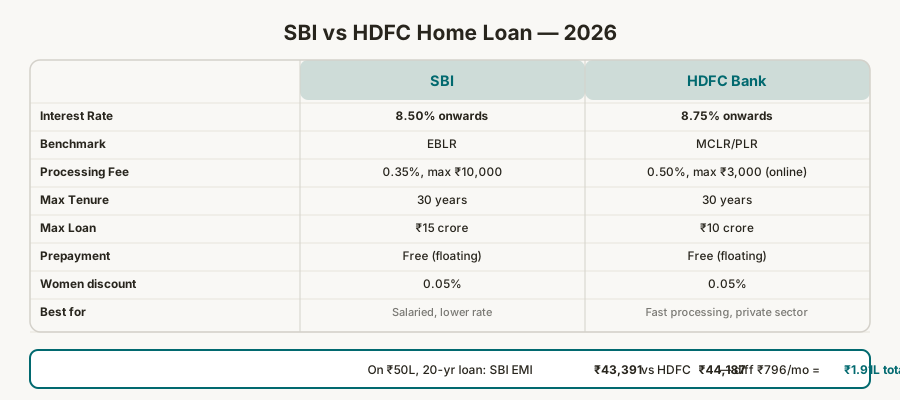
SBI starts at 8.50% vs HDFC at 8.75% — a 0.25% gap costs ₹1.52 lakh extra over 20 years on a ₹50 lakh loan. Here is every difference that matters before you choose.
Key Takeaways
- SBI home loan rates start from 8.50% p.a. (salaried women) and 8.55% (salaried men) in June 2026; HDFC Bank starts from 8.75% p.a.
- On a ₹50 lakh, 20-year loan, that 0.20% gap translates to ₹636 less EMI per month with SBI and ₹1.52 lakh less total interest.
- SBI's processing fee is capped at ₹10,000; HDFC Bank charges up to 0.50% (no published cap) — a difference of ₹27,000+ on a ₹75 lakh loan.
- HDFC Bank approves and disburses in 7–15 days; SBI typically takes 15–25 days due to more rigorous physical documentation requirements.
India has two dominant home loan lenders by loan book size and brand recognition: SBI with roughly 25% of the outstanding home loan market, and HDFC Bank (which absorbed HDFC Ltd in 2023) with approximately 17%. Between them, they originate more than four out of every ten home loans in India. Most borrowers end up comparing exactly these two, which makes this a comparison worth getting right. The rate headline is simple — SBI is cheaper. The complete picture is more nuanced, because the cheapest rate and the best loan are not always the same thing.
Interest Rates in June 2026
SBI's home loan rates are linked to EBLR (External Benchmark Lending Rate, tied directly to the RBI repo rate of 5.25% as of August 2026). HDFC Bank uses RPLR (Retail Prime Lending Rate), an internal benchmark. The practical difference: SBI rates reset automatically within 3 months of any RBI repo rate change; HDFC Bank's RPLR reset timing is at the bank's discretion, though recent practice has been quarterly.
| CIBIL Score | Loan Amount | SBI Rate (p.a.) | HDFC Rate (p.a.) |
|---|---|---|---|
| 800+ | Up to ₹30 lakh | 8.50%* / 8.55% | 8.75% |
| 800+ | ₹30L–₹75L | 8.55% | 8.75% |
| 800+ | Above ₹75L | 8.60% | 8.90% |
| 750–799 | Up to ₹75L | 8.65% | 9.00% |
| 700–749 | Up to ₹75L | 8.90% | 9.25% |
| Below 700 | Up to ₹75L | 9.65% | 9.65% |
*SBI offers a 5 bps concession for women borrowers as primary applicant — 8.50% vs 8.55% for equivalent male profiles.
Check the current home loan rates from all major banks for the most up-to-date figures before applying.
EMI and Total Interest Comparison
Real money numbers make the rate difference concrete. Use our home loan EMI calculator to model your specific loan amount and tenure.
₹50 lakh loan, 20-year tenure
| Rate Scenario | Monthly EMI | Total Interest | Total Outgo |
|---|---|---|---|
| SBI 8.55% (salaried) | ₹43,550 | ₹54,52,000 | ₹1,04,52,000 |
| SBI 8.75% (lower CIBIL) | ₹44,186 | ₹56,04,640 | ₹1,06,04,640 |
| HDFC 8.75% (prime) | ₹44,186 | ₹56,04,640 | ₹1,06,04,640 |
| HDFC 9.00% (mid-CIBIL) | ₹44,986 | ₹57,96,640 | ₹1,07,96,640 |
At the prime rate differential (SBI 8.55% vs HDFC 8.75%), SBI borrowers save ₹636 per month in EMI and ₹1,52,640 in total interest over 20 years.
₹30 lakh loan, 20-year tenure
| Rate Scenario | Monthly EMI | Total Interest |
|---|---|---|
| SBI 8.55% | ₹26,130 | ₹32,71,200 |
| HDFC 8.75% | ₹26,511 | ₹33,62,640 |
| Difference (SBI saves) | ₹381/month | ₹91,440 |
₹75 lakh loan, 20-year tenure
| Rate Scenario | Monthly EMI | Total Interest |
|---|---|---|
| SBI 8.55% | ₹65,324 | ₹81,77,760 |
| HDFC 8.75% | ₹66,278 | ₹84,06,720 |
| Difference (SBI saves) | ₹954/month | ₹2,28,960 |
For larger loans, the interest saving from SBI's lower rate compounds significantly. To compare any two offers side-by-side, use our compare loans tool — it computes total cost including fees for both options simultaneously.
Fees and Charges — The Full Picture
The processing fee difference between SBI and HDFC Bank is significant on large loans and is often overlooked when comparing headline rates.
| Charge | SBI | HDFC Bank |
|---|---|---|
| Processing fee | 0.35% of loan (min ₹2,000, max ₹10,000) + GST | Up to 0.50% (min ₹3,300) + GST; no published cap |
| Processing fee — ₹50L loan | ₹10,000 + GST = ₹11,800 | ₹25,000 + GST = ₹29,500 |
| Processing fee — ₹75L loan | ₹10,000 + GST = ₹11,800 | ₹37,500 + GST = ₹44,250 |
| Legal/technical charges | ₹5,000–₹15,000 (varies by property) | ₹5,000–₹15,000 (varies) |
| Prepayment penalty — floating | Nil (RBI mandate) | Nil (RBI mandate) |
| Prepayment penalty — fixed | 2–3% of outstanding | 2–4% of outstanding |
| Balance transfer fee | Nil | ₹5,000–₹10,000 + GST |
| MODT (Memorandum of Deposit of Title Deed) | State government charge; same for both | Same as SBI |
| Interest rate conversion (MCLR to EBLR) | ₹1,000–₹5,000 | ₹1,000–₹5,000 |
SBI's processing fee cap of ₹10,000 is a genuine structural advantage for borrowers taking loans above ₹30 lakh. HDFC Bank frequently runs processing fee waivers during festive periods (October–March) and for salary-account holders — always ask before applying during these windows.
Product Features Comparison
SBI's Distinctive Products
SBI MaxGain: SBI's flagship home loan product links your home loan to an overdraft (OD) account. Any surplus funds you park in the OD account reduce the interest-bearing outstanding balance on which interest is computed — without reducing the outstanding principal in the formal loan ledger. This means:
- If you receive a bonus of ₹3 lakh and park it in MaxGain, you pay interest on ₹47 lakh instead of ₹50 lakh for that period
- The ₹3 lakh remains accessible (like a savings account) — you can withdraw it if needed
- Unlike formal prepayment, there are no restrictions or forms; the relief is immediate and reversible
MaxGain is a genuinely powerful product for borrowers with variable income, self-employed professionals who receive lumpy payments, or salaried borrowers who build savings over time. There is no direct equivalent at HDFC Bank. For borrowers who can utilise it effectively, MaxGain alone can justify choosing SBI despite slower processing.
SBI Flexipay: Designed for younger borrowers with rising income trajectories — lower EMIs in the initial years (interest-only or reduced principal repayment), stepping up as income grows. Tenure can extend up to 30 years for borrowers below 45 at sanction.
Government employee concessions: PSU employees and central/state government employees receive additional rate concessions of 5–15 bps at SBI, reflecting their stable income and low default risk profile.
Women borrower concession: 5 bps rate discount for women as primary applicant — a small but capturable saving.
HDFC Bank's Distinctive Products
HDFC Smart EMI: Allows interest-only payments for the first 24 months during the under-construction phase of a property. Useful when you are paying rent simultaneously and the full EMI would stretch your budget. After the construction phase, full EMIs begin.
HDFC Reach: A product designed specifically for customers in Tier 3–5 towns and semi-urban markets with informal or mixed income documentation — self-employed without formal ITRs, small traders, and agricultural income borrowers. HDFC Reach uses alternative credit assessment methods and is available at slightly higher rates (9.25–10.50% depending on profile).
Step-up EMI structure: HDFC offers income-linked step-up EMI structures where the EMI increases by a pre-agreed percentage each year, allowing higher loan eligibility for borrowers whose current income would otherwise restrict the loan amount. Use our step-up EMI calculator to model whether this structure suits your income growth trajectory.
Eligibility Criteria Comparison
| Parameter | SBI | HDFC Bank |
|---|---|---|
| Minimum age | 18 years | 21 years |
| Maximum age at loan maturity | 70 years | 65 years (salaried), 70 years (self-employed) |
| Minimum income (salaried) | ₹25,000/month gross | ₹20,000/month net (metro) |
| Self-employed income documentation | 3 years ITR + audited financials | 2 years ITR acceptable; flexible on turnover proof |
| Co-applicant requirement | Mandatory for MLA/MDA property | Encouraged; not strictly mandatory |
| LTV (Loan-to-Value) — up to ₹30L | 90% | 90% |
| LTV — ₹30L–₹75L | 80% | 80% |
| LTV — above ₹75L | 75% | 75% |
| NRI home loans | Yes, through NRI branches | Yes, through dedicated NRI team |
SBI's maximum age at maturity of 70 years (vs HDFC's 65 for salaried borrowers) is a meaningful difference for borrowers starting a home loan in their late 40s. A 48-year-old borrower can get a 22-year tenure at SBI vs a maximum 17-year tenure at HDFC Bank (for salaried) — reducing the monthly EMI by making the repayment period longer.
Processing Speed and Customer Experience
This is the clearest operational difference between the two institutions.
SBI is a public sector bank with a documentation-first culture. Expect:
- 3–5 branch visits to complete physical documentation (SBI still requires wet-ink signatures on most documents)
- Legal opinion from an SBI-empanelled lawyer (which you pay for and cannot substitute)
- Property valuation by an SBI-approved valuer (separate from your builder's or seller's valuation)
- Total processing time: 15–25 business days from complete documentation submission to disbursal
- Slower response from branch staff for status updates; escalation typically requires personal visits
HDFC Bank has invested heavily in digital infrastructure:
- End-to-end digital application with video KYC available for salaried borrowers
- Automated salary verification (directly through employer databases for major corporates)
- e-Stamping, digital property verification for certain property types
- Total processing time: 7–15 business days for ready-possession properties with clean titles
- Dedicated relationship managers with personal contact numbers who respond within business hours
For under-construction properties with builder payment schedules, HDFC's faster processing also means faster disbursals at each construction milestone — avoiding builder penalties for delayed payment.
The Tax Angle
Both SBI and HDFC home loans are equally eligible for tax deductions under the Old Tax Regime:
- Section 24(b): Interest paid — up to ₹2 lakh per year for self-occupied property (no cap for let-out property)
- Section 80C: Principal repaid — within the ₹1.5 lakh combined annual limit
Under the New Tax Regime (default from FY2023–24), these deductions are not available. If you are comparing after-tax cost of the two loans, the choice of tax regime is as important as the rate difference. Use our home loan tax calculator to compute your actual after-tax EMI cost under both regimes.
Head-to-Head Verdict
| Criterion | Winner | Why |
|---|---|---|
| Interest rate (prime salaried) | SBI | 8.55% vs 8.75% — 0.20% gap saves ₹1.52 lakh on ₹50L over 20 years |
| Processing fee | SBI | ₹10,000 cap vs up to 0.50% at HDFC — saves ₹17,000–₹28,000 on ₹50L–₹75L loans |
| Processing speed | HDFC Bank | 7–15 days vs 15–25 days; critical for competitive builder deals |
| Self-employed friendliness | HDFC Bank | 2 years ITR accepted; HDFC Reach for informal income |
| Overdraft benefit (surplus parking) | SBI | MaxGain has no equivalent at HDFC |
| Branch network (rural / semi-urban) | SBI | 22,000+ branches vs HDFC's ~8,000 |
| Digital experience | HDFC Bank | Full digital KYC and application tracking |
| Maximum age at maturity | SBI | 70 years vs 65 years (salaried) at HDFC |
| NRI home loans | Broadly equal | Both have dedicated NRI products |
| Rate transmission speed (RBI cuts) | SBI | EBLR-linked; resets within 3 months mandatorily |
When to Choose SBI
- You are a salaried borrower with a CIBIL score above 750 and your primary goal is minimising total interest cost
- You are a government or PSU employee eligible for additional concessions
- You want the MaxGain overdraft facility to park surplus income flexibly
- You are borrowing above ₹30 lakh where SBI's processing fee cap generates material savings
- Your loan timeline is flexible (not a time-critical builder deal)
- You are a woman borrower — you get the lowest available rate of 8.50%
When to Choose HDFC Bank
- You need disbursal in under 15 days (competitive builder deal, resale with motivated seller, or you are relocating on a deadline)
- You are self-employed with 2 years of ITR but prefer the more flexible documentation approach
- You want a fully digital experience with a responsive RM
- You are using HDFC's Smart EMI to handle the under-construction phase
- You are in a semi-urban or emerging location where HDFC Reach is available for informal income borrowers
For a comprehensive view of all major home loan lenders beyond SBI and HDFC, see our best home loan banks India 2026 guide which covers ICICI, Axis, Kotak, and LIC Housing Finance as well.
Frequently Asked Questions
Which bank has the lowest home loan interest rate in India in 2026?
Among the two largest lenders, SBI offers the lower starting rate at 8.50% (women borrowers) and 8.55% (salaried men) vs HDFC Bank's 8.75% for prime borrowers in June 2026. However, Bank of India, Bank of Baroda, and LIC Housing Finance also offer competitive starting rates in the 8.40–8.60% range for prime profiles. The actual rate you receive depends on your CIBIL score, income, loan amount, and the specific product variant.
Is SBI home loan better than HDFC?
It depends on what "better" means for your specific situation. SBI is cheaper — 0.20–0.25% lower rates and a processing fee cap of ₹10,000 — and offers the MaxGain overdraft facility. HDFC Bank is faster (7–15 days vs 15–25), more flexible on self-employed documentation, and has a superior digital experience. For most salaried borrowers with time flexibility, SBI is the financially optimal choice. For those who need speed or have complex income documentation, HDFC Bank is often the practical winner.
Can I switch from HDFC to SBI home loan?
Yes — this is called a balance transfer. SBI accepts balance transfer requests from other lenders. You would get SBI's current rate on your outstanding balance, with a fresh loan agreement. The process requires the same documentation as a new application. Switching makes financial sense if SBI's current rate is at least 0.25% lower than your existing HDFC rate, and you have sufficient remaining tenure (typically 5+ years) to recover the transfer costs in interest savings. Check our home loan balance transfer guide for the full calculation and process.
Does SBI offer home loans to self-employed borrowers?
Yes. SBI offers home loans to self-employed professionals (doctors, CAs, architects) and self-employed non-professionals (traders, manufacturers). The documentation requirement is more extensive than HDFC — typically 3 years of ITR, audited profit and loss accounts, balance sheets, and bank statements. SBI's underwriting for self-employed income tends to be conservative; if your business income is irregular or the documentation is incomplete, HDFC Bank or ICICI Bank typically have a higher sanction rate for self-employed profiles.
What is SBI MaxGain home loan?
SBI MaxGain is an overdraft-linked home loan where your loan account operates like a current account with an overdraft limit equal to the outstanding principal. Any amount you park in this account (from salary, savings, or lump sum receipts) reduces the effective balance on which interest is charged — without constituting a formal prepayment. If you need the funds back, you can withdraw them. This is particularly valuable for borrowers with variable income or those who build savings over time. Interest is calculated daily on the net balance, so even short-term parking of funds generates interest relief. There is no additional interest rate charge for MaxGain over standard SBI home loan rates.
How long does HDFC home loan approval take?
HDFC Bank typically provides an in-principle approval within 24–72 hours for salaried borrowers applying online with CIBIL scores above 700 and complete documentation. The full process — including property verification, legal opinion, and disbursement — takes 7–15 business days for ready-possession properties with clean titles. Under-construction properties may take 10–20 days depending on the builder's documentation and HDFC's empanelment status for that project. HDFC's RM assigned to your application typically provides daily status updates via WhatsApp and email throughout the process.
Try the calculator
Run your own numbers in seconds. Pick the calculator that fits your loan type.