Should You Prepay Your Home Loan or Invest the Extra Money? The 2026 Answer
At 9% home loan rate vs. 11–12% equity returns, the math leans toward investing. But taxes, risk, and psychology change the answer. Here's the complete decision framework with numbers.
Key Takeaways
- If your after-tax home loan rate < expected after-tax investment return → invest.
- Home loan interest up to ₹2 lakh/year is deductible (Section 24b) — reduces effective loan rate by 0.5–0.9%.
- Equity mutual funds' long-term returns (10–12% CAGR) typically exceed home loan rates (8.5–9.5%) — but with higher volatility.
- The right answer often involves both: maintain an emergency fund, max out tax-saving investments, then split surplus between prepayment and investment.
You've just received your annual bonus — ₹5 lakh sitting in your savings account. Your home loan rate is 9%. Your mutual fund is returning 12% CAGR over the last 5 years. Should you prepay the loan or invest the money?
This is the most common financial dilemma for Indian middle-class homeowners. The answer depends on four variables: your effective loan rate (after tax benefits), your expected investment return (after tax), your risk appetite, and your psychological relationship with debt. Let's work through each.
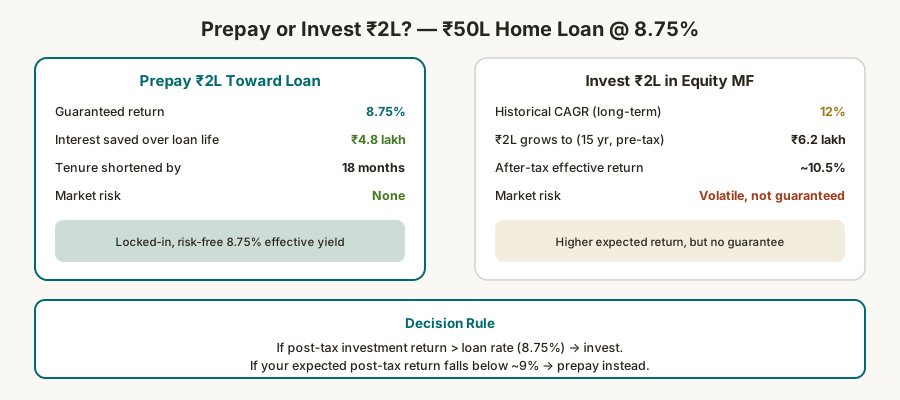
The Core Math: Effective Loan Rate vs. Investment Return
Step 1: Calculate your effective home loan rate
The government allows a deduction of up to ₹2 lakh per year on home loan interest under Section 24b for self-occupied property — but only under the Old Tax Regime (the New Tax Regime, which is the default from FY 2023–24, does not allow this deduction for self-occupied property). For borrowers on the Old Regime where the annual interest exceeds ₹2 lakh, this creates a real tax saving.
Your tax benefit depends on your income slab:
| Income Tax Slab | Tax Rate (Old Regime) | Benefit on ₹2L Deduction |
|---|---|---|
| ₹10L–₹15L | 30% | ₹60,000/year saved |
| ₹7.5L–₹10L | 20% | ₹40,000/year saved |
| ₹5L–₹7.5L | 10% | ₹20,000/year saved |
For a borrower in the 30% tax bracket with ₹60,000 in annual tax savings on interest:
- Nominal loan rate: 9%
- Effective rate (after tax benefit): approximately 8.4–8.6%
This is the "hurdle rate" — any investment returning more than this rate (on an after-tax basis) beats prepayment.
Step 2: Calculate your expected after-tax investment return
| Investment | Pre-Tax Return | Tax Treatment | After-Tax Return (30% slab) |
|---|---|---|---|
| Nifty 50 Index Fund (10Y avg) | 11–13% | 12.5% LTCG on gains > ₹1.25L (Finance Act 2024) | 9.5–11% |
| Balanced Advantage Fund | 9–11% | 12.5% LTCG | 7.5–9% |
| PPF | 7.1% (current) | Tax-free | 7.1% |
| FD (5-year) | 7.0–7.5% | 30% tax on interest | 4.9–5.3% |
| Debt Mutual Fund | 7–8% | 30% tax (no indexation post-2023) | 4.9–5.6% |
| NPS (equity) | 9–11% | Partly tax-free on maturity | ~8.5–9.5% |
The comparison:
- Effective home loan rate (30% slab borrower): ~8.5%
- After-tax return of Nifty index fund (long-term): ~9.5–11% (LTCG at 12.5% per Finance Act 2024)
- After-tax return of PPF: 7.1%
- After-tax return of FD: ~5%
Pure math verdict: Equity investing beats prepayment. FD and debt funds do not.
Why the Math Isn't the Whole Story
Risk: equity returns are not guaranteed
The 10–12% CAGR from equity is a long-term average with significant short-term volatility. In any given 3-year period, equity can return −20% to +50%. Your home loan rate of 9% is a guaranteed, risk-free "return" (money saved is money earned).
The risk-adjusted lens: If you prepay ₹5 lakh of your loan, you are guaranteed to save the interest that would have accrued on that ₹5 lakh. If you invest ₹5 lakh in equity, your return is uncertain — could be significantly higher or significantly lower.
For borrowers approaching retirement, with lower risk tolerance, or those who would genuinely stress about market volatility, prepayment has a psychologically real value beyond the numbers.
Your loan tenure position matters
The benefit of prepayment is not uniform across the loan tenure. In the early years of a loan, each EMI is ~85% interest. In the later years, each EMI is ~85% principal. The interest-saving impact of prepayment is far higher in the early years. You can see the exact interest vs. principal split for every month of your loan using our loan amortization calculator.
Prepayment impact at different loan stages (₹5 lakh prepayment, ₹50L loan at 9%):
Use our prepayment calculator to compute the exact interest saving and tenure reduction for your loan balance and prepayment amount.
| When You Prepay | Interest Saved | Remaining Tenure Reduced |
|---|---|---|
| Year 3 (of 20) | ₹6.8 lakh | 2.8 years |
| Year 8 (of 20) | ₹4.2 lakh | 1.6 years |
| Year 14 (of 20) | ₹1.9 lakh | 0.7 years |
Prepayment in year 3 saves ₹6.8 lakh — that's a 36% return on the ₹5 lakh deployed (measured as total savings vs amount prepaid). Very hard for most investments to beat over that period.
Tax deduction limits
The ₹2 lakh Section 24b deduction is capped and is only available under the Old Tax Regime. Once your outstanding loan is small enough that annual interest falls below ₹2 lakh (or if you are on the New Tax Regime), the tax benefit is irrelevant and the effective rate equals the nominal rate. At this stage, the case for investing strengthens. Use our home loan tax calculator to see exactly at what outstanding balance your annual interest drops below the ₹2 lakh threshold.
The Optimal Strategy: A Hierarchy Approach
Rather than choosing between prepayment and investment, use a hierarchy:
Tier 1: Emergency fund (non-negotiable)
Before any prepayment or discretionary investment, maintain 6 months of expenses in a liquid account. This is not optional — it's the foundation that prevents a job loss or medical emergency from triggering default.
Tier 2: Tax-efficient investments
Maximize contributions to:
- PPF: ₹1.5 lakh/year (Section 80C, fully tax-free returns)
- NPS Tier-1: ₹50,000/year additional deduction (Section 80CCD(1B))
- ELSS: Part of the ₹1.5 lakh 80C limit, equity exposure with 3-year lock-in
These provide guaranteed, tax-sheltered returns. Do not skip these in favor of prepayment.
Tier 3: Split the remaining surplus
For surplus beyond Tier 1 and 2:
- If loan is under 5 years old: Split 60:40 → 60% invest (equity funds), 40% prepay. The prepayment benefit is highest early in the loan.
- If 5–12 years into loan: Split 70:30 → 70% invest, 30% prepay.
- If approaching final 5 years: Consider more aggressive prepayment — the interest component is low, but clearing the loan gives guaranteed psychological relief and redirects the full EMI amount to investment.
The Psychological Dimension
This is real and financially valid to account for. Research consistently shows that debt-free individuals report significantly lower financial stress, better sleep quality, and make better financial decisions when they're not carrying the psychological weight of a large liability.
If you are the kind of person who genuinely sleeps better knowing the loan balance is decreasing aggressively — and this peace of mind improves your quality of life and decision-making — then the subjective value of prepayment is real and should factor into your decision.
This is not irrational. Personal finance must be personal.
A Decision Flowchart
- Emergency fund < 6 months expenses? → Build it first.
- Tax-saving investments (PPF, NPS, ELSS) not maxed? → Max them first.
- Loan rate > 10%? → Prepay aggressively (hard to beat risk-free).
- Loan rate 8.5–10%, in first 7 years of loan? → Lean toward 50:50 split.
- Loan rate < 8.5%, later in loan tenure? → Lean toward investing in equity.
- High risk aversion or significant debt-related stress? → Weight toward prepayment.
Use our prepayment calculator to model exactly how much interest you save for any prepayment amount and timing.
Frequently Asked Questions
Is it better to prepay home loan or invest in mutual funds?
If your home loan rate is below 9% and you have a 10+ year investment horizon, equity mutual funds (targeting 10–12% CAGR) mathematically beat prepayment on an after-tax basis. However, this assumes you can tolerate market volatility. A balanced approach — investing and prepaying — manages both return and risk.
What is the best time to prepay a home loan?
Early in the loan tenure — years 1–7 — when the outstanding interest component is highest. A ₹5 lakh prepayment in year 3 saves significantly more interest than the same prepayment in year 14.
Does prepaying home loan reduce EMI or tenure?
You choose. Prepaying and reducing EMI improves monthly cash flow immediately. Prepaying and reducing tenure maintains the same EMI but clears the loan faster, saving more total interest. Reducing tenure is generally the better financial choice if cash flow is comfortable.
Is home loan prepayment tax-free in India?
There is no tax on the act of prepayment itself. However, the Section 24b deduction (up to ₹2 lakh/year on home loan interest) shrinks as you prepay — since your outstanding balance decreases, so does the interest you pay. This reduces future tax deductions.
What is the minimum amount for home loan prepayment?
Most banks accept a minimum prepayment of one EMI amount or ₹10,000, whichever is higher. Some lenders allow ₹5,000. There is no maximum limit for floating-rate home loans (prepayment penalty is banned by RBI for floating-rate loans).
Should I use my bonus to prepay home loan?
A strong default for a lump-sum bonus: first ensure your emergency fund is intact, then max any outstanding tax-saving investments, then consider a 50:50 split between prepaying the loan and investing in equity funds. The exact split depends on your loan rate, tenure position, and risk tolerance.
Try the calculator
Run your own numbers in seconds. Pick the calculator that fits your loan type.