Loan Against Property (LAP) Guide 2026 — Rates, Eligibility & EMI
LAP lets you borrow ₹50–70 lakh against property at 9–12% — far cheaper than personal loans, but the wrong use can cost you your home. Complete 2026 guide.
Key Takeaways
- LAP rates range from 9–12% in 2026 — roughly half the 14–24% charged on personal loans of equivalent size.
- RBI LTV caps: up to 75% LTV for residential properties valued ≤₹75 lakh; 60–65% for commercial and higher-value properties.
- On a ₹60 lakh LAP at 9.5% for 15 years, the monthly EMI is ₹62,653 and total interest is ₹52.78 lakh — plan the exit strategy before you borrow.
- LAP interest is deductible under Section 24(b) ONLY if the loan proceeds are used for house purchase or construction — personal use (wedding, education, medical) gets zero tax benefit.
When you own property but need large amounts of money — for business expansion, a child's foreign education, debt consolidation, or a medical emergency — a Loan Against Property (LAP) is often the most powerful financial tool available. It lets you unlock the value of an idle asset at interest rates 5–10 percentage points lower than unsecured borrowing, while you continue to occupy and use the property. But LAP is also the loan where the stakes are highest: a default can cost you your home. This guide covers everything you need to make the LAP decision intelligently — rates, LTV rules, eligibility, tax treatment, and the six-step application process.
What Is a Loan Against Property?
A Loan Against Property is a secured loan in which you mortgage a property you own — residential flat or house, commercial premises, or industrial property — to a bank or NBFC, receive funds equivalent to 50–75% of the property's market value, and repay over 5–20 years. You retain possession and continue to use the property throughout the loan tenure. The lender registers an equitable or registered mortgage on the property, which is released upon full repayment.
LAP is different from a home loan in a fundamental way: a home loan is for buying or constructing a specific property, and the lender's security is the property being purchased. LAP uses a property you already own as collateral for funds that can be used for almost any purpose.
Key structural features:
- Loan amount: ₹10 lakh to ₹5 crore (some lenders go higher for commercial properties)
- Tenure: 5 to 20 years
- Interest rate: 9–14% (2026), depending on lender, property type, and borrower profile
- Purpose: Unrestricted (business, education, medical, debt consolidation, personal)
- Possession: Borrower retains possession throughout
RBI LTV Rules for LAP
The Reserve Bank of India mandates maximum Loan-to-Value ratios for LAP to limit lender risk. These are hard ceilings — no lender can legally exceed them regardless of borrower creditworthiness.
| Property Type | RBI Maximum LTV |
|---|---|
| Residential property ≤ ₹75 lakh | 75% |
| Residential property > ₹75 lakh | 60–65% (lender discretion within RBI guidelines) |
| Commercial property | 60% |
| Industrial property | 50–60% |
| Agricultural land | Not eligible |
| Disputed / encumbered property | Not eligible |
LAP LTV vs Home Loan LTV: Home loans have higher LTV caps (75–90% depending on loan size) because the loan is secured by the purchased asset itself, and the end-use is housing — a socially prioritised category. LAP LTV is lower because the funds are used for varied purposes and the bank carries more uncertainty about the borrower's repayment source.
Important: Lenders apply their own conservative valuations on top of the RBI cap. A property with a market value of ₹1 crore may be appraised by the bank's technical valuer at ₹85 lakh, limiting your maximum LAP to ₹63.75 lakh (75% of ₹85 lakh) — not ₹75 lakh (75% of ₹1 crore). Always verify the bank's likely assessed value before counting on a specific loan amount.
LAP Interest Rates — Major Lenders in 2026
| Lender | Rate Range | Max LTV | Max Tenure | Processing Fee |
|---|---|---|---|---|
| SBI | 9.50–11.00% | 65% | 15 years | 1.00% (min ₹10,000) |
| HDFC Bank | 9.50–11.00% | 60% | 15 years | 1.00% + GST |
| ICICI Bank | 9.75–11.50% | 65% | 15 years | 1.00% + GST |
| Axis Bank | 10.00–12.00% | 65% | 20 years | 1.00% + GST |
| Kotak Mahindra Bank | 9.50–11.00% | 65% | 15 years | 1.00% + GST |
| PNB Housing Finance | 9.25–12.00% | 70% | 20 years | 0.50–1.00% + GST |
Rate determinants: Your final rate within the stated range depends on: CIBIL score (750+ gets the lower end), income and FOIR, property type (residential typically gets lower rates than commercial), loan amount (larger loans sometimes get better rates), and whether the property is in a tier-1 city (easier to liquidate, hence lower risk premium).
EMI Tables: ₹60 Lakh LAP at Different Rates and Tenures
The scenario below models a ₹1 crore residential property with 60% LTV = ₹60 lakh LAP.
At 9.0% (best-in-class rate)
| Tenure | Monthly EMI | Total Interest | Total Paid |
|---|---|---|---|
| 10 years | ₹76,005 | ₹31,20,600 | ₹91,20,600 |
| 15 years | ₹60,856 | ₹49,54,080 | ₹1,09,54,080 |
| 20 years | ₹53,984 | ₹69,56,160 | ₹1,29,56,160 |
At 9.5% (mid-market rate)
| Tenure | Monthly EMI | Total Interest | Total Paid |
|---|---|---|---|
| 10 years | ₹77,639 | ₹33,16,680 | ₹93,16,680 |
| 15 years | ₹62,653 | ₹52,77,540 | ₹1,12,77,540 |
| 20 years | ₹55,928 | ₹74,22,720 | ₹1,34,22,720 |
At 10.5% (for lower-profile borrowers / commercial property)
| Tenure | Monthly EMI | Total Interest | Total Paid |
|---|---|---|---|
| 10 years | ₹80,961 | ₹37,15,320 | ₹97,15,320 |
| 15 years | ₹66,324 | ₹59,38,320 | ₹1,19,38,320 |
| 20 years | ₹59,903 | ₹83,76,720 | ₹1,43,76,720 |
At 11.5% (NBFC or complex borrower profile)
| Tenure | Monthly EMI | Total Interest | Total Paid |
|---|---|---|---|
| 10 years | ₹84,357 | ₹41,22,840 | ₹1,01,22,840 |
| 15 years | ₹70,091 | ₹66,16,380 | ₹1,26,16,380 |
| 20 years | ₹63,986 | ₹93,56,640 | ₹1,53,56,640 |
Use our LAP calculator to model your specific loan amount, rate, and tenure combination. If you want to compare LAP against other borrowing options, use our compare loans tool to see the full cost side by side.
The tenure choice matters enormously: At 9.5%, choosing 20 years over 10 years saves ₹21,711/month in EMI but costs an additional ₹41.06 lakh in total interest. Unless the monthly EMI reduction is genuinely necessary for your FOIR, a shorter tenure saves significantly.
Eligible Properties for LAP
Lenders accept the following:
Residential properties: Freehold flats, independent houses, builder floors, row houses with clear title, fully constructed (not under-construction). The property must be in the borrower's name (or jointly owned).
Commercial properties: Office spaces, shops, showrooms, commercial complexes. Lenders typically offer 60% LTV and slightly higher rates than residential.
Industrial properties: Factories, warehouses, industrial sheds. Specialised underwriting; rates tend to be at the higher end.
What is NOT eligible:
- Agricultural land (RBI restriction)
- Disputed property or property under litigation
- Properties with encumbrances (existing unpaid mortgages beyond a threshold)
- Leasehold property without NOC from the lessor (leaseholds in DDA / HUDA / city development authorities require additional clearances)
- Under-construction residential property (most lenders require occupancy certificate)
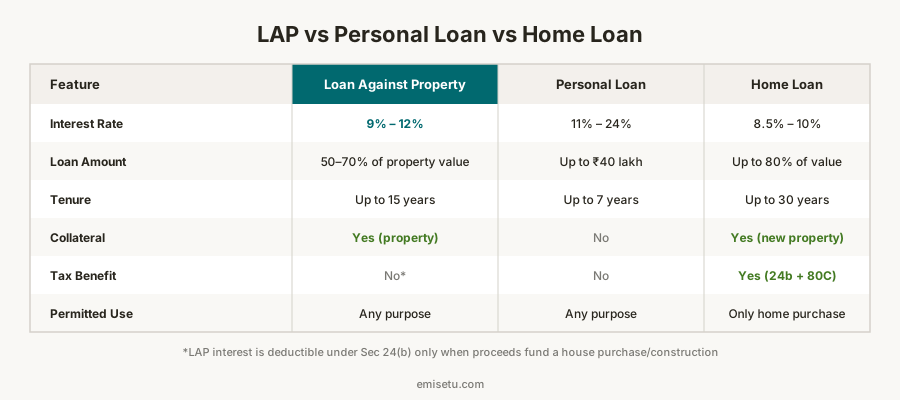
LAP vs Personal Loan vs Home Loan — Three-Way Comparison
| Feature | LAP | Personal Loan | Home Loan |
|---|---|---|---|
| Interest rate (2026) | 9–12% | 10.5–24% | 8.4–9.75% |
| Max loan amount | ₹5 crore+ | ₹50 lakh | Based on property value |
| LTV / loan basis | 50–75% of property value | Income-based | 75–90% of property value |
| Tenure | 5–20 years | 1–5 years | 5–30 years |
| Collateral | Your existing property | None | Property being purchased |
| Tax benefit on interest | Only if used for housing | None | Section 24(b): ₹2L/yr self-occupied |
| Speed | 7–21 days | 1–7 days | 10–30 days |
| End-use restriction | None (practically) | None | Housing only |
| Prepayment penalty | 2–4% (fixed); nil (floating) | Some charge 2–5% | Nil (floating, per RBI) |
For amounts above ₹25 lakh, LAP is almost always cheaper than a personal loan — but requires property ownership, takes longer, and puts the property at risk. For the full three-way comparison with gold loans included, see our detailed guide on personal loan vs gold loan vs LAP.
Tax Treatment of LAP Interest — the Most Misunderstood Rule
The tax treatment of LAP interest is more nuanced than most borrowers realise, and getting it wrong can mean missing legitimate deductions or incorrectly claiming deductions you are not entitled to.
Rule 1: LAP for house purchase or construction
If you use the LAP proceeds to purchase or construct a residential property, the interest qualifies as a deduction under Section 24(b) of the Income Tax Act — subject to the same caps as a regular home loan:
- Self-occupied property (Old Tax Regime): ₹2 lakh/year deduction cap
- Let-out property: Unlimited deduction (both Old and New Tax Regime)
- Self-occupied property (New Tax Regime): Section 24(b) deduction is NOT available
Rule 2: LAP for business purposes
If the LAP is used for business expenses — working capital, business equipment, commercial premises purchase — the full interest is deductible as a business expense under Section 37(1) of the Income Tax Act. There is no cap. This is the most tax-efficient use of LAP.
Rule 3: LAP for personal use (wedding, travel, medical, education, personal debt)
If the LAP proceeds are used for personal consumption — which is the majority of LAP use cases in India — there is no tax deduction on the interest. Period. Section 24(b) applies only to housing; personal use does not qualify. Many borrowers incorrectly claim LAP interest as a Section 24(b) deduction — this is a disallowance risk in income tax scrutiny.
Rule 4: Mixed use
If the LAP is used partly for housing and partly for personal use, only the interest attributable to the housing portion qualifies for Section 24(b). Maintain a clear record of fund utilisation.
Use our home loan tax calculator if you are using LAP proceeds for housing — it will show you the exact deduction available given your outstanding loan and interest outgo.
LAP Eligibility: What Lenders Assess
| Criterion | Salaried | Self-Employed |
|---|---|---|
| Age | 21–60 years (loan must close before 70) | 21–65 years |
| Minimum income | ₹25,000/month | ₹3 lakh/year ITR income |
| CIBIL score | 700+ (750+ for best rates) | 650+ |
| Property title | Clear and registered | Clear and registered |
| Work stability | 2+ years in current job | 3+ years in business |
| FOIR | Below 50–55% after including LAP EMI | Below 50% |
| Property age | Typically under 40–45 years | Under 40–45 years |
Joint applicants: If the property is jointly owned, all co-owners must be co-applicants on the LAP. A rented property (where you are the landlord/owner) is fully eligible — you do not need to live in the property to take a LAP on it. However, it must be in your name; a property that belongs to a parent or sibling cannot be offered as collateral without their co-signing.
Use our loan eligibility calculator to check how much LAP you qualify for based on your income and existing loan obligations.
The 6-Step LAP Application Process
Step 1 — Pre-qualification (1–2 days) Submit basic income and property documents to the lender (PAN, Aadhaar, last 3 years' ITRs, bank statements, property documents). The lender gives an indicative sanction and rate.
Step 2 — Formal application (1 day) Submit the complete application with KYC, income proof, business proof (for self-employed), and property documents (sale deed, encumbrance certificate, property tax receipts, society NOC for apartments).
Step 3 — Technical valuation (3–7 days) The lender sends an approved technical valuer to inspect the property, verify construction quality, check legal status, and arrive at the "distress value" used for LTV calculation. This is the step where the appraised value often comes in 10–20% below market price.
Step 4 — Legal due diligence (5–10 days) The lender's legal team (in-house or empanelled lawyers) reviews the entire property title chain — all previous sale deeds, encumbrance certificate for the last 30 years, pending dues, litigation search. Apartments in CHS or builder societies require additional no-objection certificates.
Step 5 — Loan committee approval (2–3 days) Based on income, CIBIL, property valuation, and legal report, the loan committee sanctions the final amount, rate, and tenure. For large loans (₹1 crore+), this may require multiple levels of approval.
Step 6 — Disbursement (1–2 days) You sign the loan agreement and mortgage deed (equitable mortgage via deposit of title deeds or registered mortgage). Processing fees and stamp duty on mortgage are paid. Funds are credited to your account.
Total timeline: 7–21 working days depending on lender, city, and property complexity. Commercial properties and leasehold properties take longer due to more complex legal checks.
Risks You Must Understand Before Taking a LAP
Property seizure on default: This is the cardinal risk. Under the SARFAESI Act (Securitisation and Reconstruction of Financial Assets and Enforcement of Security Interest Act, 2002), if you default on LAP repayment, the lender can repossess and auction your property without court intervention — after serving a 60-day notice. For most Indian families, the mortgaged property is their home. A default does not just hurt your CIBIL score — it can leave you homeless.
Over-leveraging: The ease of unlocking ₹50–70 lakh from a property creates a temptation to borrow more than you need. Every rupee borrowed has to be repaid with interest. At 9.5% for 15 years, every ₹1 lakh borrowed costs ₹1.88 lakh in total repayment (EMI × 180 months ÷ 1 lakh).
Valuation risk on foreclosure: If property prices fall and you default, the auction proceeds may not cover the outstanding loan. You remain liable for the shortfall.
Prepayment penalties on fixed-rate LAP: Unlike floating-rate home loans (where RBI prohibits prepayment charges), LAP on fixed rates may carry a prepayment fee of 2–4% of the outstanding principal. Check this before taking a fixed-rate LAP — it raises the cost of early exit significantly.
Refinancing as a trap: Some borrowers take LAP to pay off high-interest credit card debt, then accumulate new credit card debt. The result: they now carry both the LAP and the new credit card balance, with a property at risk. LAP-based debt consolidation works only with strict credit discipline post-disbursement.
When LAP Is the Right Tool
LAP makes compelling financial sense when:
-
The purpose is productive — business capital, commercial asset purchase, or an investment in human capital (child's overseas education). These uses have a high probability of generating returns that exceed the 9–12% LAP rate.
-
The amount required exceeds ₹25 lakh — the point where personal loan rates (14–24%) create a massive cost disadvantage over LAP rates (9–12%).
-
You have substantial property equity — if you own the property outright or with a small remaining home loan, LAP uses your equity without liquidating the asset.
-
Repayment capacity is clear — you have projected income or identified cash inflows sufficient to service the LAP EMI for the full tenure without relying on a speculative event.
-
You want to avoid pledging financial assets — selling equity mutual funds or fixed deposits to meet a liquidity need can disrupt long-term wealth building. LAP unlocks property equity instead.
Frequently Asked Questions
What is the maximum loan I can get against my property?
The maximum depends on the lender's appraised value (which may be 10–20% below market value), the applicable LTV ratio (50–75% depending on property type), and your income-based FOIR capacity. On a ₹1 crore residential property appraised at ₹85 lakh, at 65% LTV, the maximum LAP is ₹55.25 lakh — subject to your income supporting that EMI within 50% FOIR. Large LAPs above ₹1 crore are possible on high-value properties with matching income.
Can I take LAP on a jointly owned property?
Yes, but all co-owners must consent and typically must be co-applicants (or at minimum, co-mortgagors) on the LAP. Banks require signatures of all property owners on the mortgage deed. If one co-owner is a non-earning spouse or a parent, they still need to sign. The income of working co-applicants can be clubbed to enhance the eligible loan amount and improve the FOIR.
Is LAP interest tax deductible?
It depends entirely on how the loan proceeds are used. If used for purchasing or constructing a house: interest qualifies under Section 24(b), capped at ₹2 lakh/year for self-occupied property under the Old Regime. If used for business: deductible as a business expense without a cap under Section 37(1). If used for personal purposes (travel, wedding, medical bills, children's education in India): no deduction is available under any provision. Consult a CA to confirm the tax treatment for your specific use case.
What happens if I default on LAP?
After 90 days of missed payments (NPA classification), the lender issues a 60-day notice under Section 13(2) of the SARFAESI Act demanding repayment. If you do not respond or repay, the lender takes symbolic possession of the property and can auction it to recover the outstanding amount. You also incur penal interest (typically 2% over the contracted rate) during the default period. Your CIBIL score drops severely, and the LAP default is reportable to credit bureaus. The property auction happens without court involvement — the judicial process is only triggered if you contest the SARFAESI proceedings.
Can I take a LAP on a rented property?
Yes. The LAP eligibility is based on your ownership of the property, not your residence in it. A residential property that you have rented out to a tenant is fully eligible as LAP collateral — provided you hold clear title, there are no disputes, and the property is in your name. Rental income from the property can be included in your income for FOIR calculation, improving your eligibility. The tenant's possession does not affect the bank's ability to register a mortgage on the property.
What is the difference between LAP and a home loan?
A home loan is specifically for purchasing or constructing a residential property. The property being purchased is the collateral. Rates are lower (8.4–9.75%) because the government actively promotes housing credit. Section 24(b) and 80C tax benefits apply. Prepayment is penalty-free on floating rate per RBI rules. LAP, by contrast, uses a property you already own as collateral for any purpose. Rates are higher (9–12%). Tax benefits apply only if the funds are used for housing. For everything else, LAP is effectively a high-value personal loan at significantly lower cost — but with the critical difference that your property is at risk of forfeiture if you default.
Try the calculator
Run your own numbers in seconds. Pick the calculator that fits your loan type.