Personal Loan Eligibility in India 2026 — How to Get Approved at the Best Rate
Three steps taken before applying — improving CIBIL, closing one EMI, and applying to the right lender — can unlock ₹3–7 lakh more in loan amount and a 2–4% lower interest rate. Here's the complete playbook.
Key Takeaways
- CIBIL 750+ unlocks the best personal loan rates (10.5–13%) vs. 700–749 (14–18%) — the difference is worth ₹1–2 lakh on a ₹5 lakh loan.
- Being an existing customer of the lender (salary account, FD, home loan) is the single most impactful eligibility booster.
- Closing one existing loan EMI before applying can add ₹3–5 lakh to your eligible loan amount.
- Fintech lenders approve faster (same day) but charge 18–24% — worth it only for genuine emergencies.
A personal loan rejection is not just disappointing — it damages your CIBIL score (every hard inquiry reduces it by 5–10 points) and makes the next application harder. The right approach is to understand exactly what banks check, fix the gaps before applying, and target the right lender for your profile.
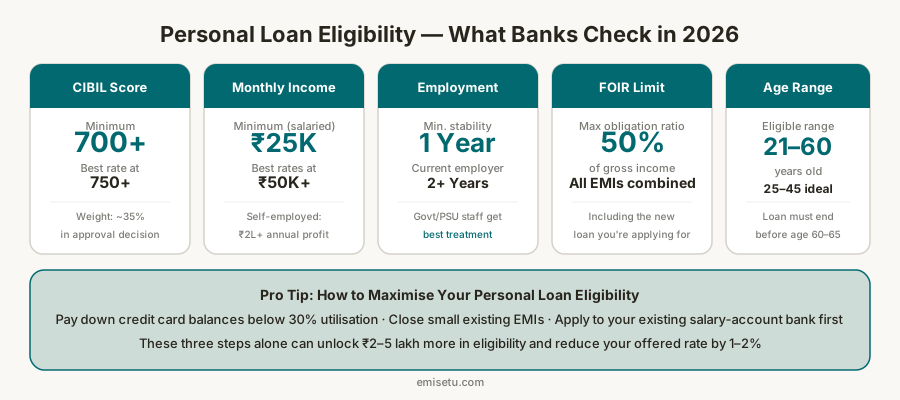
What Banks Check When You Apply
1. CIBIL Score (weight: ~35%)
Your credit score is the most heavily weighted factor. Here's how rates vary by score band:
| CIBIL Score | Rate Range | Approval Odds |
|---|---|---|
| 800+ | 10.5–12% | Excellent — pre-approved offers likely |
| 750–799 | 11–14% | High |
| 700–749 | 14–18% | Moderate — some lenders decline |
| 650–699 | 18–24% | Low — only fintechs and NBFCs |
| Below 650 | Rejected or 24%+ | Very low |
2. Income and Employment (weight: ~30%)
| Profile | Minimum Income | Preferred Income |
|---|---|---|
| Salaried (metro) | ₹25,000/month | ₹50,000+/month |
| Salaried (non-metro) | ₹20,000/month | ₹35,000+/month |
| Self-employed | ₹2 lakh annual net profit | ₹5 lakh+ annual |
| Government employee | ₹20,000/month | Any — preferred profile |
Employment stability: Most banks require minimum 1 year in the current job; 2+ years is preferred. For self-employed borrowers, 3+ years of business vintage is typically required.
3. FOIR — Existing Debt Obligations (weight: ~20%)
Your total EMI obligations (including the new personal loan) must not exceed 40–50% of gross monthly income. Each ₹10,000 in existing EMIs reduces your eligible personal loan amount by approximately ₹2.9 lakh (at 14%, 3-year tenure).
4. Employer/Business Profile (weight: ~10%)
Banks rate employers into categories:
- Category A: Listed companies, MNCs, PSUs, central/state government — best rates, higher eligible amount
- Category B: Mid-size established companies, top NBFCs — standard treatment
- Category C: Smaller companies, startups, self-employed — higher scrutiny, may require additional documents
5. Relationship with Lender (weight: ~5%)
An existing relationship — salary account, home loan, credit card, FD — is a significant positive. Banks access your internal banking data (average balance, salary credit pattern, EMI behaviour) which supplements the CIBIL picture.
Maximum Eligible Loan Amount — Quick Calculator
At 14% interest, 3-year tenure, 50% FOIR, no existing obligations:
| Gross Monthly Income | Max EMI Available | Max Personal Loan |
|---|---|---|
| ₹30,000 | ₹15,000 | ₹4.39 lakh |
| ₹50,000 | ₹25,000 | ₹7.31 lakh |
| ₹75,000 | ₹37,500 | ₹10.97 lakh |
| ₹1,00,000 | ₹50,000 | ₹14.63 lakh |
| ₹1,50,000 | ₹75,000 | ₹21.94 lakh |
Every ₹10,000 in existing EMIs reduces eligibility by ~₹2.9 lakh at 14%, 3 years. Use the loan eligibility calculator to model your exact eligible amount based on income and existing obligations.
How to Maximise Your Eligibility Before Applying
Step 1: Pull your CIBIL report and fix errors
Check your CIBIL report at cibil.com (free once/year) or via Paisabazaar/BankBazaar (free, unlimited soft checks). Dispute any incorrect entries — around 15–20% of Indian credit reports contain at least one error. A successful dispute can improve your score by 20–80 points in 30–45 days. Read our detailed CIBIL improvement guide.
Step 2: Reduce credit card utilisation below 30%
This is the fastest lever. If your combined credit card outstanding is ₹1.5 lakh against a ₹3 lakh limit (50% utilisation), paying it down to ₹80,000 (26%) can improve your score by 20–50 points within one billing cycle.
Step 3: Close or prepay one existing EMI
If you have a small personal loan (₹50,000–₹2 lakh outstanding) that you can prepay, do so before applying for the larger loan. The closed EMI reduces your FOIR and can unlock ₹3–5 lakh more in eligibility.
Step 4: Apply to your salary account bank first
Your salary account bank sees 12 months of salary credits, spending patterns, and average balance. This internal data gives them confidence beyond the CIBIL score alone. Pre-approved offers from your salary bank are typically the best rate you'll get.
Step 5: Avoid multiple simultaneous applications
Each application triggers a hard CIBIL inquiry (−5 to −10 points). Apply to 1–2 lenders sequentially, not 5 lenders simultaneously. If rejected, wait 90 days, fix the identified issue, then reapply.
Lender-by-Lender Eligibility Guide (2026)
| Lender | Min. CIBIL | Min. Income | Best Rate | Turnaround |
|---|---|---|---|---|
| SBI | 700 | ₹15,000/mo | 10.55% | 3–5 days |
| HDFC Bank | 700 | ₹25,000/mo | 10.50% | 24–48 hours |
| ICICI Bank | 700 | ₹25,000/mo | 10.75% | 24–48 hours |
| Axis Bank | 700 | ₹25,000/mo | 10.99% | 1–3 days |
| Bajaj Finance | 680 | ₹20,000/mo | 12.00% | 24 hours |
| Moneyview | 650 | ₹20,000/mo | 16.00% | Same day |
| KreditBee | 630 | ₹15,000/mo | 18.00% | Hours |
For CIBIL below 700: Banks will typically decline. Bajaj Finance, Moneyview, and similar NBFCs/fintechs fill the gap but at higher rates (16–24%). These are short-term solutions — focus on rebuilding CIBIL before the next major application.
The Self-Employed Applicant — Special Considerations
Self-employed borrowers face different (and stricter) underwriting:
What lenders assess:
- Last 3 years' ITR with CA signature — declining profits are a red flag
- Bank statements (12 months) showing consistent business cash flows
- GST registration and returns (for businesses above ₹20 lakh turnover)
- Business vintage (minimum 3 years at most lenders; 5 years preferred)
Helpful strategies for self-employed:
- Declare income accurately in ITR — underdeclared income in ITRs reduces eligibility even if actual cash flows are healthy
- Bajaj Finance and Fullerton India have more flexible underwriting for self-employed compared to banks
- A property-backed loan (LAP) at lower rates is worth considering if the personal loan amount needed is above ₹15 lakh
Use our personal loan EMI calculator to compute your exact EMI and total cost, and the compare loans tool to evaluate two lender offers side by side before applying.
Frequently Asked Questions
What CIBIL score is needed for a personal loan?
Most banks require a minimum of 700. The best rates (10.5–13%) are reserved for CIBIL 750+. Below 700, mainstream banks typically decline — NBFCs and fintechs approve at 18–24%.
Can I get a personal loan without a salary slip?
Most banks require salary slips for salaried applicants. Alternatives include bank statements showing salary credits, Form 16 for the last financial year, or an employer certificate. For self-employed borrowers, ITR + bank statements replace salary slips.
Does applying for a personal loan hurt my CIBIL score?
Each application causes a "hard inquiry" — a −5 to −10 point temporary reduction. Multiple applications within a short window compound this. Apply to 1–2 lenders only, and only after you've prepared your application to maximise approval odds.
How much personal loan can I get on a ₹50,000 salary?
At 50% FOIR and no existing obligations: up to ₹7.24 lakh at 14%, 3 years. With ₹15,000 in existing EMIs: available EMI drops to ₹10,000, reducing eligibility to ~₹2.9 lakh. Your exact number depends on FOIR cap, rate offered, and tenure chosen.
Can I get a personal loan if I already have a home loan?
Yes. A home loan doesn't disqualify you — but it reduces your available FOIR headroom. If your home loan EMI is ₹30,000 and your income is ₹80,000, you have ₹10,000 available at 50% FOIR (₹80,000 × 50% − ₹30,000 = ₹10,000), supporting a personal loan of ~₹2.9 lakh (14%, 3 years).
Try the calculator
Run your own numbers in seconds. Pick the calculator that fits your loan type.