Credit Card Debt vs Personal Loan — When to Switch and How to Save ₹30,000+
Credit card interest runs at 36–42% per annum. A personal loan at 14% can save you ₹28,000 on every lakh of debt you switch. Here's exactly when to make the move and how to avoid re-accumulating debt.
Key Takeaways
- Credit card interest in India runs at 36–42% per annum — 3–4× higher than a personal loan at 12–14%.
- On ₹1 lakh of credit card debt, a 14% personal loan saves ₹28,250 in interest over 12 months.
- The minimum payment trap is dangerous: paying only the minimum 5% on a ₹1 lakh balance at 42% takes over 20 years to clear and costs ₹2,27,000 in interest.
- After consolidating with a personal loan, reduce or freeze the card limit to prevent re-accumulating debt.
India's credit card outstanding balances crossed ₹2.8 lakh crore in March 2026 — a number that reflects a growing willingness to spend on credit, but also a deepening hole for millions of cardholders paying 36–42% per annum in revolving interest.
The financial mathematics of carrying credit card debt are brutal. One of the most effective debt management strategies available is using a lower-rate personal loan to retire high-rate card debt. But it only works if you understand the numbers and avoid the behavioural trap that defeats most people who try it.
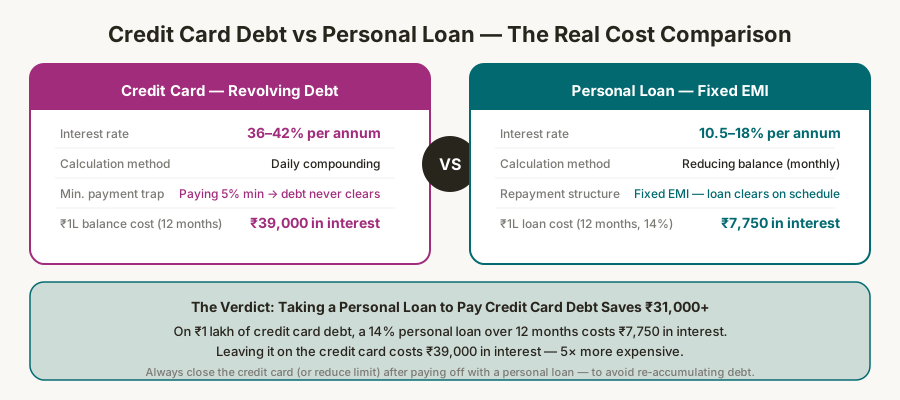
The Staggering Cost of Credit Card Interest
Credit card interest in India is quoted as a monthly rate — typically 3.0–3.5% per month. Annualised:
| Card / Lender | Monthly Rate | Annual Rate |
|---|---|---|
| HDFC Bank Credit Card | 3.49% | 41.88% |
| SBI Credit Card | 3.35% | 40.20% |
| ICICI Bank Credit Card | 3.40% | 40.80% |
| Axis Bank Credit Card | 3.49% | 41.88% |
| Kotak Mahindra | 3.40% | 40.80% |
At 42% per annum on ₹1 lakh outstanding balance:
- Month 1 interest: ₹3,500
- Year 1 total interest (if balance unchanged): ₹42,000
- Effectively: the bank earns your entire ₹1 lakh in interest every 2.4 years
The Minimum Payment Trap — How Long It Really Takes
If you pay only the minimum due (typically 5% of the outstanding or ₹100, whichever is higher):
| Outstanding Balance | Rate | Initial Min. Payment | Months to Clear | Total Interest Paid |
|---|---|---|---|---|
| ₹50,000 | 42% | ₹2,500 | 203 months (~17 years) | ₹1,10,333 |
| ₹1 lakh | 42% | ₹5,000 | 248 months (~21 years) | ₹2,27,000 |
| ₹2 lakh | 42% | ₹10,000 | 294 months (~25 years) | ₹4,60,333 |
Note: computed with minimum payment = 5% of outstanding balance each month (payment shrinks as balance falls), ₹200 floor — the standard structure at most Indian credit card issuers.
You pay more than double what you borrowed in interest. On ₹1 lakh, you pay ₹2,27,000 in interest alone before the debt is cleared — over 20 years of minimum payments.
The Personal Loan Solution — Exact Savings
A personal loan at 14% reducing balance replaces the revolving 42% card debt with a structured, time-limited repayment.
Side-by-side comparison: ₹1 lakh
| Option | Monthly Payment | Total Paid | Interest Paid | Months to Clear |
|---|---|---|---|---|
| Credit card (min. payment only, 42%) | ₹5,000 (initial min.) | ₹3,27,000+ | ₹2,27,000+ | ~248 months (~21 years) |
| Credit card (fixed ₹9,000/month, 42%) | ₹9,000 | ₹1,28,874 | ₹28,874 | 15 months |
| Personal loan at 14%, 12 months | ₹8,979 | ₹1,07,748 | ₹7,748 | 12 months |
| Personal loan at 12%, 12 months | ₹8,885 | ₹1,06,620 | ₹6,620 | 12 months |
Use our personal loan EMI calculator to model your exact scenario.
Choosing a 14% personal loan vs. minimum credit card payments: ₹7,748 vs. ₹2,27,000 in interest — a saving of ₹2,19,252 on the same ₹1 lakh debt.
Even vs. aggressively paying ₹9,000/month on the credit card (which still takes 15 months and costs ₹28,874 in interest at 42%), the personal loan saves over ₹21,000 in interest and clears the debt in 12 months instead of 15.
Where the ₹28,250 saving comes from: If you carry ₹1 lakh on a revolving credit card at 36% per annum and never reduce the principal for a year, the card charges ₹36,000 in interest. A 14% personal loan repaid over 12 months costs only ₹7,748 in interest on the same ₹1 lakh. The difference — ₹28,252 — is what you save by switching, assuming you stop using the card.
When Does the Switch Make Sense?
Switch to a personal loan if:
- Your outstanding credit card balance is above ₹30,000 and won't be cleared within 1–2 billing cycles
- Your card has gone into "revolving" mode — you're paying interest every month
- You're carrying balances on multiple cards
- You're paying only the minimum and the balance isn't declining meaningfully
Don't bother if:
- You can clear the full balance within 1–2 months from income — the personal loan processing fee (1–3%) may cost more than the interest saved
- Your credit card has a 0% EMI conversion facility (if unused balance can be converted to 0% EMI scheme on the card itself)
- Your CIBIL is below 700 — you may not qualify for a personal loan, or the rate may be 18–24%, reducing the benefit. Check your loan eligibility before applying.
How to Execute the Switch
Step 1: Tally all credit card outstanding balances
List every card, its outstanding balance, and the monthly interest rate. Sort by highest rate first.
Step 2: Apply for a personal loan
Target your salary bank first — existing customers get better rates and faster processing. Apply for the amount that covers all card balances plus a 5% buffer (for any interest that accrues during processing).
Step 3: Repay all card balances immediately upon disbursement
Transfer the full personal loan amount to your bank account, then immediately use it to pay every credit card balance in full. Confirm each card shows ₹0 outstanding.
Step 4: Freeze or reduce the credit card limits
This is the critical step most people skip. After paying off your cards with a personal loan:
- Either reduce the credit limit on each card to a nominal amount (₹10,000–₹25,000 for emergencies only)
- Or completely stop using the cards for discretionary spending until the personal loan is repaid
The worst outcome: you clear the cards with the personal loan, continue using the cards, and 6 months later you have both the personal loan EMI AND a new card balance. This double debt load is worse than where you started.
Multi-Card Consolidation Example
A realistic scenario many Indian salaried professionals face:
| Card | Outstanding | Rate |
|---|---|---|
| HDFC Credit Card | ₹45,000 | 41.88% |
| SBI Credit Card | ₹28,000 | 40.20% |
| Axis Bank Credit Card | ₹19,000 | 41.88% |
| Total | ₹92,000 | ~41% blended |
Personal loan consolidation: ₹95,000 at 13%, 2 years.
- Personal loan EMI: ₹4,507/month
- Total interest paid: ₹13,168
- vs. continuing revolving card interest: ~₹37,000–₹45,000/year
Net saving vs. revolving indefinitely: ₹24,000–₹32,000+ over 2 years.
Use our personal loan EMI calculator to plan your consolidation scenario, and the compare loans tool to model keeping the card balance versus a personal loan side by side.
Frequently Asked Questions
Is taking a personal loan to pay off credit card debt a good idea?
Yes — almost always, if your outstanding has gone into revolving mode. Credit card interest (36–42% p.a.) is 3–4× higher than a personal loan (10.5–18% p.a.). The savings are substantial and the personal loan creates a fixed payoff timeline.
Will paying off credit cards with a personal loan improve my CIBIL score?
Yes, in two ways: (1) it reduces your credit card utilisation ratio (a major score factor), and (2) it converts revolving debt (bad for score) to installment debt (better for score). Expect a gradual improvement of 20–60 points over 3–6 months of timely personal loan repayment.
What if I can't get a personal loan because my CIBIL is low?
This is the catch-22: high card debt hurt your CIBIL, which prevents you from getting the personal loan to clear it. Options: (1) negotiate with the card company to convert revolving balance to a card EMI (typically 14–22% rate — better than 42% revolving), (2) ask a family member to co-sign the personal loan, or (3) if you have gold jewellery, use a gold loan at 10–14% to clear the card debt.
Can credit card companies convert my revolving balance to EMI?
Yes — most Indian credit card issuers allow "balance-to-EMI" conversion on request. HDFC, SBI, ICICI, and Axis all offer this. Rates vary (14–22%), and terms are typically 3–36 months. It's not as cheap as a personal loan from a bank, but it's far cheaper than revolving at 42%.
Should I close my credit cards after paying them off?
Closing old cards hurts your CIBIL score (reduces average credit age and total available credit). Instead: reduce the credit limit to a manageable level (₹20,000–₹50,000), use the card for small recurring expenses (utility bills, subscriptions), and pay in full every month. Keep the card open but control how you use it.
Try the calculator
Run your own numbers in seconds. Pick the calculator that fits your loan type.