Home Loan Insurance HLPP India 2026 — Is It Worth It?
HLPP protects your lender, not your family — a ₹1 crore term plan at ₹10,000/year covers more and costs less. Here is when to take HLPP and when to decline.
Key Takeaways
- HLPP is NOT mandatory — RBI and IRDAI have explicitly stated that banks cannot condition a home loan sanction on buying their insurance product.
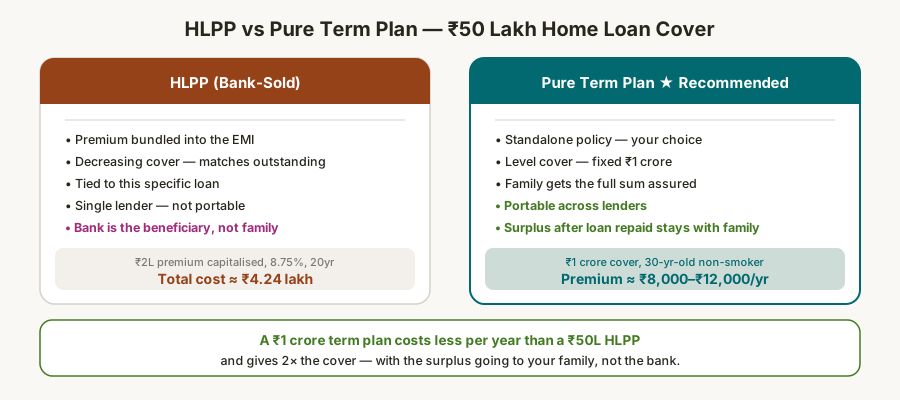
- A ₹2 lakh HLPP premium capitalised into a ₹50 lakh loan at 8.75% for 20 years costs you a total of ₹4.24 lakh (premium + extra interest over 20 years).
- A pure term plan of ₹1 crore cover for a 30-year-old male non-smoker costs approximately ₹8,000–₹12,000 per year — often less than an annual HLPP premium and provides far more cover.
- HLPP cover goes directly to the bank on the borrower's death; a term plan's surplus after loan repayment goes to your family.
You walk into a bank to finalise your home loan, and the relationship manager slides an insurance proposal across the table with the words: "Sir, this is mandatory — we need insurance cover before we can sanction." This is a script played out in branches across India every week. It is also factually incorrect. HLPP (Home Loan Protection Plan), also called mortgage reducing term assurance (MRTA), is an optional product. Understanding what it is, what it actually costs, and when — if ever — it makes financial sense is one of the most valuable exercises you can do before signing your loan documents.
What Is HLPP?
A Home Loan Protection Plan is an insurance policy designed to pay off the outstanding loan balance if the borrower dies during the loan tenure. In some plans, critical illness and total permanent disability are also covered. The key distinguishing feature is that the lender is the beneficiary, not your family. When a claim is made, the insurer pays the outstanding loan principal to the bank. The borrower's family receives nothing over and above the loan payoff — and if the outstanding balance is less than the insured sum assured (in level-cover plans), only the outstanding amount may be released.
Unlike a regular life insurance policy, HLPP is tied to a specific loan. It has no surrender value in most cases, and it lapses automatically when the loan is repaid, transferred, or foreclosed.
Is HLPP Mandatory? Know Your Rights
No. HLPP is not mandatory. This is not ambiguous.
The Insurance Regulatory and Development Authority of India (IRDAI) issued guidelines (Circular No. IRDA/Life/Cir/LB/023/03/2023 and preceding circulars) making it clear that insurers and banks cannot mandate the purchase of any insurance product as a precondition for loan sanction. The RBI has reinforced this through its Fair Practices Code for Lenders — any bundling of mandatory insurance with a loan product is classified as a mis-selling practice and can be reported to the Banking Ombudsman.
Why do banks still push HLPP aggressively? Because banks and NBFCs earn substantial commissions from insurance companies — often 20–40% of the first-year premium. For a ₹1.5 lakh single premium HLPP product, the bank branch might earn ₹30,000–₹60,000 as referral commission. The commercial incentive is significant.
If a bank RM tells you HLPP is required for sanction, ask them to put that condition in writing on official letterhead. They will not do it.
Types of HLPP Policies
Reducing Cover (Decreasing Term Assurance)
The most common and cheapest HLPP variant. The sum assured reduces over time in line with the outstanding loan balance. In Year 1, you are covered for approximately ₹50 lakh (the original loan); by Year 15, your cover might be ₹20 lakh (the remaining balance).
This is the purest product for protecting the loan — it covers exactly what is owed at any point. Premium is low because the insurer's risk reduces as the loan is repaid.
Level Cover (Level Term Assurance)
Sum assured stays fixed at the original loan amount throughout the tenure. More expensive than reducing cover because the insurer carries full risk even in Year 18 when only ₹5 lakh may be outstanding.
The surplus (cover minus outstanding balance) is paid to the nominee — meaning your family does receive something beyond the loan payoff. This makes it conceptually closer to a regular term plan, but it still lacks portability and flexibility.
Critical Illness and Disability Riders
Some HLPP products add riders for critical illness (typically 36 listed conditions) and total permanent disability. These widen the trigger conditions beyond death — if the borrower is diagnosed with cancer, heart disease, or kidney failure, the outstanding loan is waived. These riders add 20–40% to the premium.
The True Cost Comparison: HLPP vs Term Insurance
This is where the financial calculus becomes decisive for most borrowers.
Scenario: ₹50 lakh home loan, 30-year-old male borrower, non-smoker, 20-year tenure.
| Cover Type | Sum Assured | Annual Premium (approx) | Covers Loan Outstanding? | Surplus for Family | Portable If Switching Lender? |
|---|---|---|---|---|---|
| HLPP — Reducing Cover | Reduces from ₹50L to ₹0 | ₹15,000–₹20,000/yr or ₹1.5–₹2L single premium | Yes, exactly | None | No |
| HLPP — Level Cover | ₹50L fixed | ₹20,000–₹30,000/yr | Yes, outstanding + surplus | Surplus above outstanding | No |
| Pure Term Plan (₹1 crore) | ₹1 crore fixed | ₹8,000–₹12,000/yr | Yes (family repays loan from proceeds) | ₹50L+ after loan repayment | Yes — unlinked to loan |
The term plan scenario deserves unpacking. If you hold a ₹1 crore term plan and die in Year 10 of a ₹50 lakh home loan (with, say, ₹32 lakh still outstanding), your family receives ₹1 crore from the insurer. They repay ₹32 lakh to the bank and retain ₹68 lakh — a substantial inheritance and financial buffer. With an HLPP, the bank gets ₹32 lakh and your family gets nothing from the insurance.
A ₹1 crore term plan for a healthy 30-year-old male non-smoker from major insurers (LIC, HDFC Life, ICICI Prudential, SBI Life) typically costs ₹8,000–₹12,000 per year for a 30-year tenure. That is often less than the annual HLPP premium for just ₹50 lakh reducing cover — and the term plan provides double the cover with family benefit.
The Capitalised Premium Trap
Here is where HLPP truly becomes expensive in ways most borrowers do not realise until it is too late.
Banks frequently offer (or pressure) borrowers to add the HLPP single premium directly to the loan amount — meaning instead of paying ₹2 lakh upfront for the insurance, the ₹2 lakh is added to your principal. Your loan becomes ₹52 lakh instead of ₹50 lakh.
The result: you pay interest on the insurance premium for the entire loan tenure.
EMI without HLPP (₹50 lakh, 8.75%, 20 years): ₹44,186 per month. Use our home loan EMI calculator to verify this for your own loan amount.
EMI with ₹2 lakh HLPP capitalised (₹52 lakh, 8.75%, 20 years): ₹45,953 per month.
| Without HLPP | With ₹2L HLPP Capitalised | Difference | |
|---|---|---|---|
| Loan principal | ₹50,00,000 | ₹52,00,000 | ₹2,00,000 |
| Monthly EMI | ₹44,186 | ₹45,953 | ₹1,767/month |
| Total interest paid | ₹56,04,640 | ₹58,28,720 | ₹2,24,080 |
| True cost of HLPP | — | ₹2,00,000 + ₹2,24,080 | ₹4,24,080 |
The ₹2 lakh insurance premium becomes a ₹4.24 lakh expense over 20 years once you account for the interest you pay on the capitalised amount. That is a 112% markup on the premium's face value — and this is before considering that a ₹1 crore term plan costs less annually and provides superior coverage.
To see how your amortization schedule changes with and without a capitalised premium, use our amortization calculator to model the loan balance trajectory.
When HLPP Might Actually Make Sense
Despite the clear financial disadvantage in most scenarios, there are genuine situations where HLPP is the right product:
Single-Income Families Without Existing Life Cover
If you have no existing life insurance and your family is entirely dependent on your income, HLPP provides immediate loan protection from Day 1. It is not ideal, but it is better than nothing. In this situation, the right sequence is: (1) buy a standalone term plan that covers the loan and more, (2) decline the HLPP.
Borrowers Who Are Uninsurable for Term Insurance
Age (above 60), pre-existing health conditions (diabetes, heart disease, hypertension), or high-risk occupation may make a standalone term plan either very expensive or outright unavailable. HLPP underwriting is simpler — some products offer group cover with minimal medical examination. For a borrower who cannot get term insurance at a reasonable premium, HLPP may be the only available protection.
Joint Home Loan — One Partner Uninsurable
In a joint loan where one co-borrower cannot qualify for term insurance, adding that partner's coverage through HLPP can close the protection gap.
Very Small Loan Amounts
For a ₹10–15 lakh loan, the absolute rupee cost of HLPP is modest, and the convenience of tied coverage may outweigh the disadvantages. However, even here, a term plan is worth exploring first.
How to Decline HLPP — A Step-by-Step Guide
-
Politely decline at the time of offer. Say clearly: "I understand HLPP is optional under IRDAI guidelines. I would like to proceed without it."
-
If the RM insists it is mandatory, ask them to provide this requirement in writing on a bank letterhead signed by the branch manager. No branch will do this — it constitutes mis-selling documentation.
-
Send a written email to the branch manager before loan disbursement confirming that you have declined HLPP and requesting that loan sanction proceed without any insurance bundling. Keep this email as a record.
-
Cite IRDAI Circular reference if needed. The IRDAI's Master Circular on Group Insurance, issued in 2023, and preceding guidance from 2016 and 2020 all prohibit mandatory bundling of insurance with credit products.
-
Escalate to Banking Ombudsman if required. If a bank conditions your loan sanction on buying their HLPP, this is a complaint-worthy mis-selling act under RBI's Integrated Ombudsman Scheme, 2021.
Once you have declined HLPP and your loan proceeds, consider using the prepayment calculator to model how directing the money you save (the HLPP premium) toward part-prepayments each year would reduce your loan tenure and total interest cost.
Is HLPP Premium Tax Deductible?
Partially, and with conditions.
Under the Old Tax Regime, HLPP premiums may qualify for deduction under Section 80C (up to ₹1.5 lakh per year combined across all 80C instruments) if the HLPP is a life insurance policy. However, the 80C limit is a shared bucket — if you are already using ₹1.5 lakh for PPF, ELSS, and principal repayment, there is no headroom for HLPP.
Under the New Tax Regime (default from FY2023–24), Section 80C is not available. HLPP premiums are not deductible.
In all cases, consult a CA to confirm applicability for your specific HLPP product structure, as group insurance products sold through banks may have different tax treatment than individual life insurance policies.
HLPP vs Term Insurance — The Final Verdict
For most borrowers taking a home loan in 2026, the optimal strategy is:
- Buy a standalone term insurance plan covering 10–12 times your annual income (or at least 1.5 times the loan amount) from a reputable insurer. For a 30-year-old, a ₹1 crore term plan for 30 years costs ₹8,000–₹12,000/year.
- Decline the HLPP offered by the bank.
- If you already have adequate life insurance coverage, there is almost no scenario where the HLPP adds meaningful value.
The exception: if you genuinely cannot qualify for standalone life insurance, HLPP closes a critical protection gap — accept it, but understand its limitations.
For broader strategies on reducing your home loan cost, see our guide on 7 proven ways to reduce your home loan EMI.
Frequently Asked Questions
Can the bank force me to buy HLPP?
No. IRDAI and RBI guidelines both prohibit banks from making insurance purchase a precondition for loan sanction. If a bank insists that HLPP is mandatory, ask for the requirement in writing. They cannot provide it. You can report forced bundling to the RBI Integrated Ombudsman (ombudsman.rbi.org.in) and the IRDAI grievance portal (igms.irda.gov.in).
What is the difference between HLPP and term insurance?
HLPP pays off your outstanding loan balance to the lender if you die — your family receives nothing beyond the loan being cleared. A term insurance plan pays the full sum assured to your nominee (your family), who can then choose to repay the loan and keep the remainder. Term plans are also portable (not tied to a specific loan), cost less per unit of cover, and can be continued even after you switch lenders.
Is HLPP premium tax deductible?
Under the Old Tax Regime, HLPP premiums paid for a life insurance policy may qualify under Section 80C (combined limit of ₹1.5 lakh across all 80C instruments). Under the New Tax Regime (default from FY2023–24), Section 80C deductions are not available, so HLPP premiums provide no tax benefit. Consult a CA for your specific product.
Can I cancel HLPP after taking it?
Yes. IRDAI regulations mandate a free-look period of 30 days from policy receipt for life insurance products. Within this period you can cancel and receive a full refund (minus any stamp duty and proportionate premium for the cover period used). After the free-look period, surrendering an HLPP depends on the specific policy terms — most reducing-term HLPPs have no surrender value after the free-look period. Check your policy document for the exact terms.
What happens to HLPP if I foreclose the loan?
If you repay the loan early (foreclose), the HLPP policy typically terminates automatically or can be surrendered. Whether you receive a refund depends on the policy type: single-premium reducing term plans may provide a partial refund of the unused premium (calculated on an actuarial basis) upon early termination. Level-cover plans are more likely to have a refund provision. Check the policy schedule for the exact terms before foreclosing. Use our prepayment calculator to model the savings from early repayment.
Does HLPP cover job loss?
Standard HLPP (reducing term or level term assurance) does not cover job loss or income interruption — it covers only death, and optionally critical illness or permanent disability if a rider was purchased. A very small number of group insurance products sold through banks include a limited EMI waiver for involuntary job loss (typically for 3–6 months), but these are uncommon and the coverage is narrow. Do not rely on HLPP as a buffer against unemployment; an emergency fund of 6 months of EMIs is a far more reliable approach.
Try the calculator
Run your own numbers in seconds. Pick the calculator that fits your loan type.