Education Loan Repayment Guide 2026 — EMI & Prepayment Strategy
Your education loan repayment is not fixed — step-up EMIs, prepayment and balance transfer can each cut years off your loan. Here is how to use every lever.
Key Takeaways
- Your repayment schedule depends on whether moratorium interest is paid as you go or capitalized — paying it as you go can save 15%+ in total interest (see worked example).
- Most lenders bill moratorium interest quarterly, not monthly — so check your account every 3 months, not just when EMI starts.
- Step-up EMI plans let fresh graduates start with a lower EMI that rises with their salary — useful if your first job pays less than your loan was sized for.
- RBI bars prepayment penalties on floating-rate education loans — use your first bonus to prepay rather than invest, especially in years 1–3.
- Education loan balance transfer after 1–2 years of employment (once you have a credit history) can shave 1.5–3% off your rate — often a bigger saving than any single prepayment.
The day your education loan repayment schedule kicks in, most borrowers treat it as fixed: an EMI amount, a tenure, a due date, repeat for 8–15 years. In reality, the repayment phase of an education loan has more flexibility — and more traps — than almost any other loan type.
This guide picks up exactly where the moratorium ends and walks through the five decisions that determine how much you actually pay: how to read your repayment schedule, what quarterly interest billing means, whether to take a step-up EMI, when to prepay, and when to do a balance transfer.
How to Read Your Education Loan Repayment Schedule
A repayment schedule (also called an amortization table) is a month-by-month breakdown of every EMI into three numbers: how much goes to interest, how much goes to principal, and what's still outstanding afterwards. For an education loan, three things make this table different from a home or car loan schedule:
- The starting principal usually isn't your disbursed amount. If interest accrued during the moratorium was capitalized, row 1 of your schedule starts from disbursed amount + accrued interest — not the original sanctioned figure.
- The interest-to-principal ratio is more front-loaded for long-tenure loans (12–15 years), because reducing-balance interest compounds longer on a larger opening balance.
- Tenure often starts from the day repayment begins, not the disbursement date — so a "10-year loan" can mean 12.5 years from first disbursement once you add the moratorium.
To generate your own schedule, use our education loan EMI calculator — enter the post-moratorium principal (not the disbursed amount, unless you paid interest during the moratorium) and your remaining repayment tenure. The calculator returns the full amortization table along with total interest, which doubles as an education loan interest calculator for tax-planning purposes (more on that below).
The Moratorium Decision That Shapes Your Whole Schedule
Before the first EMI is even calculated, one decision has already determined your repayment schedule: what happened to the interest that accrued during your moratorium.
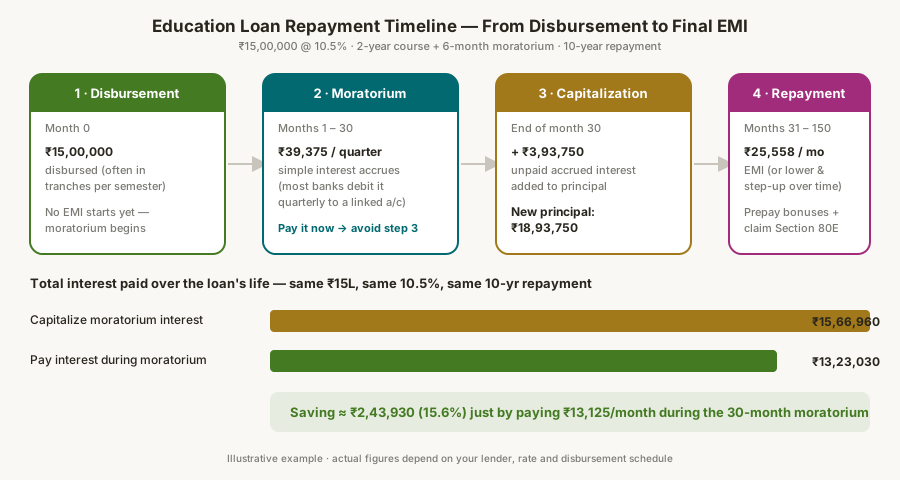
Worked example — ₹15,00,000 at 10.5%, 2-year course + 6-month moratorium (30 months), 10-year repayment:
| Capitalize interest | Pay interest during moratorium | |
|---|---|---|
| Principal when EMI starts | ₹18,93,750 | ₹15,00,000 |
| Monthly EMI (120 months) | ₹25,558 | ₹20,244 |
| Interest paid during moratorium | ₹0 (added to principal) | ₹3,93,750 (paid as ₹13,125/month) |
| Interest paid during repayment | ₹11,73,210 | ₹9,29,280 |
| Total interest over loan's life | ₹15,66,960 | ₹13,23,030 |
Paying ₹13,125 a month during a 30-month moratorium — typically funded by parents while the student studies — saves roughly ₹2.44 lakh (15.6%) in total interest on this ₹15 lakh loan. That's the single highest-leverage decision in the entire repayment lifecycle, and it's made before repayment officially starts.
Quarterly interest billing during moratorium
Here's a detail that trips up a lot of families: most banks don't wait until the moratorium ends to tell you about accrued interest. SBI, Bank of Baroda, and most PSU lenders debit (or invoice) simple interest on the disbursed amount every quarter during the course period — even though no EMI is technically due. In the example above, that's ₹39,375 every three months.
If this quarterly interest demand goes unpaid, it simply accumulates and gets capitalized at the end of the moratorium — leading straight to the ₹18,93,750 column above. If you can pay it each quarter, you land in the cheaper column instead. Either way, check your loan account statement every quarter, not just when EMI debits begin — quarterly interest is the most commonly missed line item on an education loan.
Step-Up EMI — Repayment That Grows With Your Salary
Several lenders (SBI, Bank of Baroda, HDFC Credila among others) offer a step-up EMI option specifically for education loans: instead of a flat EMI for the full tenure, the EMI starts lower and increases — typically by 5–10% every year — on the assumption that a fresh graduate's salary will grow.
| Year | Flat EMI | Step-up EMI (illustrative, +7%/yr) |
|---|---|---|
| Year 1 | ₹25,558 | ₹19,800 |
| Year 3 | ₹25,558 | ₹22,650 |
| Year 5 | ₹25,558 | ₹25,925 |
| Year 8 | ₹25,558 | ₹31,750 |
Why it matters: If your first job's take-home pay is tight, a step-up plan keeps your FOIR (Fixed Obligation to Income Ratio) manageable in year 1, when it matters most for rent, deposits and settling-in costs. The trade-off is that total interest is usually 3–6% higher than a flat EMI over the same tenure, because less principal is repaid in the early years.
When to choose it: If your offer letter shows a CTC that's meaningfully below what the lender assumed when sizing your flat EMI, a step-up plan is often the difference between comfortably managing the loan and missing early EMIs. If your starting salary already comfortably covers the flat EMI, skip step-up — the extra interest isn't worth it.
Prepayment Strategies for Education Loans
Once repayment begins, prepayment is the most direct way to shorten the schedule — and education loans have one big advantage here: RBI prohibits prepayment penalties on floating-rate retail loans, including education loans, for individual borrowers. Most education loans in India are floating-rate, so prepaying is free.
A few rules of thumb specific to education loans:
- First job bonuses and joining bonuses are the highest-impact prepayments. Because interest is front-loaded on a reducing-balance schedule, a lump sum applied in year 1 or 2 of repayment removes interest that would otherwise compound for the remaining 8–10 years.
- Choose "reduce tenure" over "reduce EMI" when you prepay, unless your monthly cash flow is genuinely tight. Reducing tenure locks in the interest saving immediately; reducing EMI just spreads the same principal over the same period at a lower monthly outflow.
- Don't drain your emergency fund to prepay. A first job comes with irregular expenses — deposits, relocation, a notice period without pay if you switch jobs. Keep 3–6 months of expenses aside before directing surplus to prepayment.
- Recompute your schedule after every prepayment. Use the prepayment calculator to see the updated tenure or EMI and the revised total interest — this is also useful for deciding how much to prepay rather than just whether to.
Education Loan Balance Transfer — Refinance Once You're Employed
This is the lever most borrowers never consider, and it's often bigger than any single prepayment: transferring your outstanding education loan to a new lender at a lower rate, once you have an employment history and a credit score to show for it.
Here's why it works specifically for education loans: the rate you were offered as a student depended on your co-applicant's profile and the lender's risk view of an unsecured (or lightly secured) loan to someone with no income. Two years into a job, with a CIBIL score of 750+ and a salary slip, you are now the bankable applicant — and banks compete hard for exactly this profile.
Illustrative numbers — ₹15,00,000 outstanding, 8 years (96 months) remaining (use the compare loans tool to model your own balance transfer numbers):
| Original lender (NBFC, 11.5%) | New lender (PSU bank, 9%) | |
|---|---|---|
| EMI | ₹23,969 | ₹21,975 |
| Total remaining payments | ₹23,01,024 | ₹21,09,600 |
That's roughly ₹1.91 lakh saved over the remaining tenure — before accounting for a one-time transfer/processing fee of 0.5–1% (₹7,500–₹15,000 on this outstanding amount), which still leaves a net saving of ~₹1.76–1.84 lakh.
When balance transfer makes sense:
- You're at least 12–18 months into stable employment with on-time EMI payments (lenders want to see this track record).
- Your CIBIL score has crossed 700–750, typically achievable within 1–2 years of consistent EMI and credit card payments.
- The rate gap is at least 1.5–2% — below that, processing fees and paperwork can erode most of the saving.
- You have at least 4–5 years of tenure remaining — balance transfer on the last year or two of a loan rarely pays back the fees.
Timing Section 80E With Your Repayment Plan
Section 80E gives you an uncapped deduction on interest paid, for 8 consecutive years starting from the year you begin repaying — available under the Old Tax Regime only (not available if you have opted for the New Tax Regime). This creates a genuine planning question once you start prepaying aggressively or doing a balance transfer:
- Aggressive prepayment shortens your loan to, say, 5–6 years — meaning you stop generating 80E-eligible interest 2–3 years before the 8-year window closes. You "lose" the unused years, but you've already paid less total interest, so this is rarely a bad trade — it's just worth knowing you won't get the full 8 years of deduction.
- Balance transfer resets the loan but not the 8-year clock — the clock is tied to when you started repaying the original loan, not which lender currently holds it. Keep your original loan's first-EMI date documented; you'll need it (along with interest certificates from both lenders, for the year of transfer) when filing your return.
- If you paid interest during the moratorium, talk to a tax advisor about whether that counts toward your 8-year window — treatment can depend on whether those payments are classified as "repayment" by your specific lender's documentation.
What To Do If You Can't Pay an EMI
If a job loss, a lower-than-expected salary, or unexpected expenses mean an EMI is at risk, contact your lender before you miss it — not after. Education loan lenders, especially PSU banks, have more flexibility here than for other retail loans:
- Moratorium extension: a further 6–12 months grace, usually available once, for documented hardship (genuine unemployment, medical emergency).
- Tenure restructuring: extending the repayment period to lower the EMI, recalculated on your outstanding principal at the current rate.
- EMI holiday: a short pause (1–3 months) with interest continuing to accrue — useful for a temporary cash crunch, not a long-term fix.
A missed EMI (even one) is reported to credit bureaus and will affect your CIBIL score for years — which, per the balance transfer section above, is also the thing you need to refinance to a cheaper rate later. Proactively restructuring is almost always better than missing a payment and dealing with both the lender and your credit score afterwards.
Frequently Asked Questions
How do I calculate my education loan repayment schedule?
Use an education loan EMI calculator and enter your post-moratorium principal — your original disbursed amount plus any capitalized interest, or just the disbursed amount if you paid interest during the moratorium — along with your interest rate and remaining repayment tenure. The calculator generates a full month-by-month schedule showing the principal and interest split for every EMI.
Are education loan EMIs paid monthly or quarterly?
EMIs during the repayment phase are paid monthly, like any other loan. However, during the moratorium (before EMIs start), most lenders bill simple interest on a quarterly basis. If you see a "quarterly interest" debit or demand notice while you're still studying, that's normal — it's not an EMI, and paying it prevents that interest from being added to your principal later.
Can I use this as an education loan interest calculator?
Yes. The results section of our education loan EMI calculator shows total interest payable separately from the principal repaid — both for the repayment phase and, if you include the moratorium details, the interest that accrues before EMIs begin. This total interest figure is also what you'd reference (alongside your lender's interest certificate) for Section 80E tax planning.
Is there a penalty for prepaying or foreclosing an education loan?
No, for floating-rate education loans. RBI directives prohibit lenders from charging prepayment or foreclosure penalties to individual borrowers on floating-rate loans, and most education loans in India are floating-rate. Always confirm the rate type on your sanction letter — a small minority of fixed-rate education loans from select NBFCs may still carry a 2–4% prepayment charge.
Should I choose a step-up EMI for my education loan?
Choose step-up EMI if your starting salary is tight relative to the flat EMI quoted at sanction — it lowers your EMI in the early years and increases it gradually (often 5–10% annually) as your income grows. The trade-off is 3–6% higher total interest over the loan's life compared to a flat EMI. If your salary comfortably covers the flat EMI from day one, a flat EMI saves more overall.
When should I do an education loan balance transfer?
Typically after 12–18 months of steady employment and on-time EMI payments, once your CIBIL score has improved to 700+. A balance transfer makes sense if the new lender's rate is at least 1.5–2% lower than your current rate and you have several years of tenure remaining — the saving needs to be large enough to outweigh the one-time transfer/processing fee (usually 0.5–1% of the outstanding balance).
Try the calculator
Run your own numbers in seconds. Pick the calculator that fits your loan type.