7 Proven Ways to Reduce Your Home Loan EMI in India (2026 Guide)
Paying too much on your home loan every month? These seven strategies — from balance transfer to prepayment timing — can reduce your EMI by ₹1,500–₹6,000 a month without cutting corners.
Key Takeaways
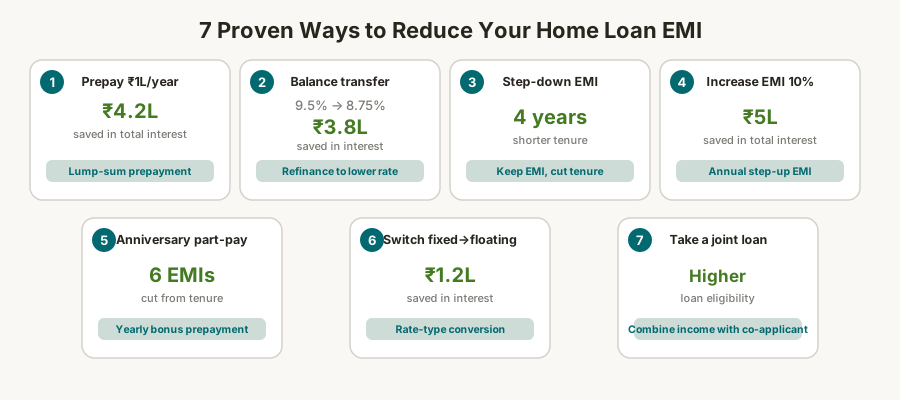
- A 50 bps rate reduction on a ₹50 lakh, 20-year loan saves ₹1,600/month and ₹3.8 lakh in total interest.
- Balance transfer is the single most impactful lever — but only if the rate gap is ≥ 50 bps and tenure remaining is > 7 years.
- Increasing your EMI by just 10% reduces a 20-year loan tenure by nearly 3 years. Use our step-up EMI calculator to model exactly how much tenure and interest you save with different annual increment rates.
- The best time to prepay is in the first half of the loan when your outstanding interest is highest.
Your home loan EMI is probably the single largest monthly outgo in your household budget. In 2026, with home loan rates between 8.40% and 9.50% for most borrowers, a ₹60 lakh loan over 20 years costs you roughly ₹53,000 a month — and over ₹67 lakh in interest alone. That is more than the principal you borrowed.
The good news: you have more levers than you think. These seven strategies are not theoretical — they are used by financially savvy homeowners across India to cut their EMI burden meaningfully. Some require a phone call to your bank; others require nothing more than tweaking your repayment strategy.
1. Negotiate a Rate Reset with Your Existing Lender
If your home loan is more than two years old and you have a clean repayment track record, you are likely paying a spread above the current EBLR (External Benchmark Lending Rate) that was set when you first took the loan. Banks routinely offer new customers lower spreads to win business — but they rarely pass those savings to existing borrowers automatically.
How to do it
Call your lender's retention team (not customer care) and ask for a "rate reset" or "spread reduction." Come prepared:
- Your current outstanding loan balance
- Current applicable rate vs. the rate being offered to new customers of the same lender
- A competing offer (a sanction letter from another bank helps enormously)
Most public-sector banks charge a nominal fee of ₹3,000–₹5,000 for a rate reset. Private banks may charge up to 0.5% of the outstanding balance, which changes the calculus if the outstanding amount is large.
What to expect
A 25–50 bps reduction is achievable for most prime borrowers (CIBIL 750+). On a ₹50 lakh outstanding balance at 9.0%, dropping to 8.5% reduces your EMI by approximately ₹1,600 per month and saves ₹3.8 lakh over the remaining tenure.
2. Transfer Your Loan to a Lower-Rate Lender (Balance Transfer)
A home loan balance transfer is the nuclear option — and often the most effective one. You shift your outstanding principal to a lender offering a significantly lower rate, which can immediately reduce your EMI or shorten your tenure. Use our home loan balance transfer guide to see whether a transfer makes sense for your situation.
When a balance transfer makes financial sense
| Condition | Rule of Thumb |
|---|---|
| Rate gap | ≥ 50 bps after all transfer costs |
| Remaining tenure | > 7 years (interest component still high) |
| Outstanding balance | > ₹20 lakh (to justify fixed costs) |
| Break-even period | < 18 months |
Transfer costs to factor in
- Processing fee at new lender: 0.25–0.5% of loan amount
- Legal/technical fee: ₹5,000–₹15,000
- Foreclosure charges at current lender: Nil for floating-rate loans (RBI mandate)
- Stamp duty on new agreement: Varies by state (₹500–₹5,000)
Example
₹45 lakh outstanding, 12 years remaining, current rate 9.15%. New lender offers 8.50%. EMI drops from ₹51,600 to ₹49,950 — a saving of ₹1,650/month or ~₹19,800/year. Transfer cost: ~₹18,000. Break-even: under 12 months.
Use our home loan EMI calculator to model your specific numbers before approaching a new lender.
3. Make a Lump-Sum Prepayment to Reduce the Principal
The fastest way to reduce your EMI permanently — without touching the interest rate — is to reduce the outstanding principal. When you prepay, you can instruct your lender to either:
- Reduce your EMI (keeping tenure the same), or
- Reduce your tenure (keeping EMI the same)
Reducing EMI is the right choice if your monthly cash flow is tight. Reducing tenure saves significantly more total interest — but only choose this if your EMI is already manageable.
Prepayment impact: ₹50 lakh loan, 9% rate, 15 years remaining
| Prepayment Amount | EMI Reduction | Interest Saved |
|---|---|---|
| ₹2 lakh | ₹2,028/month | ₹1.7 lakh |
| ₹5 lakh | ₹5,071/month | ₹4.1 lakh |
| ₹10 lakh | ₹10,142/month | ₹8.3 lakh |
Timing matters
Prepay in the early years of the loan. Because of how amortization works, 80–85% of each EMI in the first few years is interest, not principal. A ₹5 lakh prepayment in year 3 saves 2–3× more interest than the same payment in year 12. Use our amortization table to see your current principal vs. interest split, and our prepayment calculator to model how much interest a lump-sum payment saves you.
4. Increase Your EMI Annually (Step-Up EMI Strategy)
Most borrowers set their EMI once and never revisit it. A disciplined strategy is to increase your EMI by 5–10% every year — matching your salary increments. This reduces your effective tenure dramatically.
Step-up EMI impact on a ₹40 lakh loan at 8.75%, 20 years
| Annual EMI Increase | Tenure Reduction | Total Interest Saved |
|---|---|---|
| 0% (baseline) | 20 years | — |
| 5% per year | 14.5 years | ₹11.2 lakh |
| 10% per year | 11.8 years | ₹18.7 lakh |
Increasing your EMI by 10% in year 1 is the equivalent of paying ~₹3,600 more on a ₹40,000 EMI — a manageable increase that shaves over 8 years off your loan.
Ask your bank to formalize a step-up plan or simply increase your standing instruction amount annually after your appraisal.
5. Extend Your Loan Tenure (Short-Term Relief)
This is the least glamorous option but sometimes the right one: if you are under acute cash-flow pressure, extend your remaining tenure to bring down the current EMI.
Important caveats
- Your total interest outgo increases significantly with tenure extension.
- Most lenders allow this once during the loan life; some charge a fee (₹2,000–₹5,000).
- This is a relief valve, not a wealth-building strategy. Use it only if genuinely necessary — and commit to prepaying aggressively once cash flow improves.
When it makes sense
Your EMI-to-income ratio has crossed 50% due to a job change, salary cut, or a family emergency. Extending tenure by 3–5 years brings it back to a sustainable 35–40% while you stabilize.
6. Optimize Your Loan Structure (Top-Up Loan vs. High-Rate Debt)
If you carry high-interest personal loans (12–18%), credit card debt (36–42%), or a car loan (9–11%) alongside your home loan, your effective monthly debt burden is disproportionately high.
A home loan top-up — borrowed at 8.5–9.5% against your home equity — can consolidate this expensive debt at a much lower rate.
Example
Existing home loan: 8.75%. Outstanding personal loan: ₹8 lakh at 15%. Monthly personal loan EMI: ₹18,500 (5-year tenure).
Take a ₹8 lakh home loan top-up at 8.75%. Monthly top-up EMI (10 years): ₹9,900. Monthly saving: ₹8,600. Interest saving: ₹6.4 lakh.
The top-up EMI extends your home loan obligation, but the net monthly outflow drops immediately, freeing cash for prepayments.
7. Leverage Your Bank Relationship for Better Terms
Banks price risk dynamically. If your financial profile has improved since you took the loan — higher CIBIL score, salary increase, lower overall debt — you have grounds to renegotiate.
Relationship leverage checklist
- CIBIL score improvement: If your score has moved from 720 to 780+ since loan origination, you qualify for the prime rate at most banks.
- Salary certificate: A 30%+ salary increase since the loan was sanctioned strengthens your negotiating position significantly.
- Additional account relationships: Having a salary account, FDs, or mutual fund investments with the same bank gives you leverage to ask for rate preferment.
- Competitor offers: A sanction letter from HDFC, SBI, or any competing lender — even if you don't intend to transfer — is the most powerful negotiating tool you have.
Banks prefer retaining existing customers over losing them. The cost of acquiring a new ₹50 lakh home loan customer (marketing, processing, compliance) is estimated at ₹15,000–₹25,000. A 25 bps rate reduction to retain you costs them far less.
Which Strategy Should You Use First?
The right approach depends on your situation:
| Your Situation | Best Strategy |
|---|---|
| Rate is ≥ 50 bps above current market | Balance transfer (Strategy 2) |
| Clean repayment history, same lender | Rate reset negotiation (Strategy 1) |
| Windfall income (bonus, inheritance) | Lump-sum prepayment (Strategy 3) |
| Consistent salary increments | Step-up EMI (Strategy 4) |
| Acute cash-flow pressure | Tenure extension (Strategy 5) |
| Carrying high-interest debt | Debt consolidation via top-up (Strategy 6) |
| Improved financial profile | Relationship renegotiation (Strategy 7) |
The most powerful approach is combining strategies: negotiate a rate reset first, then apply lump-sum prepayments when you have surplus funds, while gradually stepping up your EMI annually.
Frequently Asked Questions
Can I reduce my home loan EMI without a balance transfer?
Yes. Rate reset negotiation with your existing lender, lump-sum prepayments, or extending your tenure all reduce your EMI without changing your lender. A balance transfer is more impactful but involves paperwork and switching costs.
How much does a 0.5% rate reduction save on a ₹50 lakh loan?
On a ₹50 lakh loan with 15 years remaining, a 0.5% rate reduction (e.g., from 9.0% to 8.5%) reduces your EMI by approximately ₹1,475/month and saves ₹2.65 lakh in total interest.
Do banks charge for home loan prepayment in India?
No. The RBI mandates that banks cannot charge prepayment penalties on floating-rate home loans. Fixed-rate loans may have prepayment penalties — check your loan agreement.
What is the minimum prepayment amount for a home loan?
Most banks have a minimum prepayment amount of one EMI or ₹10,000, whichever is higher. Some lenders allow as little as ₹5,000.
Is a home loan balance transfer worth the paperwork?
If the rate gap is ≥ 50 bps and your remaining tenure is over 7 years, yes — the paperwork is a one-time effort for years of savings. On a ₹40 lakh outstanding balance with 10 years remaining, a 0.75% rate reduction saves close to ₹1.9 lakh in interest.
How often can I prepay my home loan?
There is no legal limit on how often you can prepay. Most banks process prepayments with 3–7 business days' notice. You can prepay monthly, quarterly, or annually — as often as you have surplus funds.
Will requesting a rate reset affect my CIBIL score?
No. A rate reset negotiation is an internal banking process and does not involve a fresh credit inquiry. A balance transfer, however, does trigger a hard inquiry at the new lender, which may temporarily reduce your CIBIL score by 5–10 points.
Try the calculator
Run your own numbers in seconds. Pick the calculator that fits your loan type.