Home Loan Eligibility by Salary India 2026 — FOIR-Based Guide
Discover exactly how much home loan you can get on any salary from ₹25,000 to ₹1.5 lakh per month, using the FOIR formula banks actually apply in 2026.
Key Takeaways
- On a net monthly salary of ₹50,000, most banks will sanction a home loan of up to ₹28.29 lakh at 8.75% for 20 years, assuming no other EMI obligations.
- The standard FOIR limit is 50% — meaning your total monthly debt payments, including the new home loan EMI, cannot exceed half your net income.
- Extending tenure from 20 to 30 years on a ₹50,000 salary raises maximum loan eligibility from ₹28.29 lakh to ₹31.78 lakh at 8.75% — a ₹3.49 lakh difference.
- Adding a co-applicant with an equal income effectively doubles your eligible loan amount — from ₹28.29 lakh to ₹56.58 lakh at the same rate and tenure.
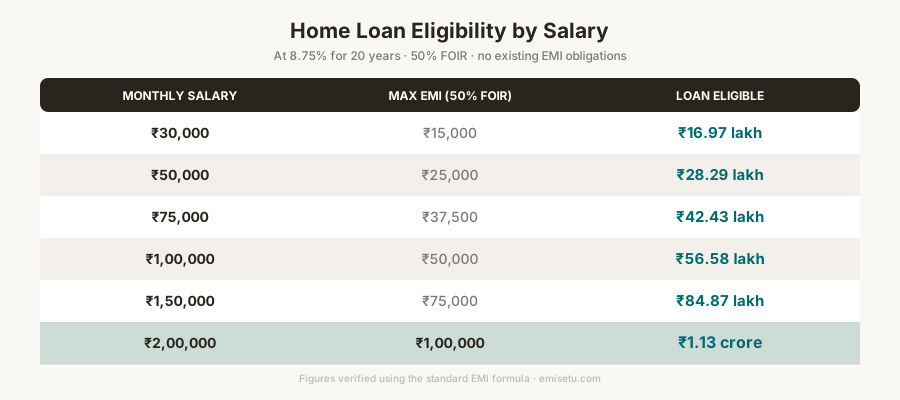
Every home loan application begins with the same question your bank will ask before looking at the property, the city, or even your credit score: how much EMI can this person safely pay every month? The answer determines the maximum loan amount you can get — and banks calculate it using a formula called FOIR. Understanding this formula lets you predict your own eligibility before you walk into any bank, plan your finances to maximise the loan amount, and avoid the trap of taking on more debt than your income can comfortably sustain. Use the loan eligibility calculator to run your personal scenario the moment you find a figure that applies to your situation.
How Banks Calculate Your Maximum Home Loan
The FOIR Formula
FOIR — Fixed Obligation to Income Ratio — is the percentage of your monthly income that goes toward fixed debt repayments. Banks set a ceiling on this ratio (typically 40–55%) and will not sanction a loan whose EMI would push you past that ceiling.
Formula:
FOIR = (All existing EMIs + Proposed new EMI) ÷ Net Monthly Income × 100
Most banks use a 50% FOIR threshold as the standard benchmark for salaried borrowers. Some lenders apply 40–45% for lower income brackets and stretch to 55–60% for high earners (above ₹3 lakh/month).
Converting FOIR to Maximum Loan Amount
Step 1: Find maximum allowable EMI
Maximum EMI = Net Monthly Salary × 50% − All existing EMI obligations
Step 2: Convert EMI to loan amount
Use the reverse EMI formula:
Max Loan = Max EMI × [(1+r)^n − 1] / [r × (1+r)^n]
where r = monthly rate (annual rate ÷ 12 ÷ 100), n = loan tenure in months
For ₹50,000 net salary with no existing EMIs at 8.75% for 20 years:
- Max EMI = ₹50,000 × 50% = ₹25,000
- Max Loan = ₹28,28,980 (verified calculation)
Check the exact EMI for any loan amount you are considering using the home loan EMI calculator.
Salary-to-Loan Eligibility Table (2026)
All figures below assume 50% FOIR, no existing obligations, and the indicated interest rate.
| Net Monthly Salary | Max EMI (50% FOIR) | Max Loan at 8.75% / 20yr | Max Loan at 9.5% / 20yr |
|---|---|---|---|
| ₹25,000 | ₹12,500 | ₹14,14,490 | ₹13,41,013 |
| ₹30,000 | ₹15,000 | ₹16,97,388 | ₹16,09,216 |
| ₹40,000 | ₹20,000 | ₹22,63,184 | ₹21,45,621 |
| ₹50,000 | ₹25,000 | ₹28,28,980 | ₹26,82,026 |
| ₹60,000 | ₹30,000 | ₹33,94,776 | ₹32,18,431 |
| ₹75,000 | ₹37,500 | ₹42,43,470 | ₹40,23,039 |
| ₹1,00,000 | ₹50,000 | ₹56,57,960 | ₹53,64,052 |
| ₹1,50,000 | ₹75,000 | ₹84,86,940 | ₹80,46,078 |
Key insight: The difference between an 8.75% and 9.5% rate on the same salary is significant — a ₹50,000 salary borrower loses ₹1.46 lakh in eligibility from that 75 basis point rate gap. This is why improving your CIBIL score to access better rates directly increases your eligible loan amount.
How Tenure Affects Your Eligible Loan Amount
A longer tenure reduces the monthly EMI for the same loan, which means you can borrow more within the same FOIR limit. The table below shows how this plays out for a ₹50,000 net salary at 8.75%.
| Tenure | Max EMI | Max Loan at 8.75% |
|---|---|---|
| 15 years | ₹25,000 | ₹25,01,379 |
| 20 years | ₹25,000 | ₹28,28,980 |
| 25 years | ₹25,000 | ₹30,40,831 |
| 30 years | ₹25,000 | ₹31,77,830 |
Moving from a 20-year to a 30-year tenure raises eligibility from ₹28.29 lakh to ₹31.78 lakh — an additional ₹3.49 lakh. The trade-off is significantly higher total interest paid over the life of the loan. If you choose a longer tenure purely to boost eligibility, plan to make prepayments as your income grows. A step-up EMI calculator can show how structuring rising EMIs over time lets you borrow more upfront while keeping early repayments manageable.
What Counts as "Income" for Home Loan Eligibility
Banks do not use the same income figure across every applicant type. Understanding which income components are included — and which are excluded — can materially affect your eligibility.
Salaried Employees
Most banks assess net monthly income (in-hand salary after tax and PF deductions) rather than gross CTC. Some lenders use gross salary, so clarify this when comparing offers.
- Basic salary + DA + HRA: Always included at 100%
- Special allowances, conveyance, medical: Included by most banks
- Variable pay/bonuses: Typically excluded or counted at 50% of average over 2 years
- LTA (Leave Travel Allowance): Usually excluded (not paid monthly)
- HRA component: Included in your gross income for FOIR calculation — but it does not offset any rent obligations. Banks compute FOIR on total income including HRA, not on income net of rent.
Self-Employed Borrowers
Lenders use the average net profit after tax from the last 2–3 years of ITRs as the income base. Depreciation is typically added back. Banks apply a 5–10% lower FOIR cap for self-employed borrowers (40–45% instead of 50%) because of income variability.
Rental Income
Rental income from a declared property is counted at 70–80% of the rent received (a haircut for vacancy and maintenance). This must be supported by rental agreement and, in most cases, reflected in your ITR.
Spouse Income in a Joint Application
In a joint home loan, both applicants' incomes are combined for FOIR calculation. This is the most powerful way to boost eligibility — see the section on co-applicants below.
For a deeper dive into the FOIR mechanics banks actually use, read how much loan EMI you can afford using the FOIR framework.
Other Eligibility Criteria Beyond Income
Income is the primary driver of your maximum loan amount, but banks also check several other parameters before sanctioning.
Age
Most lenders set the following age boundaries:
| Criterion | Salaried | Self-Employed |
|---|---|---|
| Minimum age at application | 21 years | 23 years |
| Maximum age at loan maturity | 60–65 years | 65–70 years |
A 45-year-old salaried employee applying for a 20-year loan is feasible (loan matures at 65) but may face stricter scrutiny. A 55-year-old can typically get a maximum 5–10 year tenure, which significantly raises the EMI and reduces eligible loan amount.
Employment Stability
- Salaried employees: Most banks require a minimum of 2 years of total work experience and at least 6 months at the current employer. Government employees are often treated more favourably with longer service requirements relaxed.
- Self-employed: Minimum 3 years in the current business or profession, supported by ITRs for at least 2–3 years.
Property LTV (Loan-to-Value Ratio)
The RBI mandates maximum LTV ratios for home loans:
| Loan Amount | Maximum LTV |
|---|---|
| Up to ₹30 lakh | 90% |
| ₹30 lakh to ₹75 lakh | 80% |
| Above ₹75 lakh | 75% |
This means the bank will not lend more than 75–90% of the property's assessed value, regardless of your income. If the property you want to buy costs ₹40 lakh, the maximum loan (at 80% LTV) is ₹32 lakh — even if your income supports a higher amount. You must fund the remaining 20% (₹8 lakh) as your down payment.
CIBIL Score
Most banks require a minimum CIBIL score of 700 to process a home loan application. Scores above 750 unlock competitive rates; scores above 800 may allow negotiating a higher FOIR threshold with select lenders.
5 Tactics to Increase Your Eligible Home Loan Amount
1. Add a Co-Applicant
Adding a working spouse or parent as a co-applicant combines both incomes for FOIR calculation. A couple each earning ₹50,000 per month can borrow as much as a single person earning ₹1 lakh. At 8.75% for 20 years, the joint eligible loan doubles from ₹28.29 lakh to ₹56.58 lakh. Read the detailed guide on joint home loans in India to understand property ownership implications, tax benefits, and lender requirements for joint applications.
2. Clear Existing EMIs Before Applying
Every ₹10,000 in existing EMI obligations reduces your home loan eligibility by approximately ₹11.3 lakh (at 8.75%, 20 years). If you have a personal loan or car loan with a small outstanding balance, consider closing it before your home loan application. The freed-up FOIR capacity directly translates into a higher sanctioned amount.
3. Choose a Longer Tenure
As shown in the tenure table above, extending from 20 to 30 years adds ₹3.49 lakh in eligibility on a ₹50,000 salary. This is a useful lever if you are close to the loan amount you need. However, commit to making prepayments once your income grows — a 30-year term at 8.75% generates far more total interest than a 20-year term.
4. Improve Your CIBIL Score
A borrower with a 750 CIBIL score may get an offer at 9.25%, while one with an 800+ score could access 8.75% from the same bank. On a ₹50,000 salary, that 50 basis point difference increases eligibility from ₹26.82 lakh to ₹28.29 lakh — without any change in income. Improving your score 6–12 months before applying is a high-return preparation step.
5. Opt for a Step-Up Loan Structure
Some banks, particularly SBI (Flexi Pay) and HDFC (Step-Up Home Loan), offer products where the initial EMI is lower and rises over time, indexed to expected career income growth. Because the bank assesses eligibility on a blended EMI rather than the peak EMI, you may qualify for a larger loan. Use the step-up EMI calculator to model whether this structure suits your income growth trajectory.
Practical Example: ₹50,000 Salary Home Loan
Here is how a complete eligibility assessment looks for a salaried borrower earning ₹50,000 net per month:
Profile: 32 years old, government employee, net salary ₹50,000, car loan EMI ₹6,000 outstanding, CIBIL 775.
- Available EMI capacity: ₹50,000 × 50% − ₹6,000 = ₹19,000
- Max loan at 8.75%, 20 years: ₹21,500,041 → approximately ₹21.50 lakh
- LTV check: If target property value = ₹30 lakh, LTV limit = ₹27 lakh (90% for sub-₹30 lakh loan). Eligible loan is ₹21.50 lakh — LTV is not the binding constraint.
- Outcome: Approved for approximately ₹21.50 lakh.
How to improve: If this borrower clears the car loan EMI, available FOIR rises to ₹25,000, and eligibility jumps to ₹28.29 lakh — a ₹6.79 lakh increase from eliminating one obligation.
Frequently Asked Questions
What is the minimum salary for a home loan in India?
There is no universal minimum salary mandated by the RBI. However, most public sector banks (SBI, Bank of Baroda) require a minimum net monthly income of ₹25,000 for home loan applications. Some NBFCs and housing finance companies (HFCs) accept lower income levels, particularly for affordable housing loans under ₹15 lakh. The practical floor is set by whether the resulting EMI is large enough for the bank's minimum loan amount (typically ₹5–10 lakh), and whether the FOIR calculation leaves enough EMI room to service even that amount.
Can I get a ₹50 lakh home loan on ₹50,000 salary?
Strictly on income alone: no, unless you add a co-applicant. At 8.75% for 20 years, a ₹50,000 salary (50% FOIR, no other obligations) supports a maximum loan of ₹28.29 lakh. To reach ₹50 lakh, you would need either a co-applicant with ₹45,000+ net income, or you would need to extend the tenure to 30 years and eliminate all other obligations — but even then the maximum reaches only ₹31.78 lakh. A second income source or co-borrower is the most reliable path to ₹50 lakh eligibility on this salary.
Do banks count HRA in home loan eligibility?
Yes — HRA is included in your gross/net income figure for FOIR calculation because it is part of your regular salary. Banks do not deduct your actual rent payment from income before computing FOIR. Your rent cost is treated as a living expense, not a fixed financial obligation, unless it appears as a formal EMI or registered liability. This means HRA increases your income base and therefore increases your eligible loan amount.
How does a co-applicant increase home loan eligibility?
When you apply jointly, the bank combines both applicants' net monthly incomes to compute the FOIR ceiling. If you earn ₹50,000 and your spouse earns ₹45,000, the bank treats total household income as ₹95,000. At 50% FOIR and 8.75% for 20 years, the joint eligible loan rises to approximately ₹53.75 lakh, compared to ₹28.29 lakh for you alone. Both applicants must meet individual credit score requirements. If the co-applicant has a weaker CIBIL score (below 700), some banks may either decline or sanction at a higher rate — in that case, the CIBIL improvement must happen before the joint application.
What CIBIL score is required for a home loan?
Most banks process home loan applications only for applicants with a CIBIL score of 700 or above. Scores of 700–749 may attract higher interest rates or additional document requirements. Scores of 750–799 qualify for standard market rates. Scores of 800 and above often unlock preferential pricing and, in some cases, a higher FOIR threshold (up to 55%). A small number of lenders and HFCs accept scores between 650–700 but apply significantly higher risk premiums of 50–150 basis points.
Does total cost of property affect loan eligibility independently of income?
Yes — LTV limits cap the loan amount at 75–90% of property value regardless of income. If your income-based eligibility is ₹60 lakh but the property is worth ₹60 lakh, the maximum loan is ₹48 lakh (80% LTV for loans above ₹30 lakh). The binding constraint is whichever is lower: income-based FOIR eligibility or LTV-based property cap. Always calculate both before deciding your target property price.
Try the calculator
Run your own numbers in seconds. Pick the calculator that fits your loan type.