Used Car Loan India 2026 — Interest Rates, Eligibility & EMI Guide
Used car loans cost 13–20% p.a. vs 9–11% for new cars. This guide breaks down how car age drives rates, how LTV valuation works, and what your true EMI will be.
Key Takeaways
- Used car loan rates run 13–20% p.a. vs 9–11% for new cars — on a ₹6 lakh, 5-year loan, that gap adds ₹1,00,380 in extra interest over the tenure.
- Banks lend 70–80% of the car's independently assessed value (not your purchase price) — a ₹8 lakh bank valuation at 70% LTV caps your loan at ₹5.6 lakh regardless of what you paid.
- Most lenders cap used car loan tenure at 5 years and reject vehicles over 10 years old; the car's total age at loan maturity is usually capped at 12–15 years.
- A CIBIL score of 750+ earns ~13% on a ₹6 lakh loan; dropping to 650–699 pushes the rate to 17% — a ₹75,600 difference in total interest over the same tenure.
India's pre-owned car market sells more than 4.5 million vehicles annually — almost double the new car volume in equivalent segments. For most buyers, that affordability advantage gets partially offset by a financing cost that few lender advertisements make obvious: used car loans are consistently 4–9 percentage points more expensive than new car loans, and the gap widens with every year of depreciation the car has already absorbed. Understanding exactly how lenders price this risk — and how to minimise it — is what decides whether a second-hand purchase is genuinely cheaper or merely deferred cost.
Why Used Car Loans Cost More Than New Car Loans
A new car loan is secured against a predictable asset: the vehicle has a known ex-showroom price, a manufacturer warranty, and a deep dealer-bank partnership that subsidises the interest rate. A used car loan is secured against a depreciating, increasingly uncertain asset that the bank itself must appraise.
Three factors drive the rate premium:
Collateral uncertainty. The bank cannot price the collateral from a brochure. An independent appraiser must visit the vehicle, inspect its condition, check service history, verify the chassis number against the RC, and arrive at a fair market value that may be lower than what you negotiated with the seller.
No dealer-bank rate subsidy. New car rates of 9–9.5% are often subsidised by the manufacturer or dealer as part of a promotional scheme. Pre-owned car sales through individuals carry no such subsidy.
Higher default correlation. Statistically, borrowers financing older, higher-mileage vehicles tend to have a slightly higher default rate than those financing new cars. Lenders price this in.
The net result: a used car loan rates 4–9 percentage points above the equivalent new car loan from the same bank. Use the car loan EMI calculator to model the exact monthly cost before you negotiate the purchase price.
Interest Rate by Car Age — 2026 Rate Table
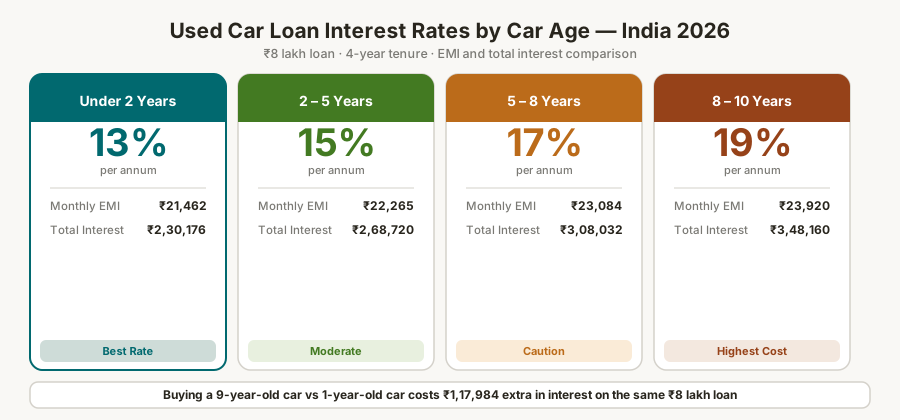
The single biggest driver of your used car loan rate is the car's age. Lenders apply higher rates for older vehicles because depreciation compounds: an 8-year-old car loses value faster in absolute terms, reducing recoverable collateral value if you default.
| Car Age at Loan Start | Typical Rate Range | Representative Rate | EMI (₹8L, 4-year loan) | Total Interest |
|---|---|---|---|---|
| Under 2 years | 13–14% | 13% | ₹21,462 | ₹2,30,176 |
| 2–5 years | 15–16% | 15% | ₹22,265 | ₹2,68,720 |
| 5–8 years | 17–18% | 17% | ₹23,084 | ₹3,08,032 |
| 8–10 years | 19–20% | 19% | ₹23,920 | ₹3,48,160 |
EMIs verified: P = ₹8,00,000, n = 48 months, using EMI = P × r × (1+r)ⁿ / ((1+r)ⁿ − 1).
The difference between financing a 1-year-old car vs a 9-year-old car, on the same ₹8 lakh loan, is ₹1,17,984 in total interest — nearly 15% of the principal, paid purely because of age.
Most lenders impose a hard cap: the car's age plus the loan tenure must not exceed 12–15 years (varies by bank). A 9-year-old car therefore cannot get a 5-year loan at most banks — the total would hit 14 years, breaching the ceiling at stricter institutions.
How Loan-to-Value (LTV) Actually Works on Used Cars
LTV on a used car loan is calculated against the bank's internal valuation — not the price you are paying the seller.
Example: You find a 2021 Swift Dzire and negotiate a price of ₹8.5 lakh. The bank sends an appraiser who values the car at ₹8 lakh based on condition, mileage, service history, and current resale comparables.
At 70% LTV:
- Maximum loan: 70% × ₹8,00,000 = ₹5,60,000
- Minimum you pay from own pocket: ₹8,50,000 − ₹5,60,000 = ₹2,90,000
At 80% LTV (some lenders, for near-new cars):
- Maximum loan: 80% × ₹8,00,000 = ₹6,40,000
- Minimum own contribution: ₹2,10,000
The critical point: if the bank's valuation comes in below your negotiated price — which happens often with private sellers — you absorb the entire gap from your own funds, on top of the minimum down payment percentage. Always ask for the appraised value before finalising the deal.
Platforms like Cars24, Spinny, and OLX Autos partner with specific lenders whose appraisals are pre-aligned with the listed price, reducing this gap — but often at the cost of a higher rate than you would negotiate independently with your bank.
CIBIL Score vs Used Car Loan Rate — The Real Numbers
Your CIBIL score affects both your eligibility and the rate you receive on a used car loan. Most banks require a minimum score of 650, while NBFCs may approve at 600 with a higher rate and reduced LTV.
| CIBIL Score Range | Typical Rate | EMI (₹6L, 5-year loan) | Total Interest |
|---|---|---|---|
| 750 and above | 13% | ₹13,652 | ₹2,19,120 |
| 700–749 | 15% | ₹14,274 | ₹2,56,440 |
| 650–699 | 17% | ₹14,912 | ₹2,94,720 |
| Below 650 | Not eligible (most banks) | — | — |
EMIs verified: P = ₹6,00,000, n = 60 months.
Moving from a 700-band to a 750+ score saves ₹37,320 in total interest on a ₹6 lakh loan — without changing any other factor. Before applying for a used car loan, run a free CIBIL check and, if your score sits in the 700–720 range, spending 3–6 months paying down a credit card balance can shift you into the 750+ bracket. The CIBIL impact guide breaks down exactly which actions move the needle fastest.
Use the car loan EMI calculator to enter your expected rate and see the EMI before approaching any lender.
New Car vs Used Car Loan — Full Cost Comparison
The argument for buying used is usually the lower purchase price. Here is how that calculates against higher financing cost when both buyers borrow ₹10 lakh over 5 years:
| Scenario | Loan | Rate | EMI | Total Interest | Total Outgo |
|---|---|---|---|---|---|
| New car | ₹10,00,000 | 9.5% | ₹21,002 | ₹2,60,120 | ₹12,60,120 |
| Used (under 2yr) | ₹10,00,000 | 13% | ₹22,753 | ₹3,65,180 | ₹13,65,180 |
| Used (2–5yr old) | ₹10,00,000 | 15% | ₹23,790 | ₹4,27,400 | ₹14,27,400 |
| Used (5–8yr old) | ₹10,00,000 | 17% | ₹24,853 | ₹4,91,180 | ₹14,91,180 |
All EMIs verified for P = ₹10,00,000, n = 60 months.
A 2–5-year-old car that costs ₹2 lakh less than the new equivalent saves ₹2 lakh on purchase but costs ₹1,67,280 extra in interest over 5 years — leaving a net saving of just ₹32,720 on a ₹12 lakh transaction. For a 5–8-year-old car, the financing premium exceeds many typical purchase price discounts entirely.
This does not mean used cars are a bad financial decision — insurance, depreciation loss in the first 3 years, and registration costs on a new car are substantial. But the financing cost must be factored in explicitly. The compare loans tool lets you model both scenarios side by side with your actual numbers.
Eligibility Criteria
| Criterion | Requirement |
|---|---|
| Employment | Salaried, self-employed, or business owner |
| Minimum monthly income | ₹20,000 net (salaried); ₹25,000+ (self-employed) |
| Age | 21–65 years at loan end |
| CIBIL score | 650+ (most banks); 700+ for best rates |
| Car age | ≤ 8–10 years (varies by bank) |
| Car + tenure limit | Combined age ≤ 12–15 years |
| Vehicle type | Private passenger car; commercial vehicles excluded |
| Geographic coverage | Car and buyer must be in the same RTO jurisdiction (many banks) |
FOIR applies to used car loans exactly as it does to any other loan. Banks will cap your new EMI so that total monthly EMIs — all existing obligations plus this new one — stay within 40–55% of gross monthly income. Use the loan eligibility calculator to check your maximum eligible loan amount before visiting a showroom.
Documents Required
For the borrower:
- PAN card and Aadhaar card (KYC)
- Latest 3 months' salary slips or Form 16 (salaried)
- ITR for 2 years + CA-certified P&L (self-employed)
- Bank statements: last 6 months
- Passport-size photographs
- Residence proof (utility bill, rental agreement)
For the vehicle:
- RC book (in seller's name, must be valid)
- Road tax receipts (all years paid)
- Insurance policy with active coverage
- NOC from previous financier if there is an existing hypothecation
- Form 28, Form 29, Form 30 (for RTO ownership transfer)
- Valid PUC certificate
- Odometer photograph at time of application
For purchase through a dealer: The dealer usually handles Form 28/29/30 and the RC transfer process. For private seller purchases, you must manage this yourself — factor in 2–4 weeks and ₹2,000–₹5,000 in RTO fees.
The RC Transfer and Hypothecation Process
Many first-time used car buyers are caught off-guard by this step. The sequence is:
- Seller signs Form 29 (Notice of Transfer) and Form 30 (Report of Transfer)
- You file at the local RTO within 14 days (45 days for an interstate transfer)
- RTO endorses the new RC in your name
- Bank adds a hypothecation entry to the RC (Endorsement of Hypothecation)
- Lender releases the full loan disbursement
Until the RC is in your name with hypothecation endorsed, most lenders disburse only 50% of the approved loan. This means you need bridge funding to pay the seller in full — plan for it. Some lenders disburse against a Form 35 undertaking from the seller, but confirm this before signing any sale agreement.
Once the loan is fully repaid, the bank issues Form 35 to remove the hypothecation entry. You must file this at the RTO to get a clean RC.
Prepayment and Foreclosure Rules
RBI's 2012 circular prohibiting prepayment penalties on floating-rate retail loans applies to used car loans. However, most banks offer used car loans at fixed rates — in which case the lender may levy a foreclosure charge.
| Scenario | Typical Charge |
|---|---|
| Fixed-rate, foreclosure within 1 year | 4–6% of outstanding principal |
| Fixed-rate, foreclosure in year 2–3 | 2–4% of outstanding |
| Fixed-rate, foreclosure after 3 years | 0–2% of outstanding |
| Floating-rate used car loan | Nil (RBI prohibition applies) |
| Part-prepayment | 2–5% (most lenders allow after 6 months) |
Pre-approved or salary-account customers of a bank frequently get foreclosure charges waived as part of the relationship benefit — always ask before assuming the charge applies.
Tips to Get the Best Rate on a Used Car Loan
Buy a near-new car. A car under 2 years old gets 13–14% vs 17–18% for a 5–7-year-old model. If your budget stretches to a car that is 18 months old rather than 4 years old, the financing saving can be ₹60,000–₹80,000 over the tenure.
Use your existing bank first. Banks almost always offer better rates to existing customers — salary account, home loan, or long-standing savings relationship. Call your bank's personal banking number before approaching a dealer's finance desk.
Bring a large down payment. A down payment of 30–35% (vs the minimum 20–25%) signals lower risk and often unlocks a 0.5–1% rate reduction. On a ₹10 lakh loan at 15% vs 14%, the saving is ₹33,000 over 5 years.
Time it to a festive offer. Banks run zero-processing-fee or reduced-rate campaigns during Onam, Dussehra, and Diwali. A processing fee of 1.5% on a ₹10 lakh loan is ₹15,000 saved immediately.
Avoid NBFC if CIBIL qualifies for a bank loan. NBFCs serve borrowers below 650 CIBIL but charge 20–24% on used car loans. If your score qualifies for a bank loan, the rate differential over 5 years makes NBFCs an expensive last resort.
Frequently Asked Questions
Can I get a used car loan for a vehicle purchased from an individual (not a dealer)?
Yes, most public sector and private banks finance private-seller transactions. The process is slightly longer because there is no dealer to manage paperwork. You will need to arrange Form 28/29/30, coordinate the RTO transfer yourself, and may face a 2–4 week delay in full disbursement until the RC is endorsed in your name with hypothecation. Some banks require the seller to be present at a branch to countersign documents.
Can I finance a used car that still has a loan from a previous owner?
Yes, but it requires an NOC (No Objection Certificate) from the existing lender and clearance of the existing hypothecation from the RC. The standard process: the seller's lender issues Form 35 after the outstanding loan is repaid, the seller files it at the RTO to remove the old hypothecation, and you then apply for your own loan against a clean RC. Lenders that have tie-ups with other banks sometimes manage this as a seamless process — ask upfront.
What is the maximum car age a bank will finance?
Most nationalised banks cap the car's age at 8–10 years at the time of application. Private banks and NBFCs may go up to 12 years but at rates of 18–22%. The more binding constraint is the combined rule: car age + loan tenure ≤ 12–15 years. A 10-year-old car typically cannot get a loan of more than 2–3 years, which drives the EMI very high for the same principal.
Is zero-cost EMI available on used cars?
No. Zero-cost EMI schemes are manufacturer-dealer partnerships that apply only to new vehicle purchases. Pre-owned car financing is always at market rates. Platforms like Cars24 occasionally run promotional schemes at slightly below-market rates, but the purchase price on such platforms tends to be 5–10% above open-market comparable prices — the discount is usually absorbed in the listing price.
Does it make financial sense to transfer a used car loan to another lender?
It can, if you are still in the first half of the tenure and can find a lender offering at least 2% lower rate. The saving must exceed foreclosure charges (2–4%) plus the new lender's processing fee (1–1.5%). On a ₹6 lakh outstanding at 17%, dropping to 14% for 3 remaining years saves approximately ₹28,000 in interest — which comfortably clears a 3% foreclosure penalty of ₹18,000. Run the numbers on the compare loans tool with your specific outstanding balance and rate before applying.
What happens to the hypothecation if I sell the car before the loan is repaid?
You must repay the outstanding loan in full, obtain Form 35 from the lender, file it at the RTO to remove the hypothecation endorsement, and only then can you transfer ownership to the buyer. Selling a hypothecated vehicle without clearing the lender's charge is a legal offence and voids the buyer's clean title. Buyers doing due diligence check the hypothecation status on the MoRTH vehicle registration portal before paying any token amount.
Try the calculator
Run your own numbers in seconds. Pick the calculator that fits your loan type.