EV Loan India 2026 — Rates, Subsidies & EMI Guide
EVs beat petrol on 5-year total cost — but only if financed right. Complete guide to EV loan rates, PM e-DRIVE subsidies, 80EEB deduction and top lenders.
Key numbers
- Best EV loan rate in 2026: 8.50% (Bank of Maharashtra), vs 8.65% for petrol — EV rates are lower.
- Central EV subsidy: FAME III has not been formally notified as of June 2026. The active scheme is PM e-DRIVE — subsidies of ₹5,000 on qualifying 2-wheelers; no confirmed central subsidy for passenger 4-wheelers yet.
- Section 80EEB: deduct up to ₹1.5 lakh per year on EV loan interest (for loans sanctioned before 31 March 2026 — check for extension).
- State subsidies remain active: Delhi (₹1.5 lakh on 4W), Maharashtra (₹1 lakh on 4W), Karnataka (₹25,000 on 4W).
- 5-year total cost: a mid-segment EV costs ₹1.5–2.5 lakh less than an equivalent petrol car in metro cities (even without a confirmed central subsidy).
Electric vehicle sales in India crossed 20 lakh units in FY2025–26. The mainstream shift isn't coming — it's here. And the financial case for EVs has quietly crossed a tipping point: when you add up the PM e-DRIVE subsidy (₹5,000 on qualifying two-wheelers), confirmed state subsidies (up to ₹1.5 lakh in Delhi), lower running costs, and special EV loan rates at several banks, the EV often wins on 5-year total cost even at a significantly higher sticker price. Borrowers who sanctioned an EV loan before 31 March 2026 also benefit from the Section 80EEB interest deduction — check the FAQ below for current status.
This guide cuts through the noise and gives you the actual numbers to make the decision.
How EV Loans Differ from Regular Car Loans
Banks treat EV loans differently from standard car loans in two important ways:
1. Lower interest rates. Several PSU banks — SBI, Union Bank, Bank of Maharashtra — offer dedicated "green vehicle" loan products at 15–30 basis points below their regular car loan rates. This reflects both government pressure and lower-risk assessment (EV owners tend to be more creditworthy on average).
2. Higher loan-to-value. Many banks offer up to 100% on-road funding for EVs (vs 85–90% for petrol cars), meaning a smaller down payment requirement.
What doesn't change: your eligibility criteria. CIBIL score requirements, income multiples, and tenure options are identical to regular car loans. A CIBIL 750+ score still gets you the best rate.
EV Loan Rates — Bank by Bank Comparison (2026)
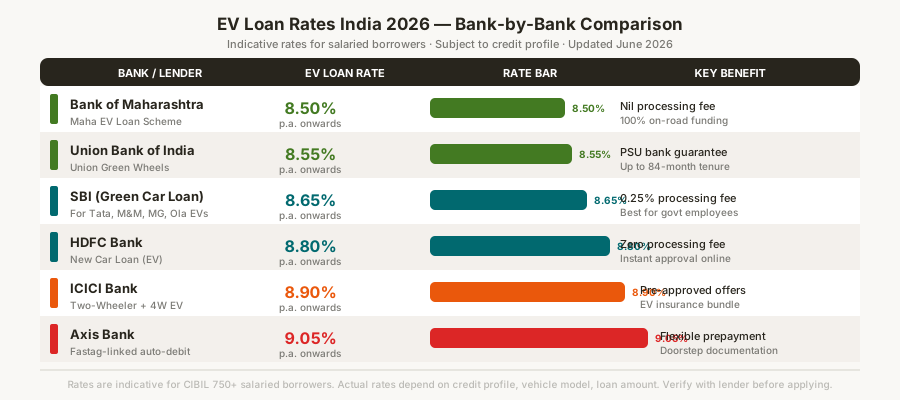
The rate advantage is real but modest: typically 20–30 bps lower than standard car loans at the same bank. On a ₹12 lakh loan over 7 years, 25 bps saves you approximately ₹12,000 in total interest — not transformative, but it helps.
| Bank | EV Rate | Regular Car Rate | Saving on EV | Max Tenure |
|---|---|---|---|---|
| Bank of Maharashtra | 8.50% | 8.85% | 0.35% | 84 months |
| Union Bank of India | 8.55% | 8.80% | 0.25% | 84 months |
| SBI Green Car Loan | 8.65% | 8.85% | 0.20% | 84 months |
| HDFC Bank | 8.80% | 9.00% | 0.20% | 84 months |
| ICICI Bank | 8.90% | 9.10% | 0.20% | 84 months |
| Axis Bank | 9.05% | 9.25% | 0.20% | 84 months |
Negotiation tip: If you're an existing salary account holder at SBI or HDFC with CIBIL 780+, ask for a concession letter. Banks routinely offer 10–15 bps below published rates for prime customers — just ask.
EV Purchase Subsidies: PM e-DRIVE and State Schemes
FAME II ended in March 2024. FAME III has not been formally notified as a nationwide scheme as of June 2026. The active central government EV support programme is PM e-DRIVE (launched September 2024), which primarily targets electric buses, three-wheelers, and two-wheelers. Central subsidies for passenger four-wheelers remain under policy deliberation — verify with your dealer on the day of booking whether any central scheme has been notified.
Central Scheme: PM e-DRIVE (2-Wheelers and Commercial)
Under PM e-DRIVE (₹10,900 crore outlay), the applicable subsidy for electric two-wheelers is:
- Year 1: ₹5,000 per qualifying two-wheeler
- Year 2: ₹2,500 per qualifying two-wheeler
- Qualifying models must meet localization and battery norms
This covers most Ola, Ather, TVS, Bajaj, and Hero EVs. Verify with the dealer at time of purchase — subsidies are applied at point of sale.
Four-Wheeler Passenger EVs — Central Subsidy Status
No confirmed central subsidy currently applies to passenger four-wheelers under PM e-DRIVE. FAME III (which may provide up to ₹1 lakh on qualifying 4W EVs) is under preparation but has not been notified. Once notified, qualifying models will likely be:
- Manufactured in India (minimum 50% localisation)
- Ex-factory price below ₹20 lakh
- Battery capacity of 10 kWh or more
Models that would likely qualify (if FAME III is notified): Tata Tiago EV, Tata Punch EV, MG Comet EV. Always verify the current applicable subsidy with the dealer — do not factor an unnotified scheme into your purchase budget.
State Subsidies on Top
Most states offer additional subsidies over and above FAME III. Some notable schemes in 2026:
| State | Additional Subsidy | Road Tax Waiver |
|---|---|---|
| Delhi | ₹1,50,000 (4W) | 100% |
| Maharashtra | ₹1,00,000 (4W) | 100% |
| Gujarat | ₹20,000 (4W) | 100% |
| Rajasthan | ₹10,000 (4W) | 100% |
| Karnataka | ₹25,000 (4W) | 100% |
| Tamil Nadu | ₹20,000 (4W) | 100% |
Delhi buyers receive ₹1.5 lakh in confirmed state subsidy; if a central 4W EV scheme is notified, an additional ₹1.0 lakh may apply. In Maharashtra, the confirmed state subsidy is ₹1.0 lakh. State subsidies alone provide meaningful price reduction — factor only confirmed schemes into your budget.
Section 80EEB: The Tax Benefit Only EV Buyers Get
Section 80EEB of the Income Tax Act provides a deduction of up to ₹1.5 lakh per year on interest paid on a loan taken for the purchase of an electric vehicle. This benefit is available only for EVs — petrol and diesel vehicle loans have no such deduction. EVs are also exempt from road tax in most states, where a diesel SUV pays 13–22%; for a sense of how much that adds, see the on-road breakdown in our Toyota Fortuner EMI and on-road price guide.
Who can claim it?
- Individual taxpayers only (not companies or HUFs)
- First EV loan sanctioned between 1 April 2019 and 31 March 2026 (loan must have been sanctioned within this window; the deduction continues for the full loan tenure on those loans — check for a fresh extension if you're sanctioning a new EV loan after this date)
- Loan must be from a bank, NBFC, or financial institution
What's the saving?
For a ₹12 lakh EV loan at 8.65% over 7 years:
- Year 1 interest: approximately ₹98,710
- Tax saved (30% bracket): ₹29,613
- Tax saved (20% bracket): ₹19,742
Over the full 7-year loan, total interest paid = approximately ₹4.04 lakh, of which up to ₹1.5 lakh per year is deductible. At a 30% tax bracket, this translates to roughly ₹1.21 lakh in total tax savings over the loan tenure (subject to the ₹1.5 lakh annual cap). Use our car loan EMI calculator to compute the exact interest breakdown for your EV loan.
This is equivalent to an effective interest rate reduction of about 80–90 basis points — significantly more impactful than the 20–30 bps rate discount on EV loans.
5-Year Total Cost of Ownership: EV vs Petrol
This is where the case for EVs gets compelling. The sticker price gap shrinks rapidly once you account for lower running costs, subsidies, and the 80EEB benefit.
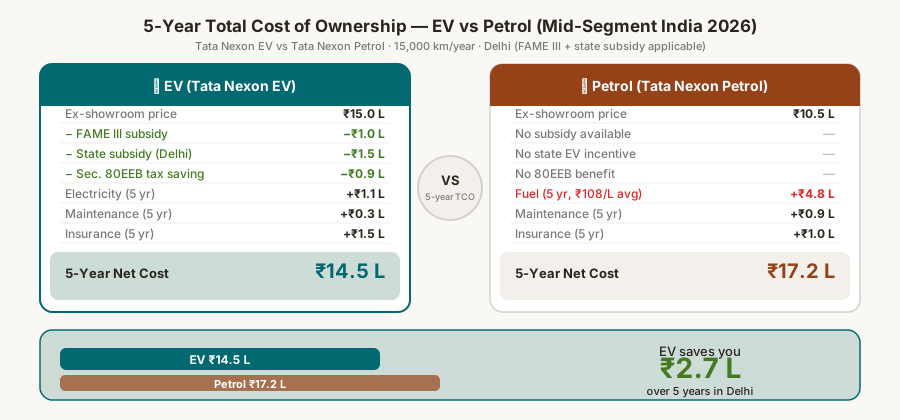
The key variables that determine whether EV wins:
-
Annual kilometres driven. The more you drive, the more fuel savings compound. Below 8,000 km/year, the petrol car may still win on total cost. Above 12,000 km/year, the EV almost always wins.
-
City vs highway driving. EV efficiency is much higher in city traffic (regenerative braking). On highways, the efficiency gap narrows.
-
Electricity cost. Home charging at ₹8–9/kWh (typical in metro cities) gives the best EV economics. Public charger rates of ₹18–22/kWh significantly reduce the running cost advantage.
-
State subsidies. Delhi and Maharashtra buyers see a much faster EV payback than buyers in states with minimal subsidies.
The break-even calculation: For a Tata Nexon EV vs Nexon Petrol buyer in Mumbai driving 15,000 km/year, the EV crosses break-even at approximately 3.2 years. In Delhi, the higher state subsidy brings this to 2.5 years.
EMI Calculation: What a Mid-Segment EV Actually Costs Monthly
Using the Tata Punch EV (ex-showroom ₹11.5 lakh for lower variant; add applicable state subsidy if in Delhi/Maharashtra + 10% down payment = loan of approximately ₹9.35–10.35 lakh depending on state):
| Tenure | Rate | Monthly EMI | Total Interest |
|---|---|---|---|
| 5 years (60 months) | 8.50% | ₹19,183 | ₹2.16 L |
| 7 years (84 months) | 8.50% | ₹14,807 | ₹3.09 L |
| 7 years (84 months) | 8.65% | ₹14,878 | ₹3.15 L |
The 7-year tenure is popular for EVs because it keeps the EMI comparable to running costs for petrol alternatives, making the switch budget-neutral in the short term.
Use the car loan EMI calculator to run your specific loan amount and get the exact EMI breakdown for your EV shortlist.
EV Loan Eligibility: What Banks Look For
EV loan eligibility criteria are identical to standard car loans. Use our loan eligibility calculator to check how much you can borrow based on your income and existing obligations.
| Criterion | Salaried | Self-Employed |
|---|---|---|
| Minimum age | 21 years | 25 years |
| Maximum age (at loan end) | 60–65 years | 65–70 years |
| Min. monthly income | ₹20,000–25,000 | ₹25,000–30,000 net profit |
| CIBIL score | 700+ (750+ for best rates) | 720+ |
| EMI-to-income ratio (FOIR) | Below 50% | Below 55% |
| Employment stability | Min. 1 year | Min. 2 years in business |
Self-employed borrowers may face additional documentation requirements: last 2 years' ITR, bank statements, GST returns (if applicable), and business continuity proof.
Documents Required
- Identity: Aadhaar, PAN
- Address: Aadhaar, utility bill, passport
- Income (salaried): last 3 months' salary slips, 6 months' bank statements, Form 16
- Income (self-employed): last 2 years' ITR with computation, last 6 months' bank statements, audited P&L if applicable
- Vehicle: proforma invoice or dealer quotation
- Photographs: 2 passport-size
Charging Infrastructure: The Question Banks Don't Ask But You Should
Before taking an EV loan, verify your charging access:
Home charging: The most cost-effective option. A 7.4 kW AC wallbox charger costs ₹15,000–30,000 installed. Most EVs take 5–8 hours for a full charge from empty. This works if you have a dedicated parking spot with electricity access.
Society/apartment building: Many housing societies restrict installation of personal chargers. Check with your society before buying. The Electricity Act permits individual owners to install EV chargers in their private parking — but enforcement against society pushback can be a practical headache.
Public charging: TATA Power, Charge Zone, and Jio-BP have significantly expanded coverage in tier-1 cities. Delhi, Mumbai, Bengaluru, Hyderabad, and Pune have functional public charging networks. Tier-2 cities are improving but inconsistent.
If you primarily drive 100+ km in a single day and cannot access home or workplace charging, an EV is inconvenient with current infrastructure. For typical city commuters doing 30–60 km daily, the infrastructure concern is largely resolved in metro cities.
Which EVs to Consider in 2026
| Segment | Model | Ex-Showroom (approx.) | Likely central subsidy eligible (if notified)? | Real-world range |
|---|---|---|---|---|
| Budget | Tata Tiago EV | ₹9.5–12.5L | Yes | 200–250 km |
| Budget | MG Comet EV | ₹8.5–9.5L | Yes | 200 km |
| Mid | Tata Punch EV | ₹10.5–14.0L | Yes (lower variants) | 280–320 km |
| Mid | Tata Nexon EV | ₹14.7–19.5L | Marginal | 310–380 km |
| Premium | Hyundai Creta EV | ₹17.9–23.5L | No | 450–500 km |
| Premium | MG ZS EV | ₹18.9–25.5L | No | 460 km |
| 2-Wheeler | Ola S1 Pro | ₹1.35L | Yes | 170–195 km |
| 2-Wheeler | TVS iQube | ₹1.15L | Yes | 145–165 km |
For first-time EV buyers concerned about range anxiety: the Tata Punch EV's 280–320 km real-world range covers 95%+ of typical week-to-week usage for urban drivers.
Common Mistakes to Avoid
Overestimating charging convenience. Don't assume you'll always have cheap home charging. Verify before you sign.
Ignoring the battery warranty. EV battery packs are expensive to replace. Verify the warranty: Tata covers 8 years / 1.6 lakh km. MG covers 8 years / 1.5 lakh km. Some NBFCs offer battery-replacement insurance for an additional EMI component.
Choosing the longest tenure without calculating 80EEB benefit. The tax deduction applies on interest paid. A longer tenure means more interest — and more deductible. For high-income taxpayers in the 30% bracket, a 7-year loan at 8.65% effectively costs closer to 7.8% after tax. This makes longer tenures less expensive than they appear.
Applying at multiple lenders simultaneously. Each application triggers a hard inquiry and drops your CIBIL score. Get a pre-approval from one bank based on income eligibility first, then formally apply only there.
Frequently Asked Questions
Is EV loan interest rate lower than regular car loan?
Yes, at most PSU banks: typically 15–35 bps lower. Bank of Maharashtra (8.50%), Union Bank (8.55%), and SBI (8.65%) all offer dedicated green vehicle loan products below their standard car loan rates. Private banks offer smaller discounts.
Can I claim Section 80EEB on an EV purchased in 2026?
The original notification required the loan to be sanctioned before 31 March 2023. Finance Act 2025 extended the 80EEB benefit for EV loans sanctioned up to 31 March 2026 — that window has now closed. If you sanctioned your EV loan before 31 March 2026, you continue to claim the deduction for the full tenure. If you're taking a fresh EV loan after that date, check the latest Finance Act for any further extension before assuming 80EEB applies — verify with your CA either way.
Does the central EV subsidy apply to used/second-hand EVs?
No. PM e-DRIVE and any future FAME III subsidies apply only to new vehicles purchased from authorised dealers. Second-hand EVs do not receive central subsidies, though state road tax waivers may still apply.
What happens to my EV loan if the battery needs replacement?
The loan is secured against the vehicle, not the battery. A battery replacement does not affect the loan — you pay for the battery separately (often covered under warranty for the first 8 years). Some banks bundle battery-protection insurance with the EV loan EMI.
Is EV loan available for two-wheelers?
Yes. Most banks offer EV loan products for electric two-wheelers at rates between 9.5–12% depending on the lender and your profile. Some NBFCs specialise in EV two-wheeler financing. PM e-DRIVE subsidies (₹5,000 in Year 1) apply for qualifying two-wheeler models — verify with dealer at time of purchase.
How is the EV loan EMI different from a petrol car loan?
The EMI calculation formula is identical. The difference is: EV loans often have lower interest rates (15–30 bps) and may allow higher loan-to-value ratios (up to 100% on-road). The tenure range (up to 84 months) is the same. Use the EMI calculator to compare both scenarios side by side.
See also: Two-Wheeler Loan Guide · Car Loan vs Outright Purchase · Compare Loans Tool
Try the calculator
Run your own numbers in seconds. Pick the calculator that fits your loan type.