Home Loan Application Process India 2026 — Step-by-Step Guide
Complete home loan process guide — from CIBIL check to disbursement, with timelines, document lists, and what to watch at each stage in India.
Key Takeaways
- A home loan for a ready-to-move property typically takes 3–4 weeks from application to disbursement; under-construction properties can take longer due to staged disbursement schedules.
- Processing fees range from 0.25% to 1% of the loan amount (non-refundable); on a ₹50 lakh loan, that is ₹12,500–₹50,000 out of pocket before the loan is sanctioned.
- You need 15–20 documents for a salaried applicant and 20–25 for self-employed; having all documents ready before approaching a lender cuts the approval timeline by 7–10 days.
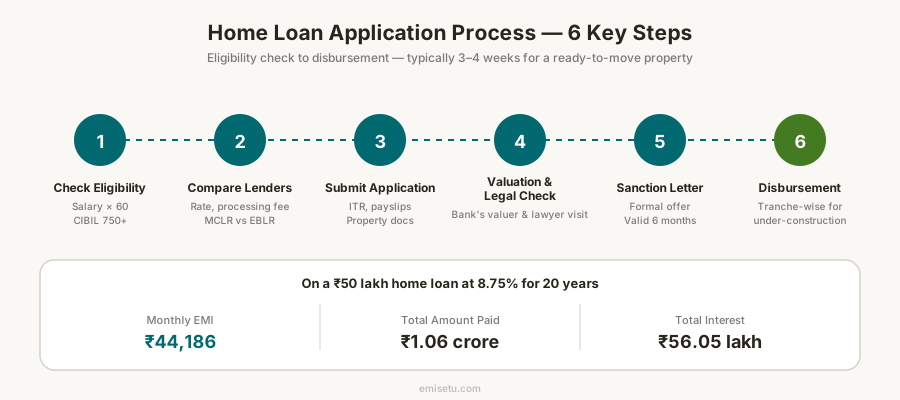
- On a ₹50 lakh home loan at 8.75% for 20 years, your EMI is ₹44,186 — totalling ₹1.06 crore over the life of the loan, of which ₹56.05 lakh is interest.
Buying a home is the largest financial transaction most Indian households ever make, yet the process between "I want a home loan" and "the money is disbursed" is poorly understood. Many buyers miss out on better rates, get rejected on technicalities, or face last-minute delays because they didn't know what was coming. This guide walks you through every step — from before you even approach a lender through to the day the funds hit the property transaction — with specific timelines, document lists, and the mistakes that cost people money at each stage.
The 10-Step Home Loan Process — Overview
| Step | What Happens | Typical Time |
|---|---|---|
| 1. Eligibility and credit check | Assess CIBIL score, income, FOIR | 1–2 days |
| 2. Compare lenders and rate type | Shortlist 3–4 lenders, decide fixed vs floating | 3–5 days |
| 3. Calculate EMI and decide loan amount | Model scenarios, decide principal | 1 day |
| 4. Gather documents | Compile salaried or self-employed file | 3–7 days |
| 5. Submit application and pay processing fee | Apply and pay | 1 day |
| 6. Property valuation | Lender's valuer visits property | 3–7 days |
| 7. Legal verification | Title search by lender's lawyer | 5–10 days |
| 8. Sanction letter | Lender issues formal offer | 2–5 days |
| 9. Sign loan agreement | Execute agreement and mortgage documents | 1–2 days |
| 10. Disbursement | Funds transferred to seller/builder | 1–3 days |
| Total (ready property) | 3–4 weeks |
Step 1 — Check Your Eligibility and Credit Score
Before approaching any lender, know where you stand. Banks evaluate two things first: your CIBIL score and your Fixed Obligation to Income Ratio (FOIR).
CIBIL score requirement: Most public sector banks (SBI, Bank of Baroda, Punjab National Bank) require a minimum CIBIL score of 700–725. Private sector banks (HDFC, ICICI, Axis) typically want 750+. Below 650, you will be rejected by mainstream lenders regardless of income.
FOIR requirement: Your total existing EMIs plus the new home loan EMI should not exceed 40–50% of your net monthly income. On a ₹1 lakh net monthly income, the bank will typically allow total EMI outgo of ₹40,000–₹50,000.
Use the loan eligibility calculator to estimate the maximum loan amount you qualify for based on your income and existing obligations — without triggering a hard enquiry on your CIBIL report.
If your CIBIL score needs work before you apply, set aside 6–9 months and follow the how to improve CIBIL score fast playbook. Applying prematurely with a 680 score and getting rejected both wastes time and adds a hard enquiry that further dips the score.
Step 2 — Compare Lenders and Lock In Rate Type
Never apply to the first bank that pre-approves you. A 50 basis point (0.50%) rate difference on a ₹50 lakh loan over 20 years means roughly ₹3–4 lakh in total extra interest. Spending 3–5 days comparing lenders is among the highest-ROI activities in this entire process.
What to compare:
- Interest rate (check the Effective Interest Rate, not just the headline spread)
- Processing fee (0.25–1%, negotiable — particularly at higher loan amounts)
- Prepayment charges (RBI bans prepayment charges on floating-rate loans to individuals; fixed-rate loans may charge 2–4%)
- MCLR or EBLR benchmark — External Benchmark Lending Rate (EBLR)-linked loans reset faster when RBI cuts rates
- Customer service reviews — you'll deal with this lender for 15–20 years
Check the current home loan rates across major banks and use the loan comparison tool to model two offers side by side with their total interest cost over your chosen tenure.
Fixed vs floating: In 2026, floating rates (EBLR-linked) are 8.40–9.00% for eligible borrowers. Fixed rates are typically 9.50–10.50% — 100–150 bps higher than floating. Most financial advisors recommend floating for tenures above 10 years because you benefit when RBI cuts the repo rate. EBLR-linked loans must be reset within 3 months of a repo rate change per RBI guidelines.
Step 3 — Calculate Your EMI and Decide Loan Amount
Once you have shortlisted lenders and rates, calculate your exact EMI before you commit to a loan amount. Many buyers borrow the maximum the bank offers without verifying they can comfortably service it.
Verified example: ₹50 lakh, 8.75%, 20 years
Using the standard EMI formula (EMI = P × r × (1+r)^n / ((1+r)^n − 1)):
- Monthly EMI: ₹44,186
- Total amount paid over 20 years: ₹1,06,04,640
- Total interest paid: ₹56,04,640
- Interest as % of principal: 112% — you pay more than double the loan in total
This means the true cost of a ₹50 lakh loan at 8.75% over 20 years is ₹1.06 crore, not ₹50 lakh. Use the home loan EMI calculator to model different loan amounts, rates, and tenures for your specific scenario — and see how a 5-year tenure reduction can save ₹15–20 lakh in interest.
Rule of thumb: Keep your home loan EMI below 35–40% of net take-home pay for comfortable servicing with room for other savings.
Step 4 — Gather Your Documents
Document incompleteness is the number-one cause of delays. Banks will not process your application without a complete file. Prepare everything before submitting.
Salaried Applicant — Documents Required
| Document Category | Specific Documents |
|---|---|
| Identity proof | Aadhaar card, PAN card |
| Address proof | Aadhaar, passport, utility bill (not older than 3 months) |
| Income proof | Last 3 months salary slips, last 2 years Form 16 |
| Bank statements | Last 6 months salary account statements |
| Employment proof | Appointment letter, HR letter confirming employment |
| Property documents | Sale agreement / booking letter, approved plan, title deed |
| Other | Passport-size photographs (4–6), CIBIL consent form |
Self-Employed Applicant — Documents Required
| Document Category | Specific Documents |
|---|---|
| Identity proof | Aadhaar card, PAN card |
| Address proof | Aadhaar, passport, utility bill |
| Income proof | Last 3 years ITR with computation, last 3 years P&L and balance sheet (CA-certified) |
| Bank statements | Last 12 months current and savings account statements |
| Business proof | Business registration certificate, GST registration, partnership deed / MOA-AOA |
| Property documents | Sale agreement / booking letter, approved plan, title deed, encumbrance certificate |
| Other | Passport photographs (4–6), last 12 months business loan / CC statements if applicable |
Self-employed applicants need 3 years of ITR to establish income stability. If you have recently shifted from salaried to self-employed, many banks will want a minimum 2–3 years of self-employment ITR before considering your application. Read our detailed guide on home loans for the self-employed for lender-specific flexibility on documentation.
Step 5 — Submit Application and Pay Processing Fee
Once the document file is complete, submit the application form along with all supporting documents to the lender. Most banks now accept online submission followed by physical verification.
Processing fee: Banks charge 0.25–1% of the loan amount as a processing fee at the time of application. This fee is non-refundable even if the loan is rejected or you withdraw.
| Loan Amount | Processing Fee Range (0.25–1%) |
|---|---|
| ₹30 lakh | ₹7,500–₹30,000 |
| ₹50 lakh | ₹12,500–₹50,000 |
| ₹75 lakh | ₹18,750–₹75,000 |
| ₹1 crore | ₹25,000–₹1,00,000 |
As per RBI's Fair Practices Code for Lenders, banks must disclose all fees and charges upfront in the loan sanction letter. If a lender charges undisclosed fees after application, this is a violation you can escalate to the RBI Banking Ombudsman.
Important: Do not apply to multiple lenders simultaneously. Each application triggers a hard enquiry, and multiple hard enquiries in 30 days look like credit-hunger to the remaining lenders. Shortlist your top choice, apply there first, and only approach a second lender if the first declines.
Step 6 — Property Valuation
After receiving your application, the bank appoints an empanelled technical valuer to assess the property. This serves two purposes: verifying the property is worth what you're paying, and confirming the construction is approved and compliant.
What the valuer checks:
- Market value of the property (determines maximum LTV — Loan to Value — the bank will fund)
- Construction quality and stage of completion (for under-construction)
- Adherence to approved building plans
- Floor area (carpet vs built-up vs super built-up)
RBI mandates that banks maintain maximum LTV of 75–90% depending on loan size:
- Up to ₹30 lakh: maximum LTV 90% (you need 10% down payment)
- ₹30 lakh to ₹75 lakh: maximum LTV 80% (20% down payment)
- Above ₹75 lakh: maximum LTV 75% (25% down payment)
If the valuer's assessed value is lower than the purchase price, the bank funds against the assessed value — not what you agreed to pay. The shortfall is your problem to fund from savings.
Timeline: 3–7 business days from application submission.
Step 7 — Legal Verification of Property Title
Simultaneously with valuation, the bank's empanelled lawyer conducts a title search. This is not optional — it protects both you and the bank from properties with disputed ownership, encumbrances, litigation, or planning violations.
What the lawyer checks:
- Chain of ownership for the past 30 years (or since land records were computerised in that jurisdiction)
- Encumbrances (mortgages, litigation, attachments by government)
- Building plan approvals and completion certificate
- RERA registration for under-construction projects
- Non-encumbrance certificate from the sub-registrar office
If the lawyer's report flags a title defect, the bank will not proceed with disbursement. Common defects include gaps in the ownership chain, properties with pending court cases, or buildings with unauthorised floor additions. Never skip independent legal verification — the bank's lawyer works for the bank, not for you.
Timeline: 5–10 business days. Complex title chains (e.g., inherited property with multiple heirs) can take longer.
Step 8 — Sanction Letter — Read Every Line
Once valuation and legal verification pass, the bank issues a Sanction Letter (also called an offer letter or in-principle approval). This is a formal commitment to lend — subject to conditions.
What the sanction letter contains:
- Sanctioned loan amount
- Interest rate (fixed or floating, and the benchmark)
- Loan tenure
- Processing fee already paid and any balance due
- Pre-disbursement conditions (e.g., submit title documents, execute mortgage)
- Validity period
Sanction letter validity: Typically 3–6 months. If you do not draw down the loan within this period, the sanction lapses and you need to reapply. This matters for under-construction purchases where possession may be delayed.
Read the fine print on the rate clause: For floating-rate loans, the sanction letter should state the EBLR + spread (e.g., "EBLR + 1.50%"). Confirm the spread is what was verbally discussed — this spread is fixed for the loan tenure, while the EBLR component changes with RBI repo rate decisions.
Step 9 — Signing the Loan Agreement
After accepting the sanction letter, you sign the loan agreement. This is a legally binding document.
What the loan agreement covers:
- Final loan terms (amount, rate, tenure, EMI)
- Mortgage creation — you pledge the property as collateral via Memorandum of Deposit (MOD) or Equitable Mortgage
- Insurance requirement (most lenders require home loan insurance; clarify if this is mandatory or optional)
- Prepayment terms (confirm floating-rate prepayment is penalty-free per RBI guidelines)
- Default and recall provisions
Get the agreement reviewed before signing. Key things to verify:
- The interest rate and spread match the sanction letter exactly
- The prepayment clause confirms no charges on floating-rate prepayment
- The insurance is not bundled and force-sold — you have the right to choose your own insurer
The MOD (Equitable Mortgage by deposit of title deeds) is registered with the local sub-registrar in most states. This registration attracts stamp duty — use the stamp duty calculator to estimate the state-specific charge, as it varies significantly (Maharashtra charges higher stamp duty than many other states).
Step 10 — Disbursement
Disbursement is when the bank actually transfers the money. The process differs for ready and under-construction properties.
Ready-to-move property (full disbursement): The bank transfers the loan amount directly to the seller's account via RTGS/NEFT on the day of registration. You bring the down payment. The sale deed is registered on the same day. The bank takes custody of original title documents.
Under-construction property (staged disbursement): The bank releases funds in tranches linked to construction milestones (foundation, plinth, floors, completion). You pay EMIs only on the disbursed amount. Pre-EMI interest accrues on the disbursed portion until you move in or the full loan is disbursed.
For under-construction properties, factor in the pre-EMI interest cost in your total purchase budget. On ₹50 lakh disbursed over 2 years, pre-EMI interest can add ₹4–7 lakh to your effective cost.
Once fully disbursed, your regular EMI cycle begins. Check your amortization schedule to see how much of each EMI goes to principal vs interest — in the early years, over 80% of each payment is interest.
For tax planning on your new loan, use the home loan tax calculator to estimate deductions under Section 24(b) (up to ₹2 lakh/year on interest under Old Regime for self-occupied) and Section 80C (up to ₹1.5 lakh on principal repayment, within the combined 80C limit). Note: under the New Tax Regime (default from FY2023–24), Section 24(b) for self-occupied property and Section 80C are not available.
Key Pitfalls — 5 Mistakes That Cost Borrowers Money
1. Applying to multiple lenders simultaneously
Each application creates a hard enquiry. Five simultaneous applications can cost 30–50 CIBIL points. Banks seeing multiple enquiries in 30 days treat this as a red flag, potentially triggering extra scrutiny or a worse rate.
2. Not reading the sanction letter before acceptance
The rate spread and fee structure in the sanction letter are what you are legally committing to — not what the bank's brochure said. Borrowers who skip this step have discovered undisclosed charges or higher-than-quoted spreads only at disbursement, too late to negotiate.
3. Skipping independent title verification
The bank's lawyer protects the bank's interest. Engage your own lawyer (₹5,000–₹15,000) to independently verify the title chain. Buying a flat that later turns out to have a disputed title or unapproved construction can strand your investment.
4. Accepting the first processing fee quoted
Processing fees are negotiable, especially for loans above ₹30 lakh with strong credit profiles. Ask for a waiver or reduction. During festive season offers (October–December), many banks waive processing fees entirely.
5. Not accounting for stamp duty and registration in the budget
Stamp duty and registration charges are 4–7% of the property value in most states — on a ₹70 lakh property, that is ₹2.8–4.9 lakh out of pocket, paid at registration, separate from your down payment and processing fee. Use the stamp duty calculator to budget this accurately before finalising your purchase price.
Frequently Asked Questions
Can I get a home loan without a CIBIL score?
Yes, some lenders will consider applicants with a -1 score (no credit history) by assessing their income stability and bank statements instead. However, the terms are less favourable — typically a higher interest rate and a lower LTV. If you have no credit history and 12+ months before your planned purchase, build a CIBIL score first with a secured credit card or small personal loan, then apply.
What is the minimum salary for a home loan in India?
Most public sector banks (SBI, Bank of Baroda) set a minimum net monthly income of ₹15,000–₹20,000. Private sector banks typically require ₹25,000–₹30,000. However, what matters more than the floor is the EMI-to-income ratio — your total EMIs (existing plus new) should not exceed 40–50% of net take-home pay (the FOIR limit). Use the loan eligibility calculator to see the maximum loan amount your income supports.
How long does home loan approval take?
For a salaried applicant with a complete document file, standard property, and CIBIL 750+: in-principle approval in 1–3 days, legal and valuation 7–14 days, sanction letter 2–5 days after that. Total: 2–3 weeks from application to sanction. Disbursement after sanction: 3–7 days for ready property. Under-construction projects add time for builder verification and staged disbursement coordination.
Can I negotiate the interest rate after sanction?
Yes, and you should. Once you have a sanction letter from one lender, use it as leverage with your preferred lender. Many banks will reduce the spread by 10–25 bps for a CIBIL 750+ borrower with a competing offer in hand. For loans above ₹50 lakh, this is common practice. Even a 10 bps reduction saves approximately ₹1 lakh over 20 years on ₹50 lakh.
What is the difference between sanction and disbursement?
Sanction is the bank's formal conditional approval — a commitment to lend if all conditions are met (property valuation, legal clearance, execution of mortgage). Disbursement is the actual transfer of funds to the seller or builder. The gap between sanction and disbursement is typically 1–2 weeks for ready property, longer for under-construction. Interest accrual begins only from disbursement, not from sanction.
What happens to my property documents after disbursement?
The bank takes physical custody of all original title documents (sale deed, mother deed, approved plan, OC/CC if applicable) for the entire loan tenure. This is standard practice — your property is the collateral for the loan. When you repay the loan in full, the bank issues a No Objection Certificate (NOC) and returns all original documents. Ensure you get an acknowledgement receipt listing every document the bank has taken at the time of disbursement.
See how a joint home loan application can increase your eligible amount and share the tax benefits with our guide to joint home loans in India, or model your EMI and total interest cost with the home loan EMI calculator.
Try the calculator
Run your own numbers in seconds. Pick the calculator that fits your loan type.