Plot Loan India 2026 — Rates, Tax Rules & Differences from Home Loan
Plot loans cost 0.5–1.5% more than home loans, cap at 15 years, and deny Section 24(b) tax relief until you build. Everything you need to know before buying land.
Key Takeaways
- Plot loans carry rates 0.5–1.5% above home loan rates and cap tenure at 15 years — a ₹40 lakh loan at 9.5% for 15 years means an EMI of ₹41,769 and total interest of ₹35.18 lakh.
- Section 24(b) interest deduction is unavailable on a plot loan; the deduction applies only after construction is complete and you start residing in the property.
- Banks lend up to 75% of the independently assessed plot value — not the stamp duty value or market price; a ₹60 lakh plot's maximum loan is ₹45 lakh.
- Most lenders mandate construction must begin within 2–3 years of purchase; failure to build can trigger loan recall, and converting to a home loan requires fresh documentation and revaluation.
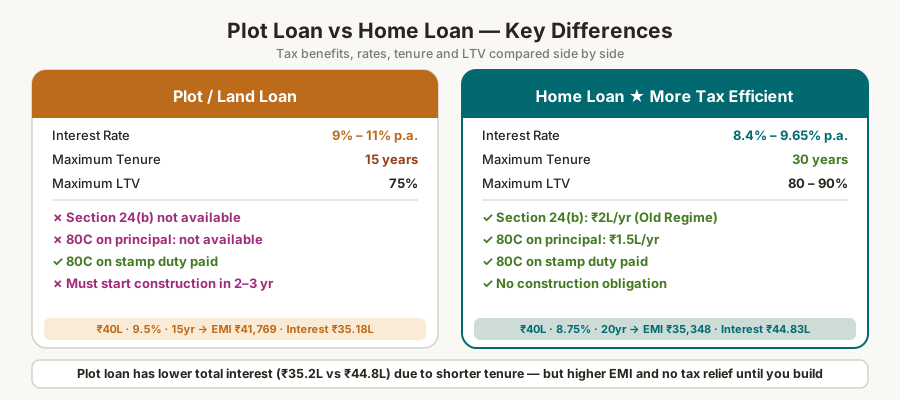
Buying a plot of land in India feels safer than buying a flat under construction — no builder default risk, no delays, no RERA disputes. But the loan that finances that plot works very differently from the home loan most borrowers are familiar with, and several of those differences are costly if discovered after disbursement. Rates are higher. Tenure is shorter. Tax benefits arrive much later than expected. And the bank places binding obligations on what you do with the land after purchase. Understanding the full picture before you sign the sale deed is the difference between a well-financed land investment and an expensive surprise.
Plot Loan vs Home Loan — 7 Key Differences
| Parameter | Plot Loan | Home Loan |
|---|---|---|
| Interest rate (2026) | 9%–11% p.a. | 8.4%–9.65% p.a. |
| Maximum tenure | 15 years | 30 years |
| LTV (Loan-to-Value) | Up to 75% | Up to 80–90% |
| Section 24(b) deduction | Not available until construction complete | Available immediately (up to ₹2L self-occupied, Old Regime) |
| Section 80C (principal) | Not available for principal repayment | Available up to ₹1.5L per year |
| Section 80C (stamp duty) | Available for stamp duty paid | Available for stamp duty paid |
| Agricultural land | Not eligible | Not applicable |
The rate gap of 0.5–1.5% looks small in isolation. In rupee terms on a ₹40 lakh loan over 15 years, the difference between a 9.5% plot loan and an 8.75% home loan is over ₹4.8 lakh in additional interest. Use the home loan EMI calculator to model both scenarios with your exact amount.
Which Plots Are Eligible for a Bank Loan?
Banks do not finance every parcel of land. The plot must meet specific regulatory criteria before it qualifies as mortgage collateral:
Approved layout status. The plot must fall within a layout approved by the relevant authority — DTCP (Directorate of Town and Country Planning), BDA (Bengaluru Development Authority), HMDA (Hyderabad Metropolitan Development Authority), CMDA (Chennai), or the equivalent in your state. Unapproved layouts — commonly called "gramthana" plots or layouts carved from agricultural land without conversion — are typically rejected.
Non-agricultural (NA) conversion. Agricultural land cannot be financed directly. If the plot was previously agricultural, it must have received formal NA (non-agricultural) or NA-approved conversion from the district collector or revenue authority.
Clear title and no encumbrances. A 30-year title search (encumbrance certificate from the sub-registrar's office) must show no disputes, pending litigation, or outstanding claims. Courts routinely have properties marked with injunctions that don't appear in physical inspections.
Plot location. Most banks restrict lending to plots within municipal limits or within a defined radius of major cities and towns. Remote or village plots in uncharted territories are excluded.
No plot reserved for road widening or government acquisition. Development plan scrutiny (available from the local planning authority) reveals if any portion of the plot is reserved for future road widening, metro corridor, or government acquisition — any of which would reduce collateral value to near zero.
Confirming all these criteria before paying any token amount is not optional. Legal due diligence on a plot typically costs ₹8,000–₹20,000 through a property lawyer — among the most valuable expenses in any land transaction.
Interest Rates and Lender Comparison 2026
| Lender | Plot Loan Rate | Max Tenure | Max LTV |
|---|---|---|---|
| SBI (Realty Loan) | 9.15%–10.35% | 15 years | 75% |
| HDFC Bank | 9.40%–10.90% | 15 years | 75% |
| ICICI Bank | 9.50%–11.00% | 15 years | 75% |
| Bank of Baroda | 9.15%–10.15% | 15 years | 75% |
| Axis Bank | 9.75%–11.25% | 15 years | 75% |
| LIC Housing Finance | 9.25%–10.50% | 15 years | 70% |
Rates are indicative as of July 2026 and vary by CIBIL score, income profile, and plot location. Always check the lender's current rate card and verify whether the quoted rate is the starting rate (for 800+ CIBIL) or applicable to your actual profile.
How the Bank Assesses Plot Value (LTV in Practice)
Banks do not accept the registered value from the sale deed, the circle rate, or the market price you negotiated. They commission an independent technical valuation, typically completed within 5–7 working days of application. The valuation considers:
- Current circle rate (government ready reckoner)
- Comparable sales in the same layout within the past 6 months
- Plot shape, road frontage, and corner or interior position
- Proximity to infrastructure (bus stops, schools, arterial roads)
- Development potential (FAR/FSI permissible)
The bank lends up to 75% of the lower of: (a) the appraised value or (b) the registered sale deed value. Use the loan eligibility calculator to check how much loan your income qualifies for alongside the LTV cap — both constraints apply, and the binding one is whichever gives the lower figure.
Example: A plot in a Pune suburb is listed at ₹60 lakh. You register the transaction at ₹55 lakh (common in India, though inadvisable). The bank's appraiser values it at ₹58 lakh.
LTV basis = lower of ₹55L and ₹58L = ₹55 lakh
Maximum loan = 75% × ₹55L = ₹41.25 lakh
You fund ₹60L − ₹41.25L = ₹18.75 lakh from own sources — nearly 31% of the purchase price. Underregistering the deed, while a common practice, directly reduces your financing headroom.
EMI by Tenure — ₹40 Lakh at 9.5% (2026)
Plot loans cap at 15 years. Here is the impact of choosing a shorter vs longer tenure on the same ₹40 lakh borrowing:
| Tenure | Monthly EMI | Total Amount Paid | Total Interest |
|---|---|---|---|
| 5 years | ₹84,007 | ₹50,40,420 | ₹10,40,420 |
| 10 years | ₹51,759 | ₹62,11,080 | ₹22,11,080 |
| 15 years | ₹41,769 | ₹75,18,420 | ₹35,18,420 |
All figures verified: P = ₹40,00,000, r = 9.5%/12/100, n = 60/120/180 months respectively.
A 15-year tenure reduces your monthly outflow by ₹42,238 compared to a 5-year loan — but costs an additional ₹24,78,000 in total interest. The right tenure depends on your cash flow. If you plan to construct within 3 years and then convert the loan to a home loan at a lower rate (see below), a shorter plot loan tenure may be advantageous to minimise interest at the higher plot loan rate.
For comparison, the equivalent ₹40 lakh borrowed as a home loan at 8.75% for 20 years carries an EMI of ₹35,348 and total interest of ₹44,83,520 — lower monthly burden, but higher total interest over the longer tenure. Model your specific scenario with the home loan EMI calculator.
Tax Rules — What You Can and Cannot Claim
This is the area where most plot loan borrowers are disappointed. The tax framework for plot loans is significantly more restrictive than for home loans.
What IS available immediately
Section 80C — Stamp duty and registration charges: The stamp duty and registration fees you pay on the purchase of the plot are deductible under Section 80C, within the combined ₹1.5 lakh annual limit. If you paid ₹4 lakh in stamp duty (at, say, 6.5% of ₹60 lakh), you can claim ₹1.5 lakh in the year of payment — the maximum Section 80C ceiling, subject to your total 80C investments.
This deduction is available under the Old Tax Regime only. Under the New Tax Regime (default from FY2023–24), Section 80C is not available.
What is NOT available on a plot loan
Section 24(b) — Interest deduction: This deduction requires a "residential house property." A vacant plot is not a residential property. No Section 24(b) interest deduction is available during the period you hold the plot without constructing.
Section 80C — Principal repayment: Section 80C(xviii) covers repayment of principal on a loan "for the purpose of purchase or construction of a residential house property." A pure plot loan, where you are purchasing land (not constructing), does not qualify for this deduction. The principal you repay over 15 years generates zero Section 80C benefit.
Section 80EEA: This deduction for first-time homebuyers applied only to loans sanctioned between 1 April 2019 and 31 March 2022, and requires the stamp duty value of the residential property to be ₹45 lakh or less. A plot (not a residential property) does not qualify.
What becomes available AFTER construction
Once you complete construction on the plot, move in, and the property becomes a residential dwelling:
- Section 24(b): Interest on the original plot loan can be claimed as deduction — but only for the construction period (up to 5 prior years) and then for the current year onwards, subject to the ₹2 lakh cap for self-occupied property under the Old Regime
- Section 80C: Principal repayment on the construction loan (if you take a separate construction/home loan) becomes eligible
- The plot loan itself, if not converted to a home loan, still does not generate 80C principal benefit retroactively
The tax treatment after construction is governed by the consolidated property, not the original financing split. Consult a CA before filing, as the pre-construction interest treatment has specific Income Tax Act rules. See the full breakdown in our home loan tax benefits guide.
The Construction Obligation — What Happens If You Don't Build
This is the clause that most borrowers miss in the fine print.
Most lenders include a covenant requiring you to begin construction within 2–3 years of taking the plot loan. The exact period varies — SBI's Plot + Construction loan mandates construction, HDFC's land loan covenants typically allow 3 years. The bank's technical team conducts periodic visits or requests a construction progress certificate.
If you fail to initiate construction within the agreed period:
- The bank may reclassify the loan as a non-conforming facility
- Interest rate may be stepped up by 1–2%
- In extreme cases, the bank can declare the loan immediately payable (acceleration clause)
This matters for pure land-investment buyers — those buying a plot to hold for appreciation without building. Lenders are aware of this use case and it is the reason most banks fund only plots within municipality limits (urban/semi-urban land) rather than agricultural or distant rural plots. If you intend to hold the land without building, you must either self-fund the purchase or find a specific "land loan" product that does not carry construction covenants — these are rare and typically more expensive.
Converting a Plot Loan to a Home Loan After Construction
Once construction is complete or substantially underway, you can request conversion to a home loan. This is not automatic — it requires:
- A fresh technical appraisal of the property (plot + construction)
- Updated title documentation (khata/patta transfer, completion certificate)
- A new loan sanction at the then-prevailing home loan rate
- Legal vetting of the construction — approved building plan, local body completion certificate
The benefit of conversion is meaningful: moving from a plot loan at 9.5–10.5% to a home loan at 8.5–9% on the outstanding balance reduces your rate by 0.75–2% and extends the tenure up to 30 years — reducing EMI significantly. For a ₹30 lakh outstanding balance, shifting from 10% to 8.75% over 20 years reduces the EMI by ₹2,440/month and saves ₹5.86 lakh in total interest.
If you plan to convert, apply to the same lender to avoid paying balance-transfer processing fees and repeat legal charges. The conversion fee at most banks is 0.25–0.5% of the outstanding principal.
Documents Required for a Plot Loan
For the borrower:
- PAN card and Aadhaar card (KYC)
- Salary slips (last 3 months) or ITR (last 2 years) + CA-certified financials for self-employed
- Bank statements (last 6 months)
- Form 16 (salaried applicants)
- Existing loan sanction letters and repayment schedules
For the plot:
- Title documents — sale deed, previous chain of title deeds (at least 30 years)
- Encumbrance certificate (at least 30 years)
- Layout approval document from DTCP/BDA/local authority
- NA (non-agricultural) order from district collector, if applicable
- Survey number and sketch from the village accountant or tehsildar
- Latest tax receipts (property tax paid to local body)
- Development plan extract (to confirm no reservations/road widening)
- NOC from layout developer (if applicable)
Additional for approved housing layouts:
- RERA registration number of the layout project (mandatory post-2016)
- Khata certificate and extract from the municipal authority
Stamp Duty on Plot Purchase
Stamp duty on plot purchases is identical in most states to stamp duty on a constructed property — it is a percentage of the registered transaction value. For specific state rates, use the stamp duty calculator and select your state.
The one difference: some states offer a rebate on stamp duty for construction activity (encouraging immediate development), while others have higher rates for agricultural-to-residential land conversions. Karnataka, for instance, applies conversion charges (DC conversion fees) separately from stamp duty.
Frequently Asked Questions
Can I get a plot loan for an agricultural plot?
No. Banks in India do not finance the purchase of agricultural land. The land must have completed NA (non-agricultural) conversion from the district revenue authority before a bank will consider it as collateral. Agricultural land can only be purchased by agriculturalists in many states and carries a separate set of land ceiling laws that make it unsuitable as standard bank collateral.
Is a RERA registration number mandatory for the layout?
For layouts developed and sold after 2017 (when RERA became operational across most states), yes — the developer must have RERA registration for the layout. However, older resale plots in pre-RERA layouts have grandfather exemptions. Banks verify RERA status for any new layout (developed post-2016). In practice, a plot without RERA registration in a new layout is a red flag and most banks will decline.
Can I claim HRA and also take a plot loan simultaneously?
Yes. Since a plot loan does not involve a "residential property" until construction is complete and you move in, you remain eligible to claim HRA (House Rent Allowance) on a rented residence simultaneously. Once you complete construction and the property becomes your primary residence, you must choose between HRA and Section 24(b) — you cannot claim both.
Do NRIs qualify for plot loans in India?
Most lenders restrict plot loans to Resident Indians. NRIs can finance under-construction or ready residential properties under standard NRI home loan products, but pure land/plot loans are generally unavailable to NRIs because of FEMA (Foreign Exchange Management Act) restrictions on NRIs acquiring agricultural or non-urban land in India. Check with the specific lender — some private banks offer plot loans to NRIs for plots in RERA-registered layouts in large metropolitan areas, with additional compliance requirements.
What is the difference between a plot loan and an SBI Realty Loan?
They are the same product — "Realty Loan" is SBI's brand name for its plot financing product. It covers purchase of a non-agricultural plot within approved layouts, with a maximum loan amount of ₹15 crore, LTV up to 75%, and tenure up to 15 years. Construction must commence within 3 years. HDFC's equivalent is called "Plot Loan," ICICI's is a "Land Loan." The underlying structure — rates, LTV, construction covenant — is similar across lenders.
Is plot loan balance transfer to another bank worth it?
Yes, if you qualify for a significantly better rate and have more than 5 years remaining. Calculate: (interest saving over remaining tenure) − (existing bank foreclosure charge) − (new bank processing fee + legal fee). On a ₹30 lakh outstanding plot loan at 10.5%, moving to 9.5% over 10 remaining years saves approximately ₹3.46 lakh in interest. Subtract a 1% foreclosure charge (₹30,000) and 0.5% processing fee (₹15,000) at the new bank — the net saving is ₹3.01 lakh. The home loan balance transfer guide covers the complete process and documents required.
Try the calculator
Run your own numbers in seconds. Pick the calculator that fits your loan type.