What is CIBIL Score? How to Check It Free & What the Number Means
Your CIBIL score (300–900) determines whether you get a loan, at what rate, and how much — here is exactly what it means and how to check it free.
Key Takeaways
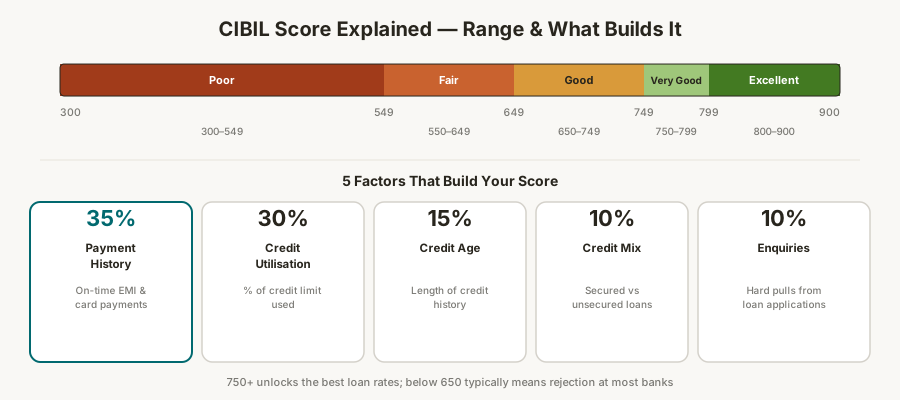
- CIBIL scores range from 300 to 900; lenders in India typically require 750+ for the best home loan rates (8.40–8.75%), while scores below 650 result in rejection at most banks.
- You can check your CIBIL score for free once a year directly at cibil.com; platforms like Paisabazaar and OneScore offer unlimited free soft checks with zero impact on your score.
- A hard enquiry from a loan application dips your score by 5–10 points; checking it yourself is always a soft enquiry and has no impact at all.
- Negative marks — late payments, defaults — stay on your CIBIL report for 7 years; a "settled" account remains visible indefinitely with that status.
Most Indians discover their CIBIL score matters at the worst possible moment: sitting in a bank branch, form filled, hoping for a home loan, and hearing that their score is too low. Your CIBIL score is the single most influential number in your borrowing life — it determines whether you get credit, what interest rate you pay, and how much the bank is willing to lend you. A difference of 100 points on this scale can mean paying ₹6–10 lakh extra over a 20-year home loan, or being rejected outright. This guide explains what the score is, what every number in the range means, and how to check it at zero cost.
What Is a CIBIL Score?
A CIBIL score is a three-digit credit score calculated by TransUnion CIBIL (Credit Information Bureau India Limited), one of four credit bureaus licensed by the Reserve Bank of India. The score ranges from 300 (poorest) to 900 (best) and represents the statistical probability that a borrower will repay credit obligations on time.
Every lender — banks, NBFCs, housing finance companies — reports your repayment behaviour to the credit bureaus each month. TransUnion CIBIL aggregates this data and runs a proprietary algorithm to produce your score. Banks then query this score whenever you apply for a loan or credit card.
India's Four Licensed Credit Bureaus
| Bureau | Full Name | Who Uses It |
|---|---|---|
| CIBIL | TransUnion CIBIL | Dominant — most banks including SBI, HDFC, ICICI, Axis |
| Experian | Experian Credit Information Company | Several private sector banks |
| Equifax | Equifax Credit Information Services | PSU banks, some NBFCs |
| CRIF High Mark | CRIF High Mark Credit Information Services | Rural lenders, microfinance, PSU banks |
While all four bureaus calculate credit scores, CIBIL is the default for 90%+ of retail credit decisions in India. When people say "credit score" in the Indian context, they mean CIBIL score. Your score at each bureau may differ by 10–30 points because not all lenders report to all four bureaus, and the scoring models vary slightly.
CIBIL Score Ranges — What Each Band Means
| Score Range | Category | What It Means for You |
|---|---|---|
| 300–549 | Poor | Almost certain rejection from mainstream banks; only high-cost lenders or NBFCs may approve |
| 550–649 | Fair/Bad | Likely rejection from PSU banks; some private banks and NBFCs may approve with higher rates and lower loan amounts |
| 650–749 | Good | Most banks will consider the application, but rate premium of 100–200 basis points over best rate |
| 750–799 | Very Good | Approved by most banks at near-competitive rates; small premium of 25–50 bps over best rate |
| 800–900 | Excellent | Best rates available; banks compete for your business |
Rate Premium by Score Band
The financial cost of a lower score is not abstract. Here is what each band actually costs you in interest rate terms, based on 2026 home loan pricing:
| Score Band | Typical Home Loan Rate | Rate vs 750+ | Extra Interest on ₹50 lakh, 20 yr |
|---|---|---|---|
| 800–900 | 8.40–8.50% | Baseline | — |
| 750–799 | 8.50–8.75% | +10–25 bps | ₹1–2 lakh |
| 700–749 | 9.00–9.50% | +50–100 bps | ₹4–8 lakh |
| 650–699 | 9.50–10.50% | +100–200 bps | ₹8–16 lakh |
| Below 650 | Likely rejected | — | Loan unavailable |
To see exactly how a rate difference affects your monthly payment, use our home loan EMI calculator — enter the same principal and tenure at two different rates and see the EMI and total interest side by side.
What Factors Make Up Your CIBIL Score?
CIBIL does not publish its exact algorithm, but the factor weightings are disclosed at an industry level. Understanding these helps you prioritise your actions.
| Factor | Approximate Weight | What Moves It |
|---|---|---|
| Payment history | ~35% | On-time EMI and credit card payments; missed payments are reported as DPD (Days Past Due) |
| Credit utilisation ratio | ~30% | Your total credit card balance as a percentage of your total credit limit |
| Length of credit history | ~15% | Age of your oldest credit account; average age of all accounts |
| Credit mix | ~10% | Balance of secured loans (home, car) vs unsecured (personal loan, credit card) |
| New credit enquiries | ~10% | Number of hard enquiries from lenders in the past 12 months |
Payment history and credit utilisation together control 65% of your score. Everything else is secondary. This is why CIBIL repair guides focus almost exclusively on clearing overdues and reducing credit card balances — those two actions address the dominant two factors.
Read our detailed guide on how to improve your CIBIL score fast for a step-by-step repair plan with realistic timelines.
How to Check Your CIBIL Score for Free
There are four ways to check your score at zero cost. They differ in frequency, depth of report, and which enquiry type they trigger.
Method 1 — TransUnion CIBIL Website (Official, 1 Free Full Report Per Year)
This is the only source that gives you the complete CIBIL Credit Information Report (CIR) for free, including your full account-level detail.
Step-by-step:
- Go to cibil.com and click "Get Free CIBIL Score & Report"
- Create an account using your PAN card number, date of birth, and mobile number
- Verify your identity via OTP (mobile) and answer authentication questions about your credit history
- Your score and full report are displayed immediately
- You can download the PDF report for records
This free check is limited to once per year. Additional checks require a paid subscription (₹550–₹1,200/year for monthly access). This is always a soft enquiry — it does not affect your score.
Method 2 — Bank Apps and Net Banking
Most major banks now show your CIBIL score directly in their mobile app or net banking portal. HDFC Bank, ICICI Bank, SBI YONO, Axis Bank, and Kotak Mahindra Bank all offer free monthly score checks for their account holders.
The advantage: you can check monthly without going to a separate platform. These are soft enquiries.
Method 3 — Paisabazaar, BankBazaar, OneScore (Free, Unlimited Soft Checks)
These financial comparison platforms partner with CIBIL and Experian to offer free unlimited score checks. No purchase required, no subscription.
- Paisabazaar — shows CIBIL score, Experian score, and a summary of your credit report
- BankBazaar — shows CIBIL score with basic report data
- OneScore — dedicated credit monitoring app; shows CIBIL score monthly with score change alerts
All three are soft enquiries with zero score impact. The limitation: they show a score summary, not the full account-level CIR. For dispute purposes or before a major loan application, get the full report from cibil.com.
Comparison Table
| Platform | Cost | Full Report? | Update Frequency | Enquiry Type |
|---|---|---|---|---|
| cibil.com (free tier) | Free | Yes (once/year) | Annual | Soft |
| cibil.com (subscription) | ₹550–₹1,200/year | Yes | Monthly | Soft |
| Paisabazaar | Free | No (summary) | On demand | Soft |
| BankBazaar | Free | No (summary) | On demand | Soft |
| OneScore | Free | No (summary) | Monthly | Soft |
| Bank apps (HDFC, ICICI, etc.) | Free | No (score only) | Monthly | Soft |
Hard Enquiry vs Soft Enquiry — The Critical Difference
Every check on your CIBIL report is either hard or soft. The distinction matters enormously.
Hard enquiry: Triggered when a lender checks your report because you have applied for credit — a loan, credit card, or overdraft facility. Each hard enquiry deducts approximately 5–10 points from your score. Multiple hard enquiries in a short window (say, 5 applications in 30 days) can cost 30–50 points — visible evidence to banks that you are credit-hungry.
Soft enquiry: Triggered when you check your own score, when a pre-approved offer is being assessed, or when a bank does a background check for a non-credit purpose. Soft enquiries have zero impact on your score, regardless of how many times you check.
The implication: Never hesitate to check your own score. Frequent self-checks do not hurt you. What hurts is applying for credit at multiple lenders simultaneously. If you're rate-shopping for a home loan, limit applications to a 30-day window and tell each lender — CIBIL treats multiple home loan enquiries within 45 days as a single enquiry to allow for shopping.
Check your loan eligibility calculator before applying anywhere — it helps you estimate what you qualify for without a hard enquiry.
How Long Negative Marks Stay on Your Report
One of the most common questions: when does a bad event stop affecting the score?
| Event | How Long It Stays |
|---|---|
| Late payment (30–89 days DPD) | 7 years from the date reported |
| Default / write-off (90+ days DPD) | 7 years from date of first default |
| Settled account | Indefinite — "Settled" status remains even after 7 years |
| Hard enquiry | 2 years (visible); impact fades after 12 months |
| Closed account (paid in full) | 7 years (positive history stays — a good thing) |
The critical nuance on settled accounts: if you negotiate a one-time settlement with a lender for less than the full outstanding amount, the account is marked "Settled" instead of "Closed." This is a permanent negative marker — it never becomes "Closed." The 7-year clock applies to fresh entries in the DPD column but the "Settled" status does not expire. This is why paying in full is categorically better than settling for a lower amount, even if the settlement amount is painful.
What CIBIL Score You Need for Each Loan Type
Different loan products have different score thresholds because the risk profiles differ. An unsecured personal loan (no collateral) requires a higher score than a secured home loan.
| Loan Type | Minimum to Qualify | Best Rate Threshold | Notes |
|---|---|---|---|
| Home loan | 650 (some lenders) | 750+ | Secured by property; HDFC, SBI prefer 750+ |
| Car loan | 650–700 | 700+ | Secured by vehicle; slightly more flexible |
| Personal loan | 700–720 | 750+ | Unsecured; stricter criteria |
| Credit card | 650–700 | 750+ | Major private banks want 700+; entry-level cards at 650 |
| Business loan (unsecured) | 700 | 750+ | Lender also checks business financials |
| Gold loan | No minimum | Not applicable | Secured by gold; score rarely the deciding factor |
Use the loan eligibility calculator to see how your current score affects the loan amount you can access at different income levels.
CIBIL Score vs Credit Score — Are They the Same?
Technically, "credit score" is the generic term for any score produced by any credit bureau. "CIBIL score" specifically refers to the score produced by TransUnion CIBIL. In common Indian usage, both terms mean the same thing because CIBIL is the dominant bureau.
When a bank says "your credit score is 760," they almost certainly mean your CIBIL score. When a financial app shows you a "credit score," it is typically pulling from CIBIL or Experian. The key point: your score at each bureau may differ, so always check the bureau your target lender actually uses before applying.
For a deeper analysis of how your score translates into specific interest rate outcomes at major banks, see current home loan rates across CIBIL score brackets and our guide on how CIBIL score affects your loan interest rate.
Score -1 or NH/NA — What It Means
If your CIBIL score shows as -1, NH, or NA, it means there is no credit history associated with your PAN. This happens when:
- You have never taken a loan
- You have never held a credit card
- You are a first-time borrower
A -1 score is not a bad score — it simply means no data. Banks treat this differently: some will approve with higher interest rates (similar to a 650–700 score), some have specific products for first-time borrowers, and some will reject outright.
Building a credit history from zero typically takes 6–12 months with a secured credit card or a small personal loan. Once you have 6 months of repayment history, your score will be calculated in the 300–900 range.
Frequently Asked Questions
Does checking my own CIBIL score reduce it?
No. Checking your own CIBIL score — whether at cibil.com, Paisabazaar, OneScore, or your bank app — is always a soft enquiry. Soft enquiries have zero impact on your score. Only hard enquiries (when a lender checks after you apply for credit) deduct points. You can check your score every day if you want — it will not move.
Why is my CIBIL score -1 or 0?
A score of -1 (sometimes shown as NH or NA) means you have no credit history on file with CIBIL. You have never held a loan, credit card, or any credit product that was reported to the bureau. This is not a penalty — it simply means there is no data to score. To generate a score, open a secured credit card against a fixed deposit, or take a small personal loan and repay it on time for 6+ months. Your score will then be calculated in the 300–900 range.
How long does it take to build a CIBIL score from scratch?
With a secured credit card or a small loan, you will have a calculated score in 6–12 months. The score typically starts in the 700–750 range if you have paid every bill on time, since there are no negative marks in a clean new history. From that base, consistent on-time payments and low credit utilisation can push you to 750–800 within another 6–12 months.
Can I dispute errors in my CIBIL report?
Yes. File a dispute at cibil.com/dispute. You flag the specific account or entry you believe is incorrect, and CIBIL contacts the lender to verify. Under RBI guidelines, the lender has 30 days to respond. If they confirm the error or fail to respond, CIBIL corrects or removes the entry. Approximately 15–20% of Indian credit reports contain at least one factual error — checking your report before a major loan application is worthwhile for this reason alone.
What is the difference between CIBIL score and credit score?
"CIBIL score" is the specific score calculated by TransUnion CIBIL. "Credit score" is the generic term for any score from any bureau — Experian, Equifax, CRIF High Mark, or CIBIL. In India, the two terms are used interchangeably in everyday conversation because CIBIL handles approximately 90% of retail credit enquiries. However, if a lender specifies they check Experian or CRIF, your score at that bureau is the one that matters for that application.
My CIBIL score dropped 50 points with no new loan. Why?
The most common causes: (1) a late payment was reported — even 1 day past the due date can be flagged; (2) your credit card balance jumped relative to your limit, increasing your utilisation ratio; (3) a lender ran a hard enquiry you weren't aware of; (4) an existing account was marked with a higher DPD category. Pull your full CIBIL report to identify which account or entry changed since your last check.
Check what loan amount your current score unlocks with the loan eligibility calculator, or see how improving your score by 50 points would reduce your monthly home loan EMI with the home loan EMI calculator.
Try the calculator
Run your own numbers in seconds. Pick the calculator that fits your loan type.