Business Loan for Small Business India 2026 — Rates, Eligibility, and Government Schemes
A complete guide to business loans for MSMEs — from MUDRA loans at 8.5% to collateral-free CGTMSE loans up to ₹5 crore. Rates, eligibility, documents, and how to choose the right product.
Key Takeaways
- MUDRA loans (up to ₹10 lakh) are the entry point for micro-businesses — no collateral, rates from 8.5–12%.
- CGTMSE scheme enables collateral-free loans up to ₹5 crore for Udyam-registered MSMEs (enhanced from ₹2 crore in Budget 2024; select categories and startups can access up to ₹10 crore per Budget 2025).
- Working capital loans (overdraft / cash credit) charge interest only on actual usage — best for businesses with seasonal or variable cash needs.
- A Udyam registration (free, online) unlocks priority-sector lending benefits that reduce your effective borrowing cost by 1–2%.
India's ₹110 lakh crore MSME sector — spanning 6.3 crore registered enterprises — remains critically underfunded. According to SIDBI, the formal credit gap for MSMEs stands at approximately ₹25 lakh crore. The government has responded with multiple schemes to channel institutional credit to small businesses. In 2026, there are more loan options for small businesses than ever — but choosing the right product for your specific need requires understanding the landscape.
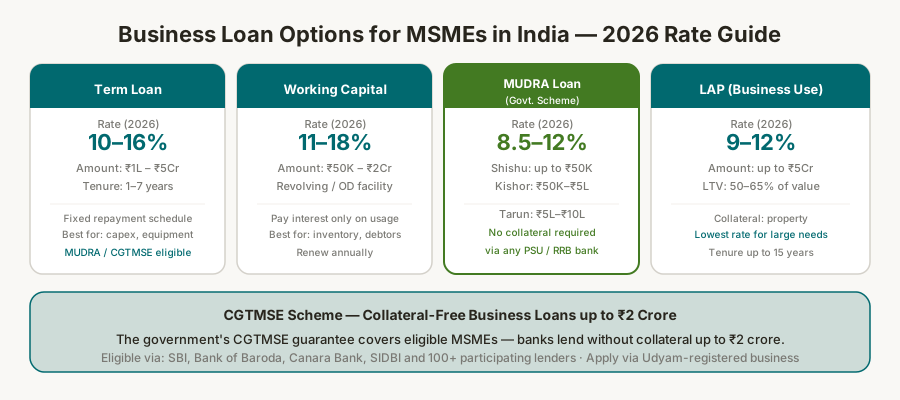
Types of Business Loans Available in India
1. Term Loan — For Capex and Asset Purchase
A standard business term loan provides a lump sum repaid through fixed monthly EMIs over 1–7 years. Best for:
- Purchasing machinery, equipment, or vehicles
- Renovating or expanding business premises
- One-time project funding
Rates (2026): 10–16% reducing balance from banks; 14–22% from NBFCs.
Use our business loan EMI calculator to compute EMI and total interest for any term loan amount.
2. Working Capital Loan — For Day-to-Day Operations
Working capital facilities are revolving credit lines (overdraft/cash credit) where you draw and repay as needed, paying interest only on the amount actually used.
| Facility Type | How It Works | Best For |
|---|---|---|
| Cash Credit (CC) | Revolving limit against stock/debtors | Traders, manufacturers |
| Overdraft (OD) | Limit against property or FD | Service businesses |
| Bill Discounting | Discount client invoices for immediate cash | Export/B2B businesses |
| Invoice Financing | Get 80–90% of invoice value upfront | Businesses with long payment cycles |
Rates (2026): 11–18% for working capital; slightly higher than term loans due to flexibility.
3. MUDRA Loan — For Micro and Small Enterprises
Pradhan Mantri MUDRA Yojana (PMMY) provides loans through all PSU banks, private banks, RRBs, and MFIs. Three categories:
| Category | Loan Amount | Target Segment |
|---|---|---|
| Shishu | Up to ₹50,000 | Starting businesses, artisans |
| Kishor | ₹50,001 – ₹5 lakh | Established micro-businesses |
| Tarun | ₹5 lakh – ₹10 lakh | Growing small businesses |
Rate range: 8.5–12% depending on lender and scheme. Collateral: Not required. How to apply: Walk into any PSU bank, SFB, or RRB branch with Udyam registration and basic KYC.
4. CGTMSE — Collateral-Free Loans up to ₹5 Crore
The Credit Guarantee Fund Trust for Micro and Small Enterprises (CGTMSE) is a government guarantee scheme that allows banks to lend to MSMEs without collateral. The standard guarantee ceiling is ₹5 crore (enhanced from ₹2 crore in Budget 2024); for startups and select categories it was further raised to ₹10 crore in Budget 2025. The government guarantees 75–85% of the loan — banks lend based on this guarantee.
Eligible borrowers: Udyam-registered MSMEs in manufacturing and services sectors. Participating lenders: SBI, Bank of Baroda, Canara Bank, SIDBI, and 100+ other scheduled commercial banks. CGTMSE guarantee fee: 0.37–1.35% per annum on the guaranteed amount (charged to the borrower).
Example: ₹50 lakh CGTMSE-backed term loan at 11.5%:
- EMI (5 years): ₹1,09,963/month (use our business loan EMI calculator to verify)
- CGTMSE fee (~0.9%): ₹45,000/year
- Total effective cost: ~12.4%
- But zero collateral required — a significant advantage for asset-light businesses.
5. Loan Against Property (Business LAP) — For Larger Amounts
If your business needs above ₹50 lakh and you own property, a business LAP provides the lowest rate (9–12%) with the longest tenure (up to 15 years).
| Business LAP | Unsecured Business Loan | |
|---|---|---|
| Rate | 9–12% | 14–22% |
| Amount | Up to ₹5 crore | Up to ₹50 lakh |
| Tenure | Up to 15 years | Up to 5 years |
| Collateral | Property (50–65% LTV) | None |
| Processing time | 7–21 days | 2–7 days |
Eligibility Criteria — What Banks Check
| Factor | Requirement |
|---|---|
| Business vintage | Minimum 2–3 years operational |
| Udyam registration | Mandatory for government schemes; strongly preferred otherwise |
| ITR filing | Last 2–3 years; growing profit trajectory preferred |
| CIBIL score (promoter) | 680+ for most banks; 720+ for best rates |
| Bank statements | Last 12 months; healthy average balance, regular turnover credits |
| GST compliance | Returns filed for last 8 quarters (if registered) |
| Existing borrowing | Existing loans serviced on time — DPD clean |
Government Schemes — Beyond MUDRA and CGTMSE
Emergency Credit Line Guarantee Scheme (ECLGS)
Originally launched in 2020 for COVID relief, ECLGS continues in modified form for MSMEs in stressed sectors. Provides additional credit of 20–40% of existing outstanding, fully guaranteed by the government. Check with your existing banker if your business qualifies.
Stand-Up India
Specifically for SC/ST entrepreneurs and women borrowers — loans from ₹10 lakh to ₹1 crore for greenfield manufacturing, services, or trading. Interest rate: bank's base rate + 3% + tenor premium (typically 9–11%). Available via scheduled commercial banks.
PM Vishwakarma Scheme (2024)
Covers 18 traditional trades (blacksmiths, potters, weavers, cobblers, etc.). Provides collateral-free Enterprise Development Loans in two tranches: up to ₹1 lakh (first tranche, 18-month tenure) and up to ₹2 lakh (second tranche, 30-month tenure) — total up to ₹3 lakh, at a concessional rate of 5% (government bears the interest subsidy difference up to 8% p.a.).
How to Choose the Right Product
| Your Situation | Best Product |
|---|---|
| Starting up, need < ₹10 lakh | MUDRA Loan (Kishor/Tarun) |
| Established, need < ₹5 crore, no collateral | CGTMSE-backed term loan |
| High seasonality, need revolving credit | Working Capital (CC/OD) |
| Need > ₹50 lakh, own property | Business LAP |
| Need speed, willing to pay premium | NBFC unsecured loan |
| Women / SC-ST entrepreneur | Stand-Up India |
Step-by-Step Application Process
Step 1: Get Udyam registered
The Udyam Registration portal (udyamregistration.gov.in) is free and takes under 10 minutes with your Aadhaar and PAN. It unlocks priority-sector lending benefits, subsidy eligibility, and government scheme access.
Step 2: Prepare financial documents
Gather last 3 years' ITR, audited financials, 12 months' bank statements, GST returns, and business registration proof. A CA-attested income certificate speeds up underwriting at most banks.
Step 3: Approach your primary banker first
Your current banker has transaction history — the biggest underwriting advantage you have. Apply for the business loan where you maintain your current account. If declined, approach PSU banks (most SE-friendly for CGTMSE and MUDRA) before NBFCs.
Step 4: Compare total cost, not just rate
A 14% bank loan with no processing fee may be cheaper than a 12% NBFC loan with 2% processing + 2% annual guarantee fee over a 3-year tenure. Use the compare loans tool to compute total interest outflow for each offer side by side. For current bank lending rates, see our loan rates page.
Frequently Asked Questions
What is the interest rate on MUDRA loans in India in 2026?
MUDRA loan rates vary by lender: PSU banks typically charge 8.5–11.5%, private banks 11–14%, and MFIs 15–18%. The rate is not fixed by the government — lenders set it within broad guidelines. PSU banks (SBI, BoB, Canara) offer the lowest MUDRA rates.
What is CGTMSE and how does it help small businesses get loans?
CGTMSE (Credit Guarantee Fund Trust for Micro and Small Enterprises) is a government guarantee scheme that covers 75–85% of a business loan default risk. This allows banks to lend to MSMEs without collateral — up to ₹5 crore standard (₹10 crore for startups and select categories from Budget 2025). The borrower pays a small annual guarantee fee (0.37–1.35%) instead of providing property as security.
Can a startup get a business loan in India?
Startups under 2–3 years old have limited options through mainstream banks. Better routes: MUDRA Shishu/Kishor for amounts up to ₹5 lakh; SIDBI Startup Mitra scheme for DPIIT-recognised startups; Startup India seed fund (up to ₹50 lakh, equity-free). NBFCs and fintech lenders (Lendingkart, Indifi, NeoGrowth) approve younger businesses at higher rates (18–24%).
Is GST registration mandatory for a business loan?
GST registration is required for most formal business loans — banks treat GST returns as the primary revenue audit trail for MSMEs above the ₹20 lakh turnover threshold. Below the GST threshold, bank statements serve as revenue evidence. MUDRA loans up to ₹5 lakh typically do not require GST returns.
How long does it take to get a business loan approved?
PSU banks: 10–21 business days. Private banks: 5–10 days. NBFCs (Bajaj Finance, Lendingkart): 2–5 days. Fintech lenders (KreditBee Business, FlexiLoans): Same day to 48 hours. The tradeoff: faster approval usually means higher rates.
Try the calculator
Run your own numbers in seconds. Pick the calculator that fits your loan type.