Home Loan vs Rent in India — When Does Buying Actually Make Financial Sense?
The price-to-rent ratio in Mumbai is 40. In Hyderabad it's 22. Those two numbers tell you more about whether to buy than any amount of social pressure can. Here's the complete framework.
Key Takeaways
- The price-to-rent ratio (purchase price ÷ annual rent) tells you whether your city favours buying or renting. Below 15 = buy; above 20 = lean toward renting.
- Stamp duty, registration, brokerage, and fit-out add 10–15% to the effective purchase price — before your first EMI.
- The true break-even horizon in most Indian metros is 8–12 years. Under 7 years of planned stay: rent.
- "Wasting money on rent" is not a financial argument. Opportunity cost of the down payment is real money.
No decision in Indian personal finance is more emotionally charged than buying a home. "Rent is waste" is practically cultural doctrine. Parents, relatives, and society collectively pressure working adults to buy the moment they are financially able to — and often before.
But the math does not always agree with the sentiment. In several Indian cities right now, renting is the financially superior choice. In others, buying is a clear win. The difference lies in a single ratio and a handful of honest calculations.
This guide gives you the framework to make this decision with numbers, not emotions.
The Price-to-Rent Ratio: Your First Signal
The Price-to-Rent Ratio (P/R) is the single most useful quick signal for the rent-vs-buy question:
P/R = Property Purchase Price ÷ Annual Rent for Equivalent Property
Interpreting the ratio
| P/R Ratio | Interpretation |
|---|---|
| < 15 | Buying is financially superior |
| 15–20 | Borderline — depends on personal factors |
| 20–25 | Renting likely better for under-10-year stays |
| > 25 | Renting is financially superior for most scenarios |
P/R ratios across Indian cities (mid-2026 estimates)
| City / Micro-market | P/R Ratio | Lean |
|---|---|---|
| Mumbai South / Bandra | 38–45 | Strong rent |
| Gurugram Premium (Golf Course Road) | 32–38 | Strong rent |
| Noida (Sector 50–100) | 22–28 | Lean rent |
| Bengaluru Outer Ring Road | 24–30 | Lean rent |
| Hyderabad (Gachibowli) | 18–24 | Borderline |
| Pune (Kharadi / Wakad) | 18–22 | Borderline |
| Chennai (OMR) | 16–20 | Borderline |
| Tier-2 cities (Nashik, Coimbatore, Indore) | 10–16 | Lean buy |
| Tier-3 cities | 8–14 | Clear buy |
In Mumbai's premium markets, you would pay ₹4–5 crore for a 3BHK that rents for ₹90,000–₹1.1 lakh a month. P/R = 4 crore ÷ 11 lakh = ~36. The math strongly favours renting.
In Nashik, the same apartment costs ₹60 lakh and rents for ₹25,000/month. P/R = 60 lakh ÷ 3 lakh = 20. Much closer to the tipping point.
The True Cost of Owning: What Your EMI Doesn't Tell You
Your EMI is the most visible but not the only cost of homeownership. A complete picture:
Upfront costs (one-time, before you move in)
| Cost | Typical Range |
|---|---|
| Stamp duty | 5–7% of property value |
| Registration charges | 1% of property value |
| Brokerage (resale properties) | 1–2% of property value |
| Home loan processing fee | 0.25–1% of loan amount |
| Property legal charges | ₹15,000–₹50,000 |
| Interior fit-out / renovation | ₹3–15 lakh (depends on size) |
Stamp duty rates vary by state (1–8%) — use our stamp duty calculator to estimate the exact amount for your state and property value.
For a ₹80 lakh flat: Stamp duty + registration + brokerage + fit-out easily totals ₹10–15 lakh before you move in. That's 12–19% added to your effective cost.
Annual recurring costs (on top of EMI)
| Cost | Typical Annual Amount |
|---|---|
| Property tax | 0.1–0.5% of property value |
| Society maintenance charges | ₹1,200–₹8,000/month (₹14,400–₹96,000/year) |
| Home insurance | ₹8,000–₹25,000/year |
| Average repair and upkeep | 1–1.5% of property value over time |
Example: ₹80 lakh flat in Bengaluru. RBI mandates 25% down payment for loans above ₹75 lakh, so the loan is ₹60 lakh. Annual EMI burden (9%, 20 years) = ₹6.48 lakh. Property tax: ₹25,000. Maintenance: ₹50,000. Insurance: ₹15,000. Repairs (averaged): ₹60,000. True annual cost: ₹7.98 lakh — not just the EMI. Use our home loan EMI calculator to model the monthly outflow for your own purchase.
The rent-vs-buy comparison must use this true ownership cost, not just the EMI.
The Opportunity Cost of the Down Payment
This is the calculation that "wasting money on rent" believers almost always omit.
A ₹80 lakh flat typically requires a 20% down payment (₹16 lakh) plus upfront costs (₹10 lakh) = ₹26 lakh deployed upfront.
If that ₹26 lakh had been invested instead:
- At 8% CAGR (equity mutual funds, conservative estimate): ₹26 lakh becomes ₹56 lakh in 10 years
- At 12% CAGR (equity markets long-term): ₹26 lakh becomes ₹80 lakh in 10 years
This is the opportunity cost. If you're renting a similar property at ₹25,000/month, you pay ₹30 lakh in rent over 10 years — but you've kept ₹26 lakh invested. The invested ₹26 lakh at 10% CAGR = ₹67 lakh after 10 years. Net position from renting: ₹67 lakh − ₹30 lakh = ₹37 lakh ahead.
Whether the property appreciates faster than this invested amount is the central question — and it depends entirely on the specific city, micro-market, and time horizon.
The Break-Even Horizon Analysis
The break-even horizon is the number of years of ownership required before total cost of buying = total cost of renting. Below this horizon, renting wins. Above it, buying wins.
How to estimate your break-even
Total cost of buying (over n years):
- Down payment deployed (₹)
- Total EMIs paid
- Total ownership costs (tax, maintenance, insurance)
- Opportunity cost of down payment (invested return foregone)
- Minus: home equity built (appreciation + principal repaid)
Total cost of renting (over n years):
- Total rent paid
- Total invested returns on down payment equivalent
In most Indian metros in 2026, at current prices and rental yields, this break-even is 8–12 years. In Mumbai premium markets, it can be 15+ years.
A worked example: Pune, ₹70 lakh flat
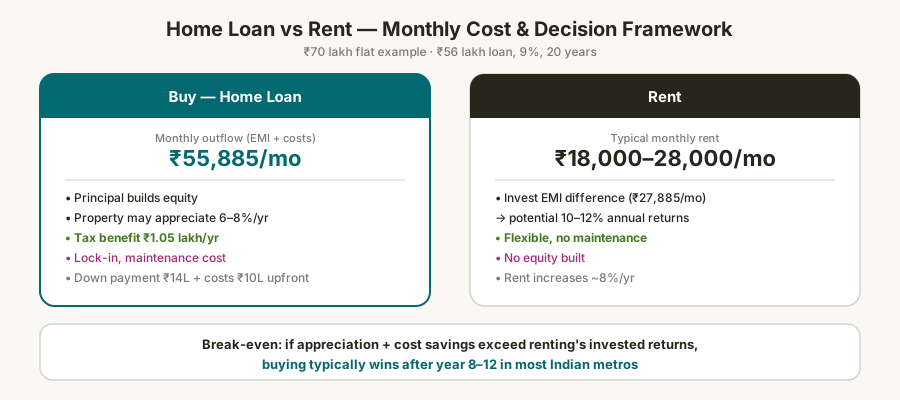
(Loan = ₹56 lakh at 80% LTV; EMI at 9%, 20 years = ₹50,385/month)
| Factor | Buy | Rent |
|---|---|---|
| Monthly outflow | ₹50,385 (EMI) + ₹5,500 costs = ₹55,885 | ₹28,000 rent |
| Upfront cost | ₹14L down + ₹10L upfront costs | ₹0 |
| Monthly outflow differential | ₹27,885 more than renter | — |
| Differential invested at 10% | — | ₹27,885/month → ₹57 lakh in 10 years |
| Down payment invested at 10% | — | ₹24L → ₹62L in 10 years |
| Home appreciation (7% CAGR) | ₹70L → ₹1.38 crore | — |
| Principal repaid in 10 years | ~₹16 lakh | — |
| Net position at year 10 (buy) | ₹1.38 crore − ₹40L remaining loan = ₹98L equity | — |
| Net position at year 10 (rent) | ₹57L + ₹62L = ₹1.19 crore portfolio | — |
In this example, renting + investing wins by ~₹21 lakh at year 10. But if property appreciates at 9–10% CAGR instead of 7%, buying wins. The outcome is extremely sensitive to property appreciation rate.
When Buying Clearly Makes Sense
Buy when:
- You plan to stay for 10+ years (break-even exceeded with buffer)
- P/R in your target area is below 20
- Your down payment is under 20% of net worth (you're not overextending)
- EMI will be under 40% of take-home pay
- You've priced the intangibles (stability, customization, no landlord risk) and they matter to you
- The property is in a location with historically strong rental demand (protects resale)
When Renting Clearly Makes Sense
Rent when:
- P/R in your city is above 25
- Your career or family situation may require relocation in under 7 years
- EMI would exceed 45% of take-home pay
- Your down payment + costs would deplete your emergency fund or investment corpus
- You're buying primarily because of social pressure — that's the most expensive motivation
The Honest Decision Framework
Neither renting nor buying is universally right. The correct answer is the one that:
- Doesn't overextend your finances — if EMI > 40% of take-home, the loan is too large regardless of how attractive the property is. Use our loan eligibility calculator to check how large a loan your income actually supports.
- Matches your time horizon — under 7 years, renting is almost always better financially.
- Accounts for the full true cost — not just EMI, but taxes, maintenance, and opportunity cost.
Use our home loan EMI calculator to model the monthly cost, and our compare loans tool to stress-test different scenarios. Then compare honestly with what renting would cost — and what you'd build by investing the difference.
Frequently Asked Questions
Is it better to buy or rent a house in India in 2026?
It depends on your city and tenure. In high P/R cities like Mumbai (P/R 35–45), Gurugram (30–38), and Bengaluru (24–30), renting is financially superior for stays under 10 years. In tier-2 cities and lower P/R micro-markets, buying makes sense sooner — often within 5–7 years.
What is a good price-to-rent ratio to decide buying vs renting?
Below 15 strongly favours buying. Between 15–20 is borderline and depends on your time horizon and investment alternatives. Above 20 favours renting for most scenarios under 10 years.
Is paying rent really "wasting money"?
No — it's paying for a service (housing), just as paying for food or utilities is not "wasting money." The question is whether the alternative (buying) is a better use of capital, which depends on your P/R ratio, tenure, and investment discipline.
How much down payment do I need to buy a home in India?
Lenders finance 80–90% of the property value depending on loan size: up to 90% LTV for loans ≤₹30 lakh, 80% for ₹30–75 lakh, and 75% for loans above ₹75 lakh (per RBI guidelines). For an ₹80 lakh property (above ₹75 lakh tier): ₹20 lakh down payment, plus stamp duty (₹4–5 lakh) and registration/other costs (₹2–3 lakh). Total upfront requirement: ₹26–28 lakh.
Should I take a home loan even if I can buy outright?
Generally yes, if your home loan rate (8.5–9%) is lower than your expected investment return (10–12% for equity funds). Keep the cash invested and use a loan for the property. This is an arbitrage that works when you have investment discipline. Read our full analysis in car loan vs outright purchase which covers the same principle for vehicles.
What happens to my home loan EMI if property prices fall?
Your EMI doesn't change — it's fixed at the time of sanction based on your loan amount, not the current market value of the property. However, a fall in property value below the outstanding loan amount creates "negative equity" — where you owe more than the property is worth. This is a risk for high LTV loans (90%+) in volatile markets.
Try the calculator
Run your own numbers in seconds. Pick the calculator that fits your loan type.