Education Loan India 2026 — Complete Guide to Rates, EMI, and Tax Benefits
Everything Indian students and parents need to know about education loans — interest rates from SBI, HDFC, and Axis, how moratorium works, EMI calculation after course completion, and how to save ₹40,000/year in tax.
Key Takeaways
- SBI's Scholar Loan offers 8.15–8.65% for premier institutions (IITs, IIMs, NITs) — the lowest education loan rate in India.
- Moratorium period (course duration + 6–12 months) means no EMI during your studies — but interest accrues and is added to principal.
- Section 80E allows deduction of the entire interest paid on education loans with no upper limit — potentially saving ₹30,000–₹1 lakh/year in tax.
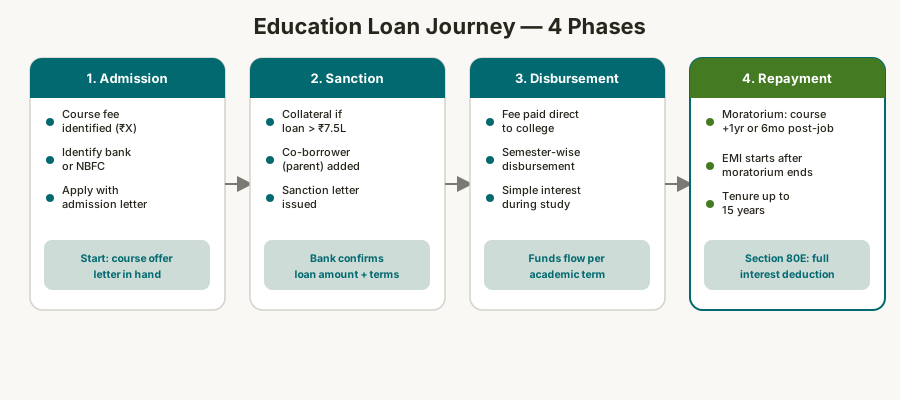
- For education loans above ₹7.5 lakh, collateral is required at most banks. Below ₹7.5 lakh, no collateral is needed (CGFSEL guarantee scheme).
For millions of Indian families, an education loan is the bridge between aspiration and access. The right loan from the right lender — at the right rate — can fund an IIT degree, an IIM MBA, or a master's programme abroad, without permanently derailing the family's finances.
But education loans have several features that make them structurally different from other loans: a moratorium period where no EMI is paid, interest that compounds during that moratorium, collateral requirements that kick in above ₹7.5 lakh, and a unique tax benefit that applies for 8 years after repayment begins. Understanding all of these is essential before signing.
Education Loan Interest Rates in India 2026
Public sector banks (best rates)
| Bank | Rate | Special Schemes |
|---|---|---|
| SBI | 8.15–11.15% | Scholar Loan at 8.15–8.65% for IIT/IIM/NIT/AIIMS |
| Bank of Baroda | 8.15–9.85% | Baroda Scholar for premier institutions |
| Canara Bank | 8.50–9.90% | Vidya Turant for select colleges |
| Punjab National Bank | 8.75–10.25% | PNB Udaan for abroad studies |
Private banks and NBFCs
| Lender | Rate | Notes |
|---|---|---|
| HDFC Credila | 10.50–14% | Specialist education loan NBFC; fast processing |
| Axis Bank | 13.70–15.20% | Higher rates; faster disbursal than PSU banks |
| ICICI Bank | 10.75–14.50% | Good for abroad studies; digital processing |
| Avanse | 11–15% | Specialises in education loans; flexible collateral |
| InCred | 12–16% | Fintech; works with lower-ranked colleges |
Key insight: For premier institutions (IIT, IIM, BITS, NIT, Top 200 QS-ranked foreign universities), public sector banks offer rates 2–5% below private lenders. The processing is slower, but the total interest saving over 8–10 years can be ₹2–5 lakh on a ₹15–20 lakh loan. Compare current bank rates on our loan rates page.
Loan Amount Limits and Collateral Requirements
The ₹7.5 lakh threshold
| Loan Amount | Collateral Requirement | Guarantee |
|---|---|---|
| Up to ₹4 lakh | None | Third-party guarantee (parent/guardian) |
| ₹4–7.5 lakh | None | Third-party guarantee (CGFSEL scheme) |
| Above ₹7.5 lakh | Tangible collateral required | Property, FD, LIC policy, NSC |
| Above ₹20 lakh (abroad) | Stronger collateral; may need NRI guarantee | Lender-specific |
The Credit Guarantee Fund Scheme for Education Loans (CGFSEL), administered by the National Credit Guarantee Trustee Company (NCGTC), covers loans up to ₹7.5 lakh at approved institutions without collateral. This is a government scheme that guarantees the bank against default — significantly reducing documentation burden for students. Note: CGFSEL is a separate scheme from CGTMSE (which covers MSME business loans only).
What qualifies as collateral
- Residential property (most preferred by banks; up to 100% of property value)
- Commercial property (60–80% of assessed value)
- Fixed deposits (FDs) pledged at the lending bank (up to 100% of FD value)
- LIC policies (up to surrender value)
- NSC, KVP, government bonds
How the Moratorium Period Works
The moratorium is the grace period during which no EMI is due. For education loans, this is typically:
Moratorium = Course duration + 6 months (some banks offer 12 months)
For a 2-year MBA: moratorium = 2 years + 6 months = 30 months of no EMI.
What happens to interest during the moratorium
This is the most misunderstood aspect of education loans. Interest continues to accrue during the moratorium — it is not waived. Banks handle this in two ways:
- Simple interest accrual (better option): Interest accumulates as simple interest during the moratorium. At EMI start, this accrued interest is either paid as a lump sum or added to the principal.
- Compounding: Some lenders compound the interest quarterly during the moratorium — making the effective loan at EMI start significantly larger than the original disbursement.
Example: ₹15 lakh education loan at 9%, 2-year course + 6-month moratorium = 30 months moratorium.
Simple interest accrued during moratorium = ₹15,00,000 × 9% × (30/12) = ₹3,37,500
If this is added to principal: EMI is now calculated on ₹18,37,500 instead of ₹15 lakh — a 22.5% larger base. At 9% for 10 years:
- EMI on original ₹15L: ₹19,000/month
- EMI on ₹18.375L (with accrued interest): ₹23,285/month
Should you pay interest during moratorium?
Yes — if you can. Most banks allow (and encourage) interest payment during the moratorium. Every rupee of interest paid during the course prevents it from being capitalized into the principal.
If parents can pay the monthly interest (₹11,250/month on ₹15 lakh at 9%), the student begins repayment on the original ₹15 lakh — saving ₹3.37 lakh in capitalized interest that would otherwise generate further interest for 10 years.
How to Calculate Education Loan EMI
After the moratorium ends, EMI is calculated using the standard reducing balance formula:
EMI = P × r × (1 + r)^n ÷ ((1 + r)^n − 1)
Where P = outstanding principal after moratorium (original loan + capitalized interest if not paid during moratorium), r = monthly rate, n = repayment tenure in months.
Use our education loan EMI calculator which handles the moratorium period automatically — enter the loan amount, rate, course duration, and repayment tenure to see exactly what your monthly EMI will be after you graduate.
Repayment tenure options
| Loan Amount | Typical Max Repayment Tenure |
|---|---|
| Up to ₹7.5 lakh | 10 years after moratorium |
| ₹7.5–20 lakh | 12–15 years after moratorium |
| Above ₹20 lakh | Up to 15 years after moratorium |
Longer repayment tenure = lower EMI but significantly higher total interest. A ₹15 lakh loan at 9% (use our education loan EMI calculator to model any scenario):
- 7-year repayment: EMI ₹24,134, total interest ₹5.3 lakh
- 10-year repayment: EMI ₹19,001, total interest ₹7.8 lakh
- 12-year repayment: EMI ₹17,070, total interest ₹9.6 lakh
Education Loans for Studying Abroad
Studying at a foreign university adds complexity: the loan must cover tuition in foreign currency, living expenses, and often travel — and the disbursement may be in USD/GBP/EUR.
Key differences for abroad education loans
- Loan amounts: Higher — up to ₹1.5–2 crore from some lenders for top institutions (Harvard, Oxford, MIT, NUS).
- Collateral threshold: Stricter — loans above ₹20 lakh for abroad almost always require collateral.
- Currency risk: Many lenders disburse in INR and you convert to foreign currency — you bear the exchange rate risk. Some specialist lenders (HDFC Credila, Prodigy Finance) offer foreign-currency loans.
- Accepted universities: PSU banks (SBI, Bank of Baroda) have approved lists. Specialist lenders (HDFC Credila, Avanse, InCred) cover a broader range of institutions including community colleges in the US.
Prodigy Finance — for top global universities
Prodigy Finance is a UK-based lender that exclusively funds students admitted to top-ranked international programmes (top-50 MBA programs, specific engineering master's). Loans are in USD/EUR, no collateral required, repayment begins 6 months after graduation. Rates are higher (10–13% USD) but the no-collateral feature is significant.
Section 80E Tax Benefit — The Underutilised Deduction
Section 80E allows a deduction for the full interest paid on an education loan — with no upper limit — from taxable income for up to 8 consecutive years, starting from the year repayment begins.
What qualifies
- The loan must be for higher education (after Class 12) for yourself, your spouse, your children, or a student for whom you are a legal guardian.
- The loan must be from a recognized financial institution (bank or approved charitable institution — not employer loans or family loans).
- The deduction is only on interest — not principal repayment.
Tax saving calculation
| Interest paid in year | 30% slab saving | 20% slab saving |
|---|---|---|
| ₹1 lakh | ₹31,200 | ₹20,800 |
| ₹1.5 lakh | ₹46,800 | ₹31,200 |
| ₹2 lakh | ₹62,400 | ₹41,600 |
| ₹2.5 lakh | ₹78,000 | ₹52,000 |
Key advantage: Unlike Section 24(b) for home loans (capped at ₹2 lakh), Section 80E has no cap. A student who borrows ₹30 lakh for an MBA abroad at 11% pays ~₹3.3 lakh in interest in year 1 of repayment — the full ₹3.3 lakh is deductible, saving ₹1,03,000 in tax at the 30% slab.
Section 80E is available under the Old Tax Regime only. Under the New Tax Regime (default from FY2023–24), Section 80E deductions are not available.
Application Process and Tips
Documents typically required
- Admission letter from the institution
- Fee structure / cost schedule
- Co-applicant (parent/guardian) KYC and income documents
- Collateral documents (if loan > ₹7.5 lakh)
- Mark sheets (10th, 12th, graduation) and entrance exam scores
Timeline expectations
| Lender type | Processing time |
|---|---|
| Public sector banks (SBI, BoB) | 15–30 business days |
| Private banks (HDFC, ICICI, Axis) | 7–15 business days |
| Specialist NBFCs (HDFC Credila, Avanse) | 5–10 business days |
Start early. Universities have fee deadlines, and bank processing timelines are non-negotiable. Apply for the loan at least 45 days before you need the first disbursement.
How to get the best rate
- Check if your institution is on SBI's or BoB's preferred/scholar list — this alone can reduce the rate by 1–2%.
- Apply to 2–3 lenders simultaneously. Unlike home loan inquiries, education loan inquiries don't cluster-protect in the same way — but the rate difference justifies multiple applications.
- Negotiate on processing fees, moratorium interest (some banks waive partial interest for meritorious students), and repayment tenure.
- A co-applicant with a strong CIBIL score and income can reduce the rate at private lenders. Run the loan eligibility calculator with the co-applicant's income added to confirm the combined maximum loan amount before approaching a lender.
Frequently Asked Questions
What is the interest rate on SBI education loan in 2026?
SBI's regular education loan rate is 8.65–11.15% depending on the institution type and loan amount. For premier institutions (IITs, IIMs, NITs, AIIMS, top 200 QS-ranked foreign universities), SBI's Scholar Loan scheme offers 8.15–8.65% — the lowest rate in the market.
Do I need collateral for an education loan in India?
No collateral is required for loans up to ₹7.5 lakh under the CGFSEL guarantee scheme. Above ₹7.5 lakh, banks typically require tangible collateral (property, FD, LIC policy). Some specialist lenders and Prodigy Finance offer unsecured loans above ₹7.5 lakh for premier institutions.
Is education loan interest tax deductible?
Yes, under Section 80E of the Income Tax Act. The full interest paid on a qualifying education loan is deductible from taxable income for up to 8 consecutive years from the year repayment begins. There is no upper cap. Section 80E is available under the Old Tax Regime only — it is not available if you opt for the New Tax Regime.
What happens if I can't repay my education loan after graduation?
Contact your lender immediately before missing an EMI. Banks can extend the repayment tenure, offer a moratorium extension (3–6 months in genuine hardship), or restructure the loan. For collateral-backed loans, default eventually triggers SARFAESI proceedings against the pledged asset. For collateral-free loans under CGFSEL, the government guarantee covers the default — but your CIBIL score is severely damaged.
Can I repay my education loan before the scheduled tenure?
Yes. RBI mandates that banks cannot charge prepayment penalties on education loans with floating interest rates. For fixed-rate education loans (some private lenders), prepayment charges of 2–4% may apply. Prepaying early significantly reduces total interest — especially recommended for high-value abroad loans.
How long is the moratorium period for education loans?
The standard moratorium period is the course duration plus 6 months (or 1 year at some banks). For a 4-year engineering degree, the moratorium is 4 years + 6 months = 54 months. During this period, no EMI is due, but interest continues to accrue and is added to the principal at moratorium end unless paid separately.
Can both parents and the student claim Section 80E deduction?
No. Section 80E can be claimed by either the student (borrower) or the parent/guardian (co-applicant), not both. Typically, the person who is actually repaying the EMI claims the deduction. If the student is employed and repaying, they claim it. If parents are repaying, they claim it.
Try the calculator
Run your own numbers in seconds. Pick the calculator that fits your loan type.