RBI Rate Cut and Your Home Loan EMI — What Changes and When
When the RBI cuts the repo rate, your floating-rate home loan EMI should drop — but the timeline, the mechanism, and the exact amount depend on factors most borrowers don't know. Here's the complete picture.
Key Takeaways
- When the RBI cuts by 25 bps, your floating-rate home loan rate drops by exactly 25 bps — within 3 months (EBLR mandate).
- On a ₹60 lakh, 20-year loan, each 25 bps cut saves ₹961/month (or reduces tenure by ~1 year if EMI stays constant).
- MCLR-linked loans pass on cuts slower and partially. If you're still on MCLR, switch to EBLR immediately.
- Lenders can choose to keep your EMI the same and reduce tenure, or reduce EMI. Most choose tenure reduction — ask to switch.
The RBI cut the repo rate four times between February and December 2025 — from 6.50% to 5.25% — a total reduction of 125 bps, including a 50 bps jumbo cut in June 2025. The rate has been held steady at 5.25% through all four MPC meetings in 2026 (February, April, June and August). Check current home loan rates linked to this benchmark on our bank loan rates page. If you have a floating-rate home loan, these cuts directly affect your monthly EMI and total interest cost. But the mechanism and timeline confuse many borrowers.
This guide explains exactly how a repo rate cut flows to your home loan EMI, when you'll see the benefit, and how to maximise the savings.
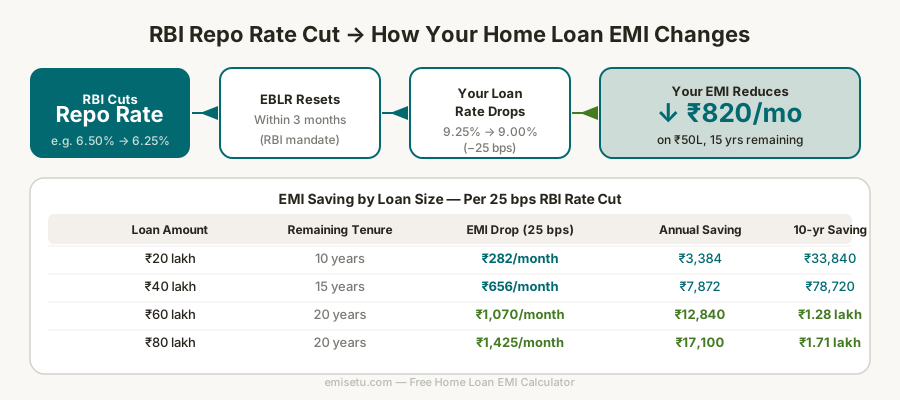
The Transmission Chain: Repo Rate → Your EMI
The path from RBI announcement to your EMI reduction involves three steps:
Step 1: RBI announces a repo rate cut
The Monetary Policy Committee (MPC) meets every two months. Rate decisions are announced immediately after the meeting. Recent history:
- February 2025: Cut 25 bps (6.50% → 6.25%) — first cut in 5 years
- April 2025: Cut 25 bps (6.25% → 6.00%)
- June 2025: Cut 50 bps (6.00% → 5.50%) — jumbo cut
- December 2025: Cut 25 bps (5.50% → 5.25%) — cycle low
- February / April / June / August 2026: Held at 5.25% (neutral stance)
Step 2: Your bank's EBLR resets
Since October 2019, all floating-rate retail loans must be linked to an External Benchmark Lending Rate (EBLR). For most home loans, the EBLR is directly tied to the RBI repo rate. Banks must reset EBLR within 3 months of a repo rate change.
In practice, most major lenders (SBI, HDFC Bank, ICICI, Axis) reset EBLR monthly on the first business day of each month following the RBI announcement. So a February rate cut typically reflects in your March or April EMI.
Step 3: Your EMI or tenure changes
Your loan rate = New EBLR + Your Spread (unchanged since sanction)
When EBLR drops by 25 bps, your loan rate drops by exactly 25 bps.
Exact EMI/Tenure Impact by Loan Size
| Loan Amount | Remaining Tenure | Rate Before | Rate After (−25 bps) | EMI Drop | Annual Saving |
|---|---|---|---|---|---|
| ₹20 lakh | 10 years | 9.00% | 8.75% | ₹270/month | ₹3,240 |
| ₹30 lakh | 15 years | 9.00% | 8.75% | ₹445/month | ₹5,340 |
| ₹50 lakh | 20 years | 9.00% | 8.75% | ₹800/month | ₹9,600 |
| ₹60 lakh | 20 years | 9.00% | 8.75% | ₹961/month | ₹11,532 |
| ₹80 lakh | 20 years | 9.00% | 8.75% | ₹1,281/month | ₹15,372 |
| ₹1 crore | 25 years | 9.00% | 8.75% | ₹1,706/month | ₹20,472 |
Use our home loan EMI calculator to compute the precise impact for your exact loan balance and remaining tenure.
EMI Reduction vs Tenure Reduction — How Banks Handle Rate Cuts
When your rate drops, banks can respond in one of two ways:
Option A — Reduce EMI, keep tenure same: Your monthly payment drops immediately. Cash flow improves.
Option B — Keep EMI same, reduce tenure: Your monthly payment stays unchanged but the loan ends earlier. You save more total interest.
Most banks default to Option B (tenure reduction) — your EMI stays constant and the loan clears faster. This is generally the better financial outcome, but it doesn't improve your immediate cash flow.
If you want EMI reduction instead:
- Call your lender and request the EMI adjustment explicitly
- Most banks allow this with a written request and a small processing fee (₹500–₹2,000)
- The switch can be done at any rate reset date
The Cumulative Effect of Multiple Rate Cuts
| Rate Cuts | Total Reduction | EMI Saving (₹60L, 20yr) | Total Interest Saved |
|---|---|---|---|
| 1 cut (25 bps) | 25 bps | ₹961/month | ₹2.31 lakh |
| 2 cuts (50 bps) | 50 bps | ₹1,915/month | ₹4.60 lakh |
| 3 cuts (75 bps) | 75 bps | ₹2,860/month | ₹6.86 lakh |
| 4 cuts (100 bps) | 100 bps | ₹3,798/month | ₹9.12 lakh |
| Actual 2025 cycle (125 bps) | 125 bps | ₹4,727/month | ₹11.34 lakh |
The full 125 bps cut through 2025 means a ₹60 lakh home loan borrower who was on an EBLR-linked loan since early 2025 has already saved approximately ₹11.34 lakh in total interest — automatically, with no action required. This is why confirming your loan is on EBLR rather than MCLR matters so much: MCLR borrowers captured only a fraction of this.
Why MCLR-Linked Loans Miss Out
If your home loan was sanctioned before October 2019, it may still be linked to MCLR (Marginal Cost of Funds-based Lending Rate) — your bank's internal rate. MCLR is NOT directly linked to the repo rate.
The difference:
- EBLR-linked loan: 25 bps RBI cut → 25 bps reduction in your rate within 3 months
- MCLR-linked loan: 25 bps RBI cut → Eventually maybe 10–20 bps reduction, after 6–12 months lag
MCLR loans transmit cuts partially and slowly. Over a rate-cutting cycle of 100 bps, an MCLR borrower might see only 40–60 bps reach their loan.
How to switch from MCLR to EBLR
- Contact your lender's home loan department
- Request a "benchmark switch" from MCLR to EBLR
- Pay the switching fee (typically ₹1,000–₹5,000, sometimes waived)
- Your loan is repriced on the next EBLR reset date
This is one of the most impactful one-time actions an existing home loan borrower can take in 2026.
How to Maximise Your Rate Cut Benefit
Strategy 1: Don't take the EMI reduction — use it for prepayment
When your rate cuts, if you voluntarily maintain the original (higher) EMI, the surplus automatically reduces your principal faster. On a ₹60 lakh loan, a 50 bps cut saves ₹2,140/month — if you keep paying the original EMI, you're effectively prepaying ₹2,140 extra every month. Over 12 months, that's ₹25,680 in additional principal reduction.
Use our prepayment calculator to see how this strategy reduces your total tenure.
Strategy 2: Request tenure reduction confirmation in writing
When your lender reduces tenure after a rate cut, ask for a revised amortization schedule. Confirm the new tenure is reflected correctly. You can verify your own schedule using our loan amortization calculator. Errors in tenure calculations (rare but possible, especially at smaller lenders) can go unnoticed for months.
Strategy 3: Check your outstanding balance statement after each reset
After each rate reset, verify your outstanding balance and new rate on your loan account statement or net banking. Confirm the rate matches exactly: EBLR rate announced by your bank + your contracted spread.
Frequently Asked Questions
How long does it take for a repo rate cut to reflect in my home loan EMI?
For EBLR-linked loans: within 3 months (RBI mandated). Most major banks reset on the 1st of the following month, so practically 1–3 months. For MCLR-linked loans: 6–12 months, and only partially.
If the RBI cuts by 25 bps, does my EMI drop by exactly 25 bps?
Your interest rate drops by exactly 25 bps. Whether your EMI drops depends on your lender's policy — most keep EMI constant and reduce tenure. Ask your lender to reduce EMI if you want immediate cash flow relief.
Does a repo rate cut affect fixed-rate home loans?
No. Fixed-rate home loans are not linked to EBLR or the repo rate. A fixed-rate borrower receives zero benefit from RBI rate cuts during the fixed period.
My lender hasn't reduced my rate after the RBI cut — what can I do?
Check if your loan is EBLR or MCLR linked (it's in your loan agreement). For EBLR loans, the lender is legally required to reset within 3 months — file a written complaint with your lender, citing RBI guidelines. If unresolved within 30 days, escalate to the RBI Banking Ombudsman.
Should I wait for more rate cuts before taking a home loan?
Timing the market for interest rates is as unreliable as timing equity markets. If you need a home loan now, take it at the current floating rate — you'll automatically benefit from all future cuts. Waiting 6–12 months to save 25 bps costs you the benefit of property appreciation and extended rent payments during that period.
Try the calculator
Run your own numbers in seconds. Pick the calculator that fits your loan type.